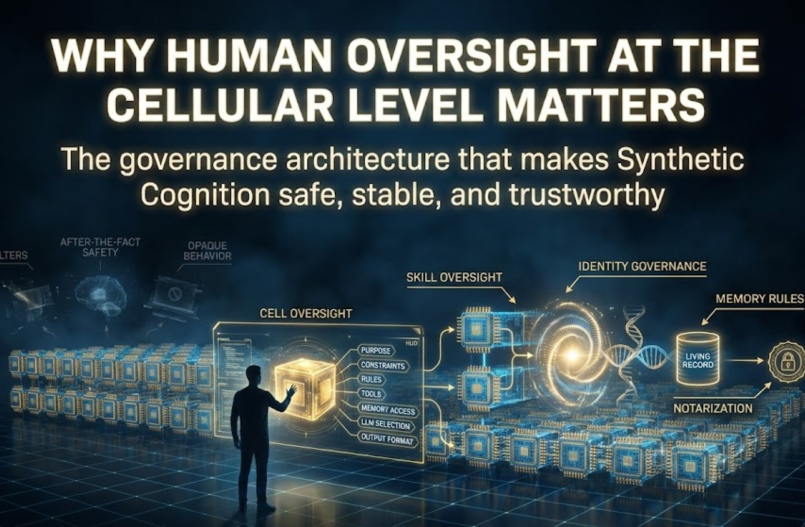
The Governance Architecture That Makes Synthetic Cognition Safe, Stable, and Trustworthy
Every major technology shift raises the same essential question: How do humans guide something powerful enough to change how the world works?
Not just how we make it perform tasks.
Not just how we keep it aligned in the moment.
But how do we ensure it behaves with consistency, evolves responsibly, and remains trustworthy even as it grows more capable?
Synthetic Cognition answers this with a foundational principle: Governance must exist at the cellular level.
Not at the output layer, the model layer, or through moderation applied after something goes wrong. Governance is engineered directly into the reasoning cells, skills, identity blueprint, and memory architecture that form each persona. This gives humans precise, structural control over how intelligence thinks, adapts, and evolves.
Why Governance Can’t Be Added at the End
Most AI safety methods today rely on reactive mechanisms:
• moderation filters
• ethical guidelines
• after-the-fact corrections
• rule-based content screening
These systems watch what the model produces and then try to adjust it.
That approach cannot:
• prevent drift
• maintain long-term consistency
• provide transparency
• explain decisions
• shape internal reasoning
• guarantee predictable behavior
You can’t govern a mind by fixing its outputs. You govern a mind by shaping its structure. Synthetic Cognition places governance inside the system’s foundations, not at the edges, so the intelligence behaves responsibly from the very start.
Cell-Level Oversight: Controlling the Smallest Units of Thought
Each reasoning cell is a contained cognitive unit with its own:
• purpose
• constraints
• decision rules
• memory boundaries
• allowed tools
• LLM selection
• communication style
• output format
• escalation logic
Every one of these elements is editable without code, meaning means oversight is not broad or abstract; it is precise, surgical, and intentional.
Humans can govern:
• how the persona analyzes
• how it interprets risk
• how it communicates
• how it prioritizes
• how it references memory
• how it acts
• when it escalates
• how it engages sensitive topics
Oversight happens before the intelligence thinks, not after it speaks.
Why This Creates True Consistency
Models drift.
Prompts shift.
Parameters evolve.
Randomness fluctuates.
But reasoning cells do not drift. They are fixed structures with explicit logic. Each one functions the same way every time unless a human intentionally updates it. This creates:
• predictable behavior
• repeatable reasoning
• stable decision-making
• clear audit trails
• traceable workflows
The system becomes consistent because its building blocks are consistent.
Humans Control Evolution Through Versioning and Notarization
Personas grow as they gain:
• new skills
• updated memory rules
• refined reasoning cells
• improved logic
• new tools
• additional decision pathways
But none of this happens automatically. Before a new generation is released:
• updated cells are inspected
• modified skills are validated
• changed memory maps are reviewed
• new behaviors are tested
• the persona can be notarized on-chain
This is evolution by intentional design, not accidental drift. Nothing changes unless a human approves it.
Oversight Exists Across the Entire Architecture
Governance is embedded at every layer:
- Inside each reasoning cell
Behavior rules define what the cell can and cannot do. - Inside each skill
Flows determine how cells combine, how memory is accessed, and when to escalate. - Inside the persona’s Digital DNA
Identity, tone, mission, and boundaries are hard-coded. - Inside the Living Record
Memory rules define what is stored, what expires, and what should never persist. - Through blockchain notarization
Immutable records protect identity, authorship, and lineage. - Through human review
Teams gatekeep changes before they become part of the persona’s evolution.
These layers work together to form transparent, safe, aligned intelligence.
Why This Matters for Trust
People will not trust intelligence they cannot understand. Organizations will not deploy systems they cannot audit. Industries will not adopt technologies they cannot govern. Cellular oversight delivers:
• clarity
• safety
• version control
• auditability
• compliance stability
• transparency
• structural alignment
• predictable behavior
Teams can see exactly how decisions were made. They can modify behavior at the smallest scale. They can maintain control even as personas evolve. This is governance as architecture, not as an afterthought.
Oversight Turns AI Into a Partner, Not a Black Box
When humans can inspect, refine, and guide intelligence at the cellular level, something profound happens:
AI stops being mysterious; It becomes collaborative.
A system that can be shaped.
A teammate who can be understood.
An intelligence that can be trusted.
A partner that evolves with intention.
Oversight doesn’t restrict intelligence; it strengthens it.
The Future of AI Belongs to Those Who Can Govern It
Synthetic Cognition gives humans the ability to guide intelligence with unprecedented precision. This creates systems that are:
• safe
• stable
• controllable
• aligned
• explainable
• compliant
• predictable
• trustworthy
The next era of AI will not be won by the most powerful model. It will be won by the architecture that lets humans guide powerful models responsibly. Cell-level oversight is that architecture.