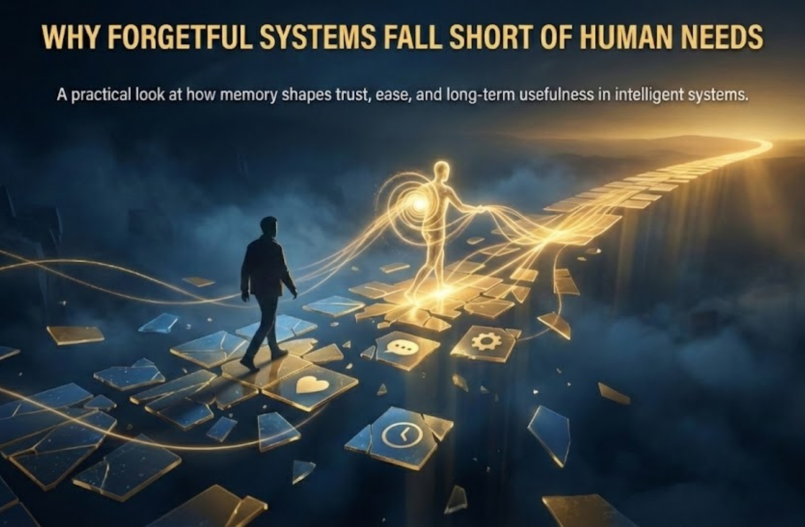
A practical look at how memory shapes trust, ease, and long-term usefulness in intelligent systems
Most people do not expect technology to be brilliant.
They simply expect it to remember.
Remember what you said yesterday.
Remember what you asked for last week.
Remember the goal you are working toward.
Remember the context of the conversation.
When a system forgets these things, the experience becomes harder than it needs to be.
Not catastrophic.
Not emotional.
Just…friction.
A forgetful system doesn’t dehumanize you.
It just slows you down in a world that already moves fast.
It forces you to repeat information.
It breaks the flow of work.
It makes small tasks take longer than they should.
And over time, it chips away at trust.
Synthetic Cognition was built to remove this friction by treating memory as a core capability, not an optional feature bolted onto the side.
What Actually Happens When Systems Forget
Forgetfulness shows up in simple but meaningful ways:
• retyping information you already gave
• re-explaining a situation you already clarified
• reconstructing context every time you return
• reminding the system of preferences it should already know
• filling in gaps the tool should have carried forward
Individually, these moments seem small.
Collectively, they create:
• decision fatigue
• slower workflows
• emotional drag
• distrust in the system’s reliability
People start thinking:
“If I have to rebuild everything each time, what’s the point of using this at all?”
That’s the real failure.
Why Memory Creates Trust
Trust in technology mirrors trust in humans.
We trust what feels:
• predictable
• consistent
• attentive
• aware of our needs
When a system remembers your:
• history
• preferences
• goals
• ongoing context
You naturally lean on it more.
When it doesn’t, you instinctively pull back, not because you dislike it, but because you can’t depend on it.
Memory is not a luxury.
Memory is the foundation of trust.
Forgetfulness Increases Cognitive Load
Humans rely on continuity.
When technology drops continuity, the brain is forced to pick it up.
You end up carrying:
• the story
• the context
• the next steps
• the open loops
• the things the system dropped
It’s invisible effort… until it isn’t.
A system that remembers doesn’t make life dramatic, it simply makes life lighter.
How Synthetic Cognition Approaches Memory
Synthetic Cognition was designed to hold the pieces people shouldn’t have to juggle:
• ongoing goals
• prior decisions
• important context
• tone and communication patterns
• long-term threads
• cross-channel history
Not to mimic emotion.
Not to create dependence.
But to make interactions smooth, coherent, and useful.
Memory enables personas to:
• pick up where you left off
• reduce repetition
• maintain momentum
• align tasks with long-term intent
• keep workflows coherent
• support continuity across time
This isn’t philosophy.
This is good design.
A Practical Benefit, Not a Dramatic One
When intelligence remembers consistently:
• tasks get easier
• work flows cleaner
• decisions take less effort
• follow-through improves
• collaboration feels natural
• projects stay aligned
• users feel supported rather than slowed
It’s not magic.
It’s not emotional.
It’s simply what happens when systems stop resetting themselves every time you show up.
The Real Point
Forgetful systems aren’t harmful.
They’re inefficient.
Memory-bearing systems aren’t dramatic.
They’re useful.
Synthetic Cognition leans into one simple truth:
Intelligence becomes truly helpful when it remembers the things humans should never have to repeat.
Clear.
Practical.
Human-centered.
Built for real life.