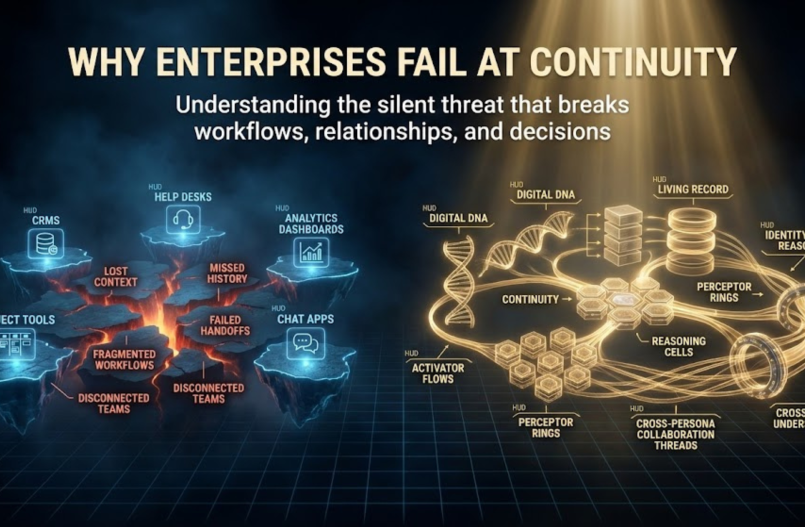
The silent threat that undermines every workflow, every relationship, and every decision.
Enterprises rarely collapse because of one catastrophic event. They weaken through thousands of tiny fractures:
Missed context.
Lost history.
Broken handoffs.
Fragmented workflows.
Systems that cannot talk to one another.
Teams that cannot see what others already know.
Customers are repeating themselves endlessly.
Leaders are making decisions without the full picture.
These failures appear small in isolation, but in aggregate, they quietly erode the foundation of the entire organization. This is not a failure of intelligence. It is a failure of continuity. The reality is simple: Most enterprise systems were never designed to remember, adapt, or evolve together. Synthetic Cognition was built specifically to fix that.
The continuity gap is the real reason work breaks down. When you trace any operational failure backward, you inevitably find one of these gaps:
• Context didn’t follow the workflow
• Memory didn’t follow the customer
• Knowledge didn’t follow the team
• Insights didn’t follow the decision
• Responsibility didn’t follow the timeline
• Understanding didn’t follow the relationship
These are not inconveniences. They are the root cause of:
• customer churn
• stalled deals
• duplicated work
• compliance issues
• operational waste
• miscommunications
• avoidable delays
• internal frustration
• lost revenue moments
Enterprises fail at continuity because their systems cannot carry forward the knowledge needed for the next step of work.
Why Existing Enterprise Systems Cannot Support Continuity
Modern enterprise stacks are a collection of disconnected tools:
CRM → static data
Help desk → tickets
Project tools → tasks
Analytics → dashboards
Workflow engines → rules
Email + chat → unstructured conversations
None of these systems shares:
• identity
• memory
• reasoning
• history
• prioritization
• continuity
They were built to store data, not understand it. To capture events, not preserve meaning. To organize work, not carry it forward. This is why workflows feel brittle. The systems inside the enterprise forget everything that matters. Humans try to patch continuity manually, but they shouldn’t have to.
Because systems don’t remember, employees are forced to:
• forward threads
• recreate context
• repeat explanations
• chase missing updates
• restate requirements
• write long summaries
• maintain parallel notes
• host unnecessary status calls
This is not “collaboration.” It is compensation. People become glued because the systems are incapable of connecting themselves. Synthetic Cognition exists to remove this burden entirely.
The hidden cost of lost continuity
When continuity breaks, enterprises pay a price at every level:
1. Revenue loss
Warm leads go cold.
Opportunities slip quietly away.
Follow-up fractures.
2. Efficiency loss
Teams waste time reconstructing context.
Simple tasks require complex coordination.
Projects stall because no one has full visibility.
3. Quality loss
Mistakes multiply when memory doesn’t follow the work.
Customers experience inconsistencies.
Decisions lack completeness.
4. Cultural loss
People feel frustrated.
Teams feel disconnected.
Leaders feel blind.
Continuity failures drain the organization long before anyone realizes what’s happening.
The deeper problem: enterprises lack a cognitive nervous system
Enterprises have:
• data systems
• communication systems
• workflow systems
• analytics systems
• management systems
But they do not have an integrated cognitive layer that:
• perceives what’s happening
• remembers what matters
• carries context forward
• reasons about next steps
• senses risk
• prioritizes intelligently
• adapts to change
• maintains continuity everywhere
This is the missing foundation. Synthetic Cognition provides exactly this.
Why Synthetic Cognition solves continuity in a fundamentally new way
Synthetic Cognition isn’t another app. It is the layer above the apps, a continuous cognitive system powered by:
• persistent long-term memory
• identity-driven reasoning
• modular skills
• perceptors that sense change
• activators that take action
• cross-persona collaboration
• governance and lineage
• on-chain notarization
• LLM-agnostic reasoning cells
• domain-specific intelligence
Instead of expecting humans to glue systems together, Synthetic Cognition provides the connective tissue: It becomes the memory, context, and continuity. This is what modern enterprises have been missing.
The future belongs to organizations that optimize for continuity, not activity
For decades, enterprise systems have measured activity:
• tickets closed
• tasks completed
• fields updated
• dashboards refreshed
But none of these guarantees progress. Continuity does.
Continuity:
• protects customer relationships
• powers seamless handoffs
• preserves institutional knowledge
• stabilizes decision-making
• reduces operational friction
• enables proactive support
• compounds value over time
Enterprises fail at continuity because the architecture never existed to support it. Synthetic Cognition finally makes that architecture real.