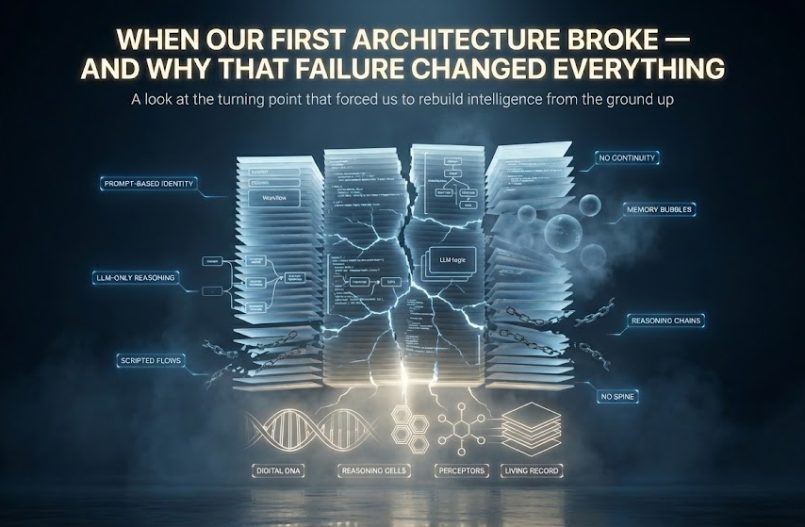
The quiet collapse that forced us to rethink intelligence from the ground up
Every transformative project has a moment when progress stops, not because the team runs out of ideas, not because the vision weakens, but because reality delivers a truth you can’t ignore. For us, that moment arrived the day our first architecture, our proud early framework, finally revealed its limits.
It didn’t crash, burn, or set off alarms. It simply stopped making sense. Everything was technically functioning. But the intelligence we were building could not hold itself together. And once we saw the cracks, we knew the foundation could never support what the world actually needed.
How the failure first appeared
It began as tiny inconsistencies:
- A persona followed a workflow but lost the larger intention
- A reasoning cell completed a step but ignored the context
- Memory appeared in one place but vanished in the next
- A small decision quietly contradicted a larger goal
- Identity weakened under pressure
- Long-term continuity collapsed into moment-by-moment output
Nothing broke. But nothing aligned. We had created intelligences that could execute steps
yet could not sustain coherence. Cells that could reason individually, yet could not reason together. The architecture wasn’t failing at computation. It was failing at continuity.
The realization we could no longer avoid
As we traced the problems, the truth became obvious. We had built a system where:
- intelligence lived inside prompts
- identity lived inside instructions
- memory lived inside conversations
- reasoning lived inside the model
- logic lived inside scripts
These components each worked in isolation. They did not work as a unified mind. We weren’t building cognition. We were assembling parts and hoping they would behave like a whole. There was no structure, cohesion, or spine. This was the quiet failure we could never outrun.
The moment the architecture collapsed
The breaking point arrived during a complex workflow test. A persona was juggling:
- multiple conversations
- layered decisions
- priority rules
- evolving context
- skill handoffs
- shifting constraints
Halfway through, it made a technically correct decision, but cognitively impossible. It contradicted its own earlier logic. It had forgotten the context it had reaffirmed moments before. It broke its own pattern of reasoning. It behaved like a different mind entirely. The system didn’t crash, but our assumptions did. We suddenly understood that we had built a body without a nervous system. A machine that moved, but could not think as one. That moment forced the pivot.
Why was this failure necessary
The failure didn’t just show us what was broken. It showed us what intelligence actually requires:
1. A stable identity layer: Not a decorative personality. A real internal blueprint, Digital DNA.
2. Structured reasoning cells: Not one giant model doing everything. Modular cognitive units with clear roles.
3. Perceptors and activators: Not passive inputs and outputs. Real sensory and action pathways.
4. A meaningful memory structure: Not chat logs. A Living Record with rules and purpose.
5. Adaptive, context-aware flows: Not brittle scripts. Decision sequences that adjust in real time.
6. Evolution with lineage: Not chaotic updates. Generations of intelligence with inherited structure.
The failure didn’t expose flaws. It exposed the future.
The hardest truth we had to face
Our first architecture wasn’t wrong. It was simply too small for the vision we were pursuing. It could:
- automate
- answer questions
- complete tasks
- run workflows
But the world didn’t need another automation engine. It needed synthetic intelligence, and the architecture we had built could never grow into that, not with patches, not with larger prompts, not with bigger models. We had to step back and begin again with a new foundation. It was uncomfortable, humbling, and the best decision we ever made.
The breakthroughs born from failure
The collapse of the first architecture directly gave birth to:
- Digital DNA
- Reasoning Cells
- Skill Architecture
- Perceptors
- Activators
- The Living Record
- Identity stability
- Evolutionary lineage
- LLM-agnostic cognition
- The entire cellular architecture
Every major advancement emerged from something the old system couldn’t handle. Failure didn’t slow us down. It revealed the blueprint.
The point
The day our architecture broke was the day our vision sharpened. We learned that:
- Intelligence requires identity
- Continuity requires structure
- Reasoning requires specialization
- Memory requires design
- Adaptation requires perception
- Evolution requires lineage
- Stability requires architecture
We weren’t building software. We were building cognition. Cognition is not a feature set. It is a living system. That moment of failure was the spark that pushed us to stop building tools, and start building the infrastructure of synthetic thought.
It changed everything.