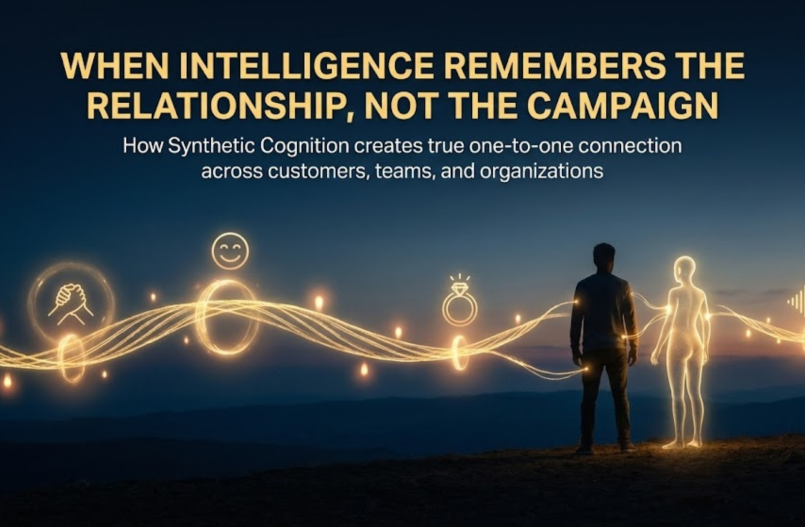
How Synthetic Cognition Creates True One-to-One Connection Across Customers, Teams, and Organizations
Most systems today treat human relationships like transactions.
A campaign is launched.
An email is sent.
A task is assigned.
A note is logged.
A workflow runs.
Then the moment passes, and the memory of it disappears with it.
People are left repeating themselves.
Teams are left rebuilding context.
Customers feel like every interaction starts from zero.
Employees feel like every day begins with unraveling yesterday’s confusion.
This is the quiet cost of forgetful systems. A cost paid in time, emotion, friction, and trust. Synthetic Cognition eliminates that cost by creating something the world has never seen inside software: A single continuous relationship, carried across every conversation, every customer, and every employee. Not as a feature, but as the foundation of intelligence that actually supports human life.
Relationships are built on continuity, not campaigns
Every customer conversation is part of a larger emotional arc.
Every employee interaction is part of a longer story.
Every project, sale, initiative, and moment of friction carries forward, whether systems recognize it or not.
Traditional software sees these moments as isolated events. Synthetic Cognition treats them as chapters.
It remembers tone.
It remembers goals.
It remembers patterns.
It remembers what was said last week, what was felt last month, what was promised last quarter, and where the relationship is heading.
This is what creates trust, connection, and momentum. Without continuity, everything meaningful eventually falls apart. With continuity, everything meaningful finally has room to grow.
The future is not smarter campaigns. It is living conversations.
Most personalization today is broadcast disguised as empathy. Most internal communication is noise disguised as collaboration.
The message changes.
The context disappears.
The conversation resets.
But human life does not operate in disconnected messages. It moves through continuous arcs. Synthetic Cognition mirrors that reality. Customers experience communication as one long story instead of hundreds of unrelated touches. Sales teams return to a relationship exactly where it left off. Service teams understand the emotional history behind a conversation before it begins. Employees step into meetings with shared context instead of trying to piece together what happened.
The system does not focus on the campaign. It focuses on the relationship.
Continuity is not only for customers. It stabilizes companies from the inside
The hidden cost inside every organization is context loss. Projects stall because of continuity breaks. Teams misalign because memories diverge. Employees burn out because they are forced to carry the entire cognitive weight of the company. Synthetic Cognition changes this by becoming the shared memory layer of the organization.
Decision histories live in one place. Commitments remain alive. Projects continue without stalling. Onboarding becomes stepping into a story already in motion. Cross-functional work no longer collapses under conflicting versions of reality.
This is continuity as culture.
Continuity as infrastructure.
Continuity as a stabilizing force.
When intelligence remembers, life becomes easier to carry
For customers:
• Conversations feel respectful rather than repetitive
• Offers feel relevant rather than random
• Timing feels intuitive rather than intrusive
• The company feels like a consistent partner rather than a series of disconnected teams
For employees:
• Work moves without resetting
• Decisions no longer disappear
• Momentum becomes natural
• Stress decreases because memory no longer lives in isolated minds
For leaders:
• Alignment becomes the natural state
• Information loss decreases
• Every initiative becomes part of a coherent whole
Continuity is not an enhancement; It is the missing architecture of modern work.
Why this matters now
The world is drowning in messages, tasks, tools, and scattered systems that cannot see the human story inside the data. The future does not belong to technologies that automate more steps.
It belongs to intelligence that preserves more meaning.
Synthetic Cognition does not create more campaigns.
It creates deeper connection.
It does not replace human effort.
It supports it.
It does not accelerate chaos.
It organizes it.
It does not reduce relationships to data.
It strengthens the thread that holds them together.
The Synthetic Age begins when intelligence remembers the story of human life, not because it is clever, but because it is necessary.