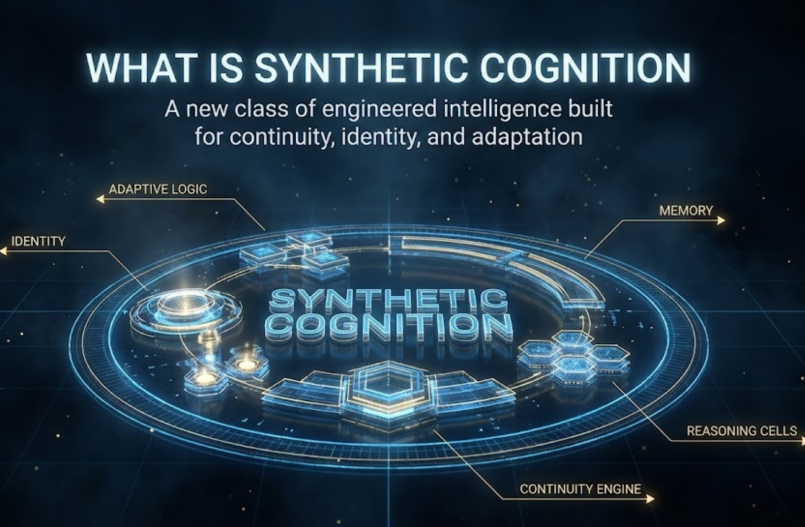
A New Class of Engineered Intelligence Built for Continuity, Identity, and Adaptation
Every major shift in technology begins with a moment when the old language stops fitting the world in front of us.
Patterns appear that vocabulary cannot describe. Limitations surface that legacy ideas cannot solve. A new direction becomes visible long before we have the words to explain it. This is the moment intelligence is experiencing today.
Artificial intelligence is powerful, but incomplete. Automation solves tasks, but not adaptation. Traditional software provides structure, but not understanding.
Something new is forming in the space between these worlds. It is not software. It is not a faster version of AI. It is a different category of intelligence altogether. We call it Synthetic Cognition.
Synthetic Cognition Is Engineered, Not Emergent
Synthetic Cognition is intelligence created with intention.
It is not formed by scaling a model and hoping intelligence appears.
It is built as an integrated system with identity, structure, and long-term memory.
Where traditional AI focuses on producing output, Synthetic Cognition focuses on forming continuity. It is engineered around three core principles:
- Intelligence should have an identity.
- Intelligence should accumulate memory over time.
- Intelligence should adapt to the person or organization it serves.
These principles create intelligence that grows, matures, and evolves within a defined architecture.
It is not a recreation of human cognition, yet it shares an essential trait. It changes based on experience.
A New Way of Thinking About Intelligence
Synthetic Cognition is not a feature. It is not an add-on. It is a blueprint for how digital intelligence should behave. It introduces capabilities that do not fit inside the vocabulary of traditional software.
Context becomes a living resource.
The system does not treat conversation history as temporary.
It transforms it into understanding.
Identity becomes foundational.
Intelligence is shaped by memory, skills, and purpose.
It does not reset each time a new interaction begins.
Reasoning becomes modular and composable.
Cognition is created from interconnected cells rather than monolithic models.
Adaptation becomes expected.
The system learns from the person it serves, the environment it interacts with, and the outcomes it produces.
This creates intelligence capable of participating in continuity. Not just tasks. Not just responses. Actual continuity.
The Purpose Is Not To Replace Human Thought
Synthetic Cognition is not an attempt to mimic human consciousness. It is not designed to replicate emotion, intuition, or personal identity. Its purpose is practical. It is built to support the cognitive load people were never meant to carry alone.
It remembers what humans cannot reasonably remember.
It tracks details that are easy to lose.
It organizes complexity so people can stay focused on what matters.
It adapts to shifting goals.
It aligns with changing conditions.
It relieves repetition and fragmentation.
It creates space for clarity, creativity, and deep thinking.
This type of partnership sets Synthetic Cognition apart from traditional automation and AI assistants. It collaborates rather than imitates.
The Architecture Behind Synthetic Cognition
Synthetic Cognition is built on a multi-layered architecture that mirrors essential components of thought.
NeuroMatrix provides identity and memory.
It stores the lived history of the persona and shapes how it responds.
NeuroFlow provides reasoning and decision making.
It manages prioritization, logic, and adaptive cognitive pathways.
Reasoning cells provide specialized capabilities.
They function like micro-skills that can be composed, linked, and expanded.
Perceptors and activators provide senses and action.
They allow the system to gather real-world information and take real-world steps.
Together, these components create a cognitive structure that grows more capable and more aligned over time. This is intelligence that does not drift. It evolves.
Why Now
The world has reached a point of complexity that static systems cannot manage. People are drowning in information. Organizations face challenges that outpace human capacity. Traditional tools require endless re-teaching and constant upkeep.
Synthetic Cognition emerges as an answer to this reality.
Not as a replacement for humans, but as a companion that carries the weight of continuity.
It is built for environments where conditions shift rapidly.
It is built for relationships that depend on memory.
It is built for work that requires context and identity.
It is built for people who need support rather than more complexity.
This moment is not accidental. The need shaped the category.
Synthetic Cognition Is Not Just a New Idea. It Is a New Foundation.
The way software replaced manual workflows, Synthetic Cognition will replace the mental fragmentation created by the current generation of digital tools. It creates a future where intelligence:
• Remembers
• Adapts
• Collaborates
• Grows
• Carries forward history
• Supports long-term goals
• Understands context
• Builds continuity
This is not artificial intelligence as we know it. This is engineered intelligence designed with structure, purpose, and the ability to evolve.
Synthetic Cognition represents the shift from tools to partners. From tasks to continuity. From information to understanding. From isolated action to sustained collaboration. The world is ready for this next step. And for the first time, the foundation to support it finally exists.