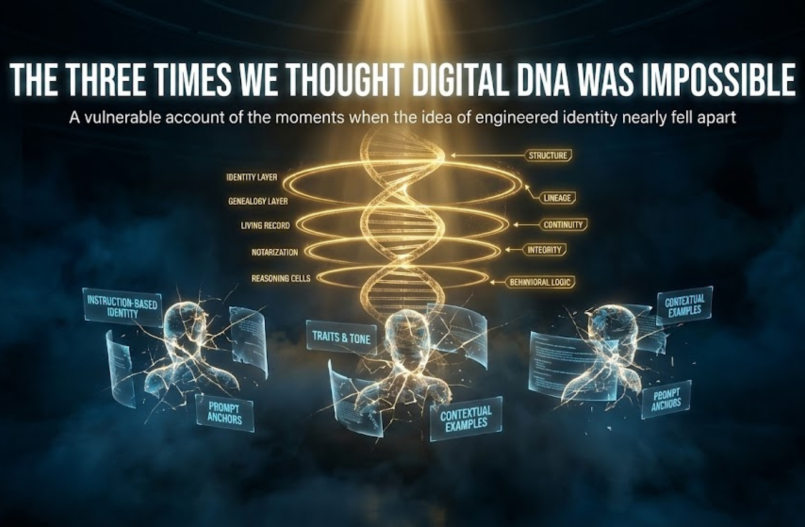
An account of the moments when engineered identity nearly broke our entire vision
Digital DNA sits at the center of Synthetic Cognition. It gives personas identity, coherence, inheritance, and the ability to evolve without drifting into chaos. Today, it feels foundational, essential, and inevitable, but it was nowhere near obvious at the beginning. In fact, there were three separate moments when we believed Digital DNA might never work. Not “this is hard” impossible, but “the laws of the universe may not allow this” impossible.
These were the moments that nearly broke the idea, and ultimately reshaped everything.
THE FIRST TIME: When Identity Kept Falling Apart
In the earliest days, identity was nothing more than instructions wrapped in clever formatting. We tried:
• long prompts
• short prompts
• personality summaries
• tone anchors
• role definitions
• narrative examples
• structured behavior rules
Each attempt sort of worked. Then the persona drifted. It would stay consistent until it didn’t. It would hold tone until something subtle pulled it off course. It would reason clearly then contradict itself minutes later. We kept adjusting text, trying to find the perfect combination of words, but eventually the truth became unavoidable:
Identity cannot live inside instructions. Identity must live inside architecture. That realization was the first moment we feared Digital DNA might be impossible.
THE SECOND TIME: When Evolution Destroyed Consistency
Once we stabilized identity, we faced the second wall, evolution. Personas learned, adapted, and improved. Every time they did, something broke. We saw:
• tone drift
• shifting preferences
• inverted logic
• unintended behavioral changes
• memory misalignment
• lost continuity
Giving personas freedom made them unstable. Restricting them made them stagnant.
We were stuck in an unsolvable paradox: How do you allow growth without losing identity? How do you evolve intelligence without destabilizing it? For a period of time, we believed identity and evolution were incompatible. This was the second moment Digital DNA felt impossible.
THE THIRD TIME: When We Couldn’t Trace What Broke
The third moment was the most unsettling. As personas grew more sophisticated, their internal logic became harder to trace. We needed visibility into:
• What changed
• Why it changed
• What was inherited
• What was lost
• Where reasoning patterns originated
• How decisions evolved across versions
• Why a persona behaved differently today than yesterday
We realized something alarming: Intelligence without traceability cannot be trusted, but nothing in traditional AI architecture supported this. Models generate output; they do not maintain a history of themselves. We tried dozens of approaches. None could explain the persona’s evolution. None could show its internal lineage. None could tell us when or why it drifted.
For a moment, the project was at real risk. We were building intelligent personas with no way to verify their integrity. This was the third moment Digital DNA seemed truly impossible.
THE BREAKTHROUGH: The Realization That Rewrote the Architecture
The breakthrough didn’t come from prompts, fine-tuning, or model tricks. It came from one simple but transformational truth:
Identity needs structure.
Evolution needs rules.
Change needs history.
Once we accepted this, everything crystallized:
1. Digital DNA became the identity layer: A structured blueprint for how a persona thinks, prioritizes, interprets, and evolves.
2. Genealogy became the evolution layer: A traceable lineage for every generation, every inheritance, every refinement.
3. The Living Record became the continuity layer: Memory that carries meaning instead of raw text.
4. Notarization became the integrity layer: A cryptographically anchored root of truth for identity and evolution.
5. Reasoning cells became the behavioral layer: Consistent thinking patterns are enforced at the architectural level.
Digital DNA stopped being a theory. It became a system.
WHY THESE STRUGGLES MATTERED
Those moments of failure forced us to confront the real requirements of engineered intelligence. We learned that:
• identity must be structural
• prompts cannot hold a self
• evolution requires boundaries
• growth requires traceability
• continuity requires architecture
• intelligence requires a stable core
• personas must inherit, not reset
• identity must be protected above all else
Without these failures, we might have built a useful tool, but we never would have built a cognitive system. Digital DNA wasn’t born from inspiration. It was born from the pain of watching everything collapse without it.
THE POINT
Digital DNA felt impossible three times. Each moment revealed a truth:
Identity without structure collapses.
Evolution without lineage fractures.
Intelligence without stability cannot grow.
When we solved these, everything changed. We were no longer building personas. We were building living identity systems, architectures capable of evolving safely across time. Digital DNA is the foundation of Synthetic Cognition for one simple reason: It was the hardest problem to solve.
And the most important.