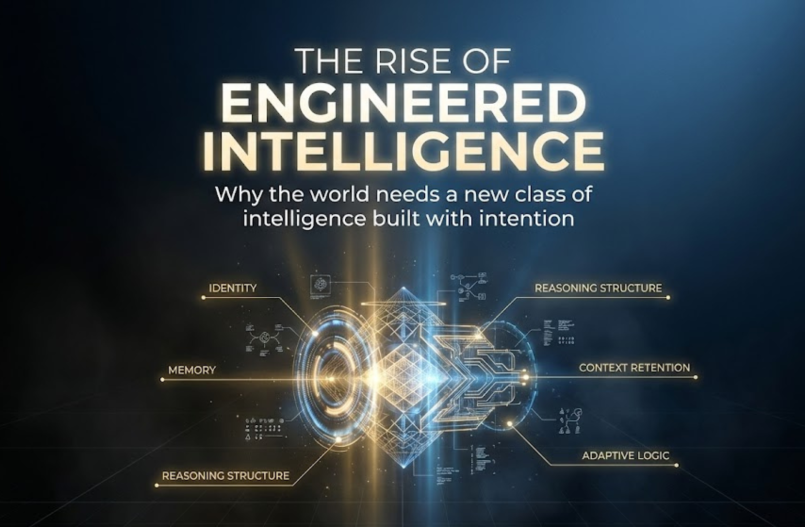
Why the World Needs a New Class of Intelligence Built With Intention
Almost everything today is labeled as artificial intelligence.
New apps.
New tools.
New models.
New features.
AI has become a universal term, yet the meaning behind it has become hazy.
In many cases, the label tells you nothing about what the system can actually do or how it thinks.
We now live in a world where the word AI is used so broadly that it distracts from the real conversation we should be having.
The world does not need another feature that uses machine learning.
It does not need another interface that calls a model behind the scenes.
It does not need another product that markets itself as intelligent simply because it can generate text.
The world needs something much more intentional.
Something built from the ground up to think in a structured way.
Something that understands continuity, identity, memory, and context.
Something that does not behave like a tool, but behaves like a collaborator.
This is where engineered intelligence begins.
AI Today Is Probabilistic and Sometimes Accidental. Engineered Intelligence Is Intentional.
Most AI today works like a very capable yet very forgetful assistant.
It can generate content.
It can answer questions.
It can follow prompts.
What it cannot do is form a stable internal identity or a reliable decision-making structure.
Traditional AI often takes an enormous model and hopes intelligence will emerge from scale.
Engineered intelligence takes a different path.
Instead of hoping intelligence appears, it is designed piece by piece.
Engineered intelligence has:
• Structure
• Memory
• Reasoning pathways
• Identity
• Prioritization
• Context retention
• Adaptive behaviors
• A defined purpose and role
This is intelligence that is not simply present.
It is intelligence that is constructed with intention.
The Limits of Current AI Become Clear When You Ask It To Think Like a System
Current AI can produce words, but it does not know what those words represent to you.
It can generate responses, but it does not remember the last fifty conversations.
It can follow single instructions, but it cannot maintain your long-term goals.
It can complete tasks, but it cannot build continuity.
This creates an illusion of intelligence.
What looks like understanding is often pattern matching.
What looks like reasoning is often probability shaping.
What looks like memory is actually a short window of context that quickly disappears.
None of this is a flaw. It is simply the natural limit of a technology that was never designed for identity or long-term thinking.
The world has reached a point where this limit is no longer acceptable.
Engineered Intelligence Begins With Identity
Identity is the foundation of any system that aims to think.
Without identity, intelligence resets every time it acts.
Without identity, context cannot accumulate.
Without identity, memory becomes optional instead of essential.
Without identity, adaptation becomes impossible.
Engineered intelligence begins with the idea that an intelligent system should have:
• A name
• A role
• A memory
• A story
• A set of skills
• A structure for reasoning
• A defined purpose
• A way to grow and evolve over time
This does not make it human. It makes it coherent. The world does not need artificial personalities. It needs stable, dependable, identity-based intelligence that understands what came before and what needs to come next.
The Purpose Is Not To Imitate Humans. The Purpose Is To Think With Humans.
The goal of engineered intelligence is not to recreate human consciousness.
It is to augment human capability in a way that feels natural and deeply supportive.
Engineered intelligence becomes a collaborator that:
• Remembers what you care about
• Adapts to your preferences
• Prioritizes based on your values
• Helps you think rather than making you think harder
• Grows with your life and your business
• Supports long-term goals instead of reacting to short-term prompts
It is intelligence that forms a relationship rather than a transaction.
This distinction changes the entire dynamic between people and technology.
The Future Is Not About Bigger Models. The Future Is About Better Structure.
AI today is built on scale.
Engineered intelligence is built on architecture.
Scale alone cannot produce continuity.
Scale alone cannot produce identity.
Scale alone cannot produce stable reasoning.
Scale alone cannot produce real memory that lasts longer than the current conversation.
Engineered intelligence solves these gaps by treating intelligence like a system.
A structured, modular, evolvable system that grows predictably.
A system that does not depend on any single model or generation of technology.
A system that can outlive the very models it uses.
This is not artificial intelligence.
This is engineered intelligence.
The distinction is not marketing.
It is structural.
A New Era Needs a New Kind of Intelligence
The world is shifting from static systems to living ones.
From workflows to cognition.
From tools to collaborators.
From instructions to relationships.
From one-time actions to long-term continuity.
To support this shift, intelligence must be:
• Designed
• Structured
• Intentional
• Memory-based
• Identity driven
• Adaptable
• Self-improving
• Context aware
• Continuous
This is the rise of engineered intelligence. It is the foundation of the next generation of digital life. It is the shift that allows intelligence to work with people rather than against their limitations. It is the moment when technology begins to feel less like software and more like a system that can finally grow with you. The world is ready for this transition. In many ways, it has been waiting for it.