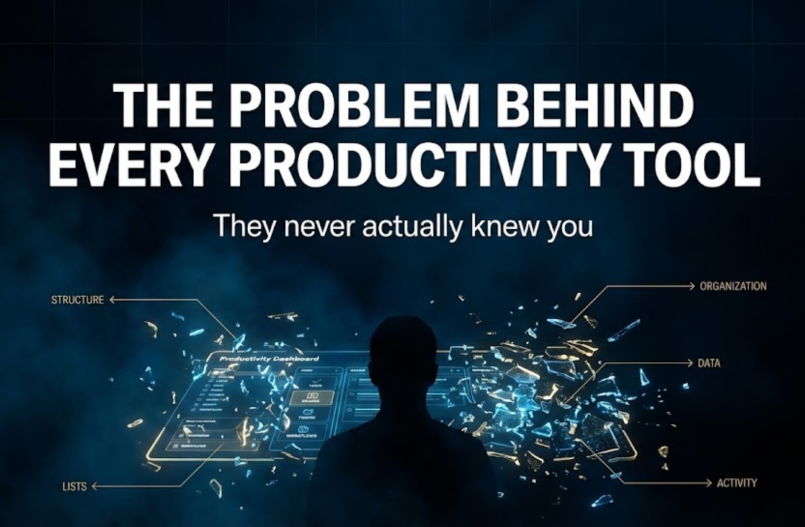
A Look At Why Traditional Tools Can Organize Your Tasks, But Never Truly Support Your Life
There is a familiar pattern with productivity tools. They feel powerful at first. Hopeful. Even transformational.
You install the new app. You set up the new workflow. You organize the lists, boards, calendars, and routines. For a moment, it feels like everything is finally under control.
Then slowly, the excitement fades.
The tool becomes background noise.
The workload feels the same.
The stress feels the same.
Life does not change.
The truth is simple and surprisingly human. Productivity tools never actually knew you.
Not your patterns.
Not your capacity.
Not your stress cycles.
Not your goals.
Not your timing.
Not your values.
Not the meaning behind your work.
They managed surfaces, not substance, and eventually, that gap became impossible to ignore.
Why Productivity Tools Fall Short
Productivity tools excel at structure. They give you:
• Tasks
• Lists
• Boards
• Timers
• Reminders
• Workflows
• Dashboards
These systems look impressive. They feel organized. They create the sensation of control. But the structure is not supported.
Tools can store information.
They cannot interpret it.
They cannot carry it forward.
They cannot understand the difference between what is urgent and what is meaningful.
They cannot sense your energy or mental bandwidth.
They cannot adapt to the changing rhythm of your life.
Without understanding, organization becomes pressure.
The Invisible Burden
What people rarely acknowledge is the hidden emotional cost these tools create. You become responsible for:
• Maintaining the system
• Feeding it information
• Remembering to use it
• Reorganizing it when priorities shift
• Cleaning it up when life gets messy
• Keeping every goal alive manually
The tool does not know when you are tired or overwhelmed. It does not soften when you need a break. It does not adjust when life shifts unexpectedly. It does not remove weight from your plate. It only reflects the state of your effort. And the weight never leaves your shoulders.
The Gap Between What You Need and What You Get
People need systems that can:
• Understand what they are working toward
• Support them when life is busy
• Adapt when life is unpredictable
• Reduce cognitive load
• Follow the story behind the work
• Maintain continuity across time
• Support personal growth
• Adjust to tone, pace, and stress levels
Productivity tools cannot do this because they lack the most important capability. They do not know you. They know your tasks, your deadlines, and your lists.
But they do not know:
• Why the task matters
• How it connects to your identity
• How you behave when you are tired versus focused
• When you need help versus when you need space
• What you are actually trying to become
Without understanding, productivity tools support activity but not progress.
The Personal Cost of Being Unknown
There is a quiet emotional strain that comes from living inside systems that only see fragments of your life. When a tool does not know you, you feel:
• Scattered
• Misaligned
• Overwhelmed
• Behind
• Pressured to keep up
• Responsible for holding everything together alone
This is why people abandon productivity tools so quickly. They do not leave because the tools are flawed. They leave because the tools are blind. What they needed most was recognition.
The Moment of Realization
At some point, everyone begins to see the same patterns.
They complete tasks without moving closer to real goals. They feel busy instead of fulfilled. They maintain their tools more than their tools support them. They jump between apps to fill missing context. They still forget the important things. They still feel behind. They still juggle too much.
And eventually, they recognize the truth. The problem was never the tools. The problem was that the tools never understood them.
What Productivity Would Look Like If It Actually Knew You
Imagine a system that understands:
• Your tendencies
• Your cycles
• Your energy levels
• Your emotional patterns
• Your long-term direction
• Your short-term pressures
• Your evolving priorities
• Your unfinished thoughts
• The story behind your tasks
• The meaning behind your goals
Productivity would no longer feel like a race.
It would feel like alignment.
It would feel like support.
It would feel like continuity.
It would help you grow, not just organize your day. This is where the idea of Synthetic Cognition begins.
The Point
Productivity tools were never designed to carry the full complexity of human life.
They were built to organize, not to understand.
To structure, not to reason.
To store, not to remember.
The problem behind every productivity tool is not the interface or the feature set. It is the missing piece. They never actually knew you.
Synthetic Cognition introduces a different future. A future where intelligence understands the person behind the tasks and carries the continuity that makes real progress possible. The shift begins when people stop trying to fit their lives into tools and begin using intelligence that fits into their lives.