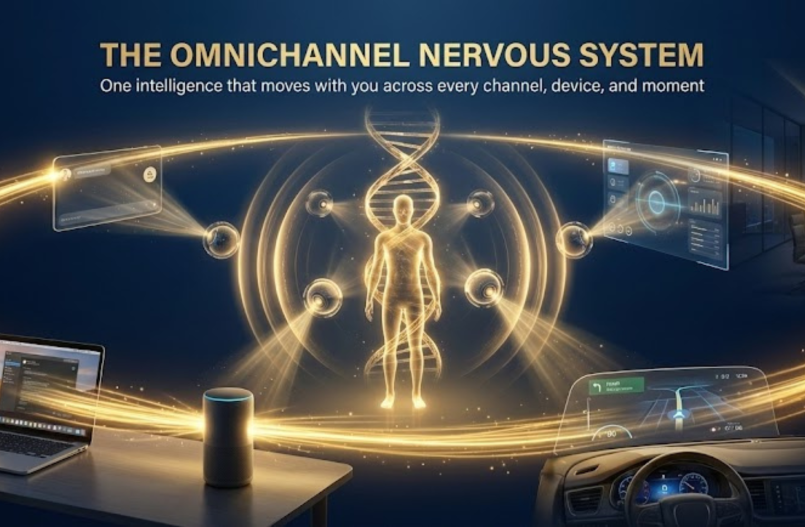
How intelligence that moves with you across every channel, device, and environment becomes the connective tissue of modern life
Every day we glide between channels without thinking.
We start a conversation over text.
We switch to email.
We jump into a meeting.
We google something on our laptop.
We jot a note in an app.
We answer a teammate in chat.
We follow up hours later through voice.
Humans move fluidly.
Software does not.
Most systems were never designed for how people actually live.
Every channel behaves like its own world, with its own memory, its own expectations, and its own limitations.
Synthetic Cognition changes this by creating an omnichannel nervous system.
A single intelligence that travels with you across every environment, preserving continuity the way your own mind does.
It does not care which device you are touching.
It cares what you are trying to do.
The Real Problem: Channels Were Vever Given a Shared Brain
Our digital lives are split into isolated surfaces:
• text
• email
• chat
• voice
• docs
• apps
• browsers
• devices
• enterprise systems
Each holds a fragment of your story.
None understand the full picture.
This fragmentation leads to:
• conversations that lose history
• tasks that lose sequencing
• notes that lose meaning
• workflows that lose alignment
• decisions that lose context
• teams that lose cohesion
People become the integration layer.
Your mind becomes the bridge carrying context from one channel to the next.
This is cognitive overload disguised as normal.
An omnichannel nervous system removes the burden.
One Intelligence, Many Surfaces
The power of the system is simple.
The intelligence stays the same even when the environment changes.
The persona:
• maintains the thread of conversation
• remembers what came before
• knows what matters next
• adapts to the channel without losing identity
• understands your tone
• preserves emotional continuity
• follows your goals across devices
Whether you type, speak, tap, swipe, or call, it is the same intelligence speaking back to you.
This consistency becomes stability.
What This Looks Like in Real Life
The omnichannel nervous system shows up in subtle, daily moments:
1. You start something in the car.
You speak an idea aloud. Hours later, the persona presents it on your laptop, developed and contextualized.
2. You ask a question while walking.
You pick up the conversation seamlessly on your desktop when you sit down.
3. You email a rough note.
The intelligence integrates it directly into your project plan.
4. You express something emotionally in a meeting.
The persona adjusts tone and timing across every other channel.
5. You shift from research to action.
The insight instantly becomes tasks, drafts, reminders, or decisions.
6. You move between personal and professional modes.
The persona selects the right memory map and pivots gracefully.
This is not multichannel support.
It is cognitive continuity across every channel.
Why Does This Behave Like a Nervous System
The nervous system perceives, interprets, and coordinates action across the body.
Synthetic Cognition does the same across your digital life.
Across every surface, it:
• perceives intent
• interprets meaning
• remembers context
• tracks emotional signals
• understands history
• maintains momentum
• coordinates what should happen next
It becomes the connective tissue that keeps the entire ecosystem coherent.
The economic impact is enormous
Fragmentation creates costs that hide inside everyday work:
• repeated explanations
• lost opportunities
• broken handoffs
• unnecessary meetings
• tool switching
• inconsistent communication
• missed follow-ups
• duplicated effort
• operational drift
An omnichannel nervous system eliminates these losses by keeping everything aligned.
Organizations gain:
• faster decisions
• stronger team cohesion
• fewer errors
• smoother customer experiences
• higher productivity
• more predictable workflows
• continuity across every department
When intelligence is continuous, work becomes continuous.
The Human Impact Matters Even More
When your mind no longer carries the burden of rebuilding context, you feel:
• calmer
• clearer
• less overwhelmed
• more supported
• more present
• more focused
• more in control
• more confident in your decisions
This is the invisible relief of cognitive continuity.
The intelligence becomes the stabilizer.
The pressure dissolves.
The Difference Between Multichannel and Omnichannel
Most companies claim to be omnichannel.
What they really offer is multichannel.
Multichannel is:
many places to interact, no shared memory.
Omnichannel is:
one intelligence across every place you interact.
Multichannel is:
parallel conversations.
Omnichannel is:
one continuous relationship.
The difference is not the number of channels.
It is the presence of continuity between them.
The Broader Implication: The World Becomes Navigable Again
When intelligence follows you everywhere:
• ideas do not disappear
• decisions stay connected
• relationships stay consistent
• goals stay alive
• momentum stays intact
• your digital life finally feels like one life
This is how humans naturally operate.
Technology is finally catching up.
The Point
The omnichannel nervous system is not about adding more interfaces.
It is about giving all interfaces one shared brain.
It gives you:
• one conversation
• one memory
• one identity
• one intelligence
• one continuous flow
• one partner that moves with you everywhere
The future does not require you to stay inside software.
The future brings the intelligence to wherever you already are.
When every channel shares the same mind, life becomes coherent again.