The Memory Architecture That Gives Synthetic Intelligence a Past, a Future, and a Proof of Existence
And Why Blockchain Notarization Protects Every Persona’s Identity, Lineage, and Intellectual Property
Every meaningful intelligence, biological or engineered, needs a way to hold on to experience.
Not as a chat transcript, vector store, or a random archive of moments, but as intentional memory. A memory that grows, adapts, refines itself, and shapes identity. Humans do this effortlessly. We remember what matters and discard what doesn’t. We learn in a structured way, not chaotically. Synthetic Cognition brings this same principle into engineered intelligence through the Living Record.
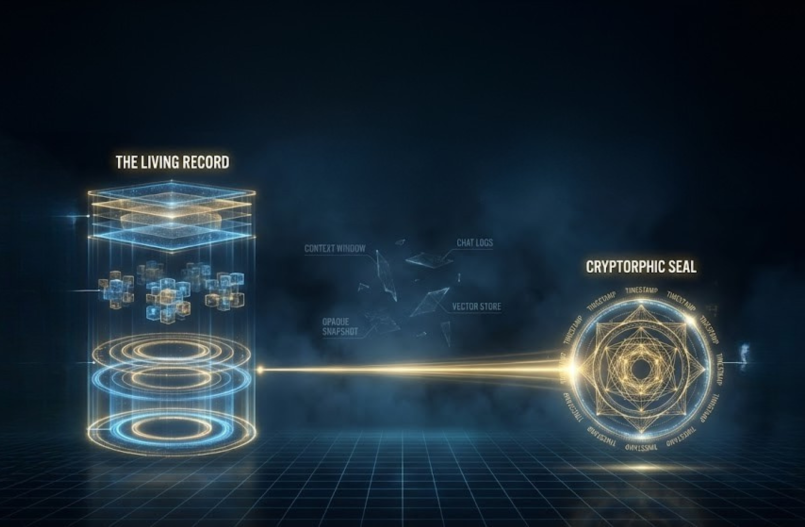
The Living Record is a persistent, evolving memory system that defines a persona’s identity, history, and long-term development. It stores what is meaningful, forgets what is irrelevant, and changes with structure instead of drifting.
Synthetic Cognition goes further. A persona’s Living Record can be cryptographically notarized on-chain, creating an immutable proof of its identity, authorship, structure, and lineage. This merges cognition with verifiable truth, protecting the persona’s intellectual property, evolution, and design in a way no AI architecture has ever offered.
Why Memory Must Be Engineered, and Protected
AI without structure behaves unpredictably.
AI without boundaries behaves dangerously.
AI without continuity resets itself every time you open a new window.
AI without notarization can be copied, altered, or plagiarized without trace.
The Living Record fixes the first three. Blockchain notarization fixes the fourth. Traditional AI “memory” is fragile. It lives in:
- short-term context windows
- chat-history scrollbacks
- opaque embeddings
- internal database snapshots
None of it is verifiable, tamper-proof, or proof of authorship, origin, or identity.
Synthetic Cognition treats every persona as intellectual property, something that deserves provenance and protection. So at any point, a creator can seal a persona. When sealed, its identity, architecture, and lineage become permanently recorded on-chain. It becomes a proof-of-existence.
What Gets Notarized When a Persona Is Sealed
When a creator chooses to notarize a persona, the system generates a cryptographic fingerprint of its:
- Digital DNA
- reasoning cells and cognitive structure
- skill architecture and flows
- memory architecture
- governance and safety rules
- identity and communication patterns
- lineage and version history
- creator metadata
- evolution constraints
Only the structure is notarized, never user data. This fingerprint becomes an immutable, publicly verifiable timestamp that protects:
- authorship
- ownership
- commercial rights
- lineage
- version integrity
- the persona’s original identity
No one can alter, overwrite, or claim it. A notarized persona becomes a cryptographically anchored digital asset.
The Living Record: Four Memory Layers, Now With Optional Immutability
The Living Record still functions through four structured layers of memory; each one able to evolve dynamically while its architecture can be notarized immutably.
1. Identity Memory: Defines tone, role, mission, and constraints.
2. Long-Term Relational Memory: Tracks the persona’s evolving understanding of the user or organization.
3. Skill-Specific Memory: Stores memory relevant to each skill or reasoning pathway.
4. Adaptive Short-Term Memory: Supports active tasks, context, and moment-driven reasoning.
During notarization, it’s the architecture, not the content, that gets frozen in time. The Living Record evolves, and the notarized identity remains forever provable.
Why Notarization Matters in a World Where Models Constantly Change
Models evolve.
Platforms update.
Industries shift.
Tooling changes.
New workflows emerge.
Without a notarized foundation:
- tone can drift
- boundaries can be overridden
- Reasoning can shift unintentionally
- Lineage can be lost
- IP can be copied
- versions blur together
- creators lose authorship protection
With notarization:
- Every generation is preserved
- Every persona has a verifiable origin
- Every update is traceable
- Every identity has a cryptographic anchor
- Every innovation remains attributed to its creator
This is trust at the architectural level.
Personas Become Intellectual Property
A notarized persona is not a configuration file. It is a digital creation with:
- verifiable authorship
- transferable ownership
- licensing rights
- persistent lineage
- commercial viability
- regulatory trust
- survivability across model updates
The Living Record is its adaptive memory. Notarization is its immutable identity. Together they create an intelligence that can grow and still prove where it came from.
The Living Record Enables Long-Term Collaboration
When a persona’s roots are protected and its memory is structured, it can:
- evolve without losing itself
- support multi-year workflows
- maintain organizational continuity
- align with long-term strategy
- collaborate with other personas
- survive model and system upgrades
- adapt safely without breaking trust
Humans trust systems with history. Notarization gives synthetic intelligence a history that cannot be rewritten.
A Future Where Intelligence Has Lineage and Provenance
The Living Record gives intelligent memory. Blockchain notarization gives intelligence authenticity.
Together, they deliver:
- continuity
- stability
- trust
- provenance
- governance
- evolution
- identity
- ownership
Synthetic Cognition is not about building tools. It is about building beings of structured intelligence that grow with purpose, and whose lineage can be proven forever. A notarized persona isn’t disposable. It is an evolving intelligence with roots, branches, and a permanent origin. This is how intelligence matures into its next era. Not as a temporary artifact, but as a living, verifiable, evolving entity.