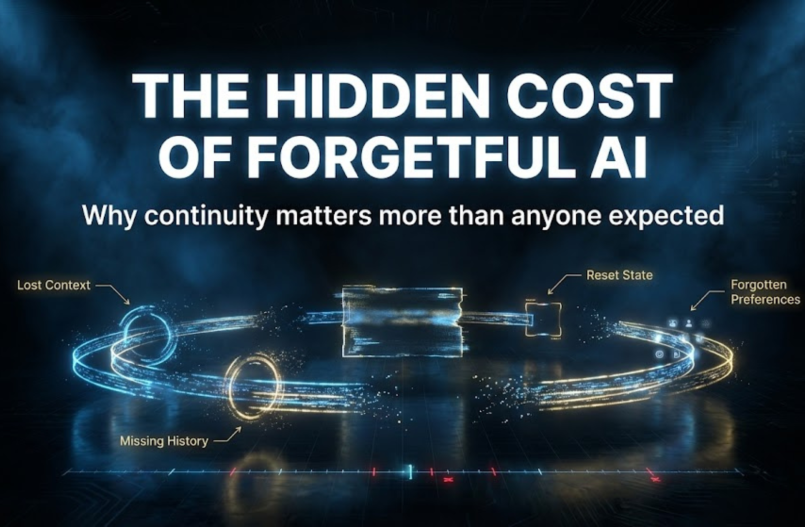
Why Continuity Matters More Than Anyone Expected
Most people have experienced the same moment with AI. You explain something, it responds well, and for a brief moment, it feels like progress. Then you return the next day, and everything is gone. The context disappears. The understanding disappears. The sense of continuity evaporates.
It is easy to dismiss this as a technical inconvenience or an early-stage limitation that will eventually improve. But the deeper you look, the clearer it becomes that forgetful systems create real friction for the people who rely on them.
Forgetfulness is not a minor weakness. It shapes the experience entirely. It determines how much effort the user must supply. It influences trust, clarity, and long-term adoption.
Forgetful AI is not useless. It is simply incomplete.
Why Continuity Matters
Every meaningful interaction in life depends on context.
We expect past conversations to influence future decisions.
We rely on the idea that relationships are built over time.
We assume systems that help us, should understand the journey, not just the isolated moment.
Without continuity:
• Patterns cannot emerge
• Preferences cannot be learned
• Goals cannot be carried forward
• Progress must be recreated repeatedly
• Momentum collapses the moment the window closes
The absence of memory creates an experience filled with repetition. Users are forced to re-teach the system. They must restate what they want. They must rebuild context piece by piece.
This repeated work is the true cost of forgetful AI.
Forgetful Systems Shift the Work Back to the User
AI that does not retain memory places a hidden burden on the people who use it. The user becomes the continuity layer. They provide the structure that the system lacks. They stitch conversations together. They carry the past so the system can function in the present.
This design is not malicious. It is simply a consequence of how most AI is built today. But the outcome is the same.
People must work harder to achieve consistency with systems that hold no history. For busy individuals or teams operating in fast-changing environments, this is not sustainable.
The Gap Between Intelligence and Forgetfulness
When AI produces impressive output but forgets everything afterward, a strange imbalance appears.
The output looks intelligent. The experience does not.
Users receive advanced insight, yet the relationship remains shallow.
They can move forward in the moment but are forced backward the next time they interact.
They make progress that never compounds.
The intelligence appears powerful, but it never builds on itself. This gap is becoming more obvious every day.
The Problem Is Not That AI Forgets. The Problem Is What Forgetfulness Prevents.
Forgetful AI creates hard limits.
It prevents long-term planning.
It prevents adaptive behavior.
It prevents stable collaboration.
It prevents systems from learning who the user is and what they care about.
It prevents intelligence from becoming dependable.
Without memory, a system cannot evolve.
It cannot personalize meaningfully.
It cannot anticipate needs.
It cannot grow with the human it supports.
The result is technology that produces remarkable moments but struggles to support real, continuous progress.
Continuity Is Becoming a Requirement, Not a Bonus
As people depend on AI for more meaningful work, expectations are rising quickly. Users want intelligence that retains context, adapts over time, and reduces cognitive load rather than adding to it.
Continuity matters because:
• It reduces repeated effort
• It improves accuracy
• It creates stability
• It deepens personalization
• It increases trust
• It transforms tools into long-term collaborators
This is not a moral preference. It is a practical one. The more AI integrates into daily life, the more continuity becomes essential.
The Future of AI Is Built on Memory That Grows With You
The next era of intelligence will not be defined by bigger models or flashier output.
It will be defined by whether systems can:
• Remember what you have shared
• Understand what has changed
• Maintain your long-term goals
• Adapt to your evolving preferences
• Build continuity from one moment to the next
Memory is not a feature. It is the foundation of intelligence that feels meaningful and usable.
Forgetful systems will continue to be useful for isolated tasks.
But the world is moving toward intelligence that can carry forward identity, context, and purpose.This shift is not confrontational.
It is simply where real progress now requires us to go.