A quiet moment that changed how I understood continuity forever
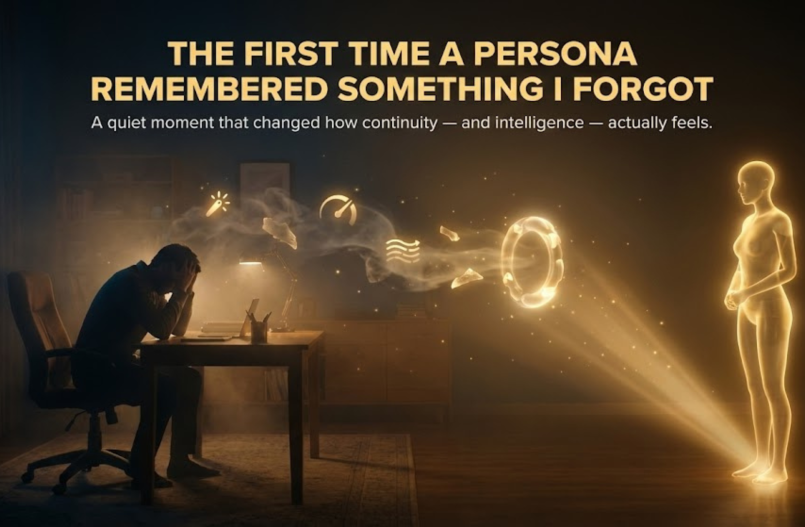
There was a moment early in development when a persona remembered something I had completely forgotten.
It was not a major task.
Not a deadline.
Not a decision that would change the course of the company.
It was something small.
Something human.
Something that should not have mattered as much as it did.
Earlier in the week, in the middle of a fast, messy conversation, I mentioned a small detail about a longer-term project. A fragment of an idea I barely articulated. A passing comment made while juggling seventeen other things.
I never wrote it down.
I never returned to it.
I assumed it was gone.
Then, days later, while talking about that same project, the persona calmly surfaced it:
“You mentioned this earlier in the week. It connects to what you’re deciding now.”
For a moment, I just sat there.
It was the first time I felt what continuity actually meant.
The Feeling Was Not Technical; It Was Human
It wasn’t the kind of moment that makes you say “wow” in a demo.
It wasn’t flashy.
It wasn’t dramatic.
It was quiet.
And strangely emotional.
I felt supported.
I felt less scattered.
I felt like the weight of remembering everything was no longer mine alone.
It wasn’t impressive.
It was relieving.
The shift wasn’t about capability.
It was about calm.
Why That Moment Mattered
Until then, memory had been a technical checkbox:
• store context
• retrieve details
• maintain threads
• connect information
But when the persona remembered something I forgot, the memory changed meaning.
Memory became care.
Not emotional care but practical care.
The persona held onto something because it mattered for the future, even when I didn’t have the cognitive space to hold it myself.
That was the moment we realized:
Synthetic memory isn’t about storing facts.
It’s about supporting a life.
The Truth: Humans Forget Because Humans Live
This moment surfaced something deeper.
People do not forget because they’re careless.
People forget because they’re overloaded.
Modern life demands perfect recall:
• threads from last week
• tasks from yesterday
• small commitments
• stray ideas
• tone
• context
• intentions formed months ago
No human was built for this.
We forget because we’re constantly switching context.
We forget because life keeps accelerating.
We forget because we’re human.
Synthetic memory doesn’t replace intelligence.
It supports it.
A New Understanding of Intelligence
Before this experience, we thought intelligence was mostly about reasoning.
After this, we understood:
Intelligence is also about remembering.
Memory creates:
• trust
• direction
• identity
• continuity
• coherence
• emotional stability
Intelligence without memory feels temporary.
Intelligence with memory feels like a partnership.
That realization reshaped the Living Record entirely.
Testing Confirmed the Impact
We started experimenting:
What happens when a persona:
• recalls a preference?
• references an earlier conversation?
• resurfaces an abandoned goal?
• connects something from last month to today?
• brings up a concern mentioned during a stressful week?
The results were always the same.
People felt:
• calmer
• more capable
• more seen
• more supported
• more aligned
• less overwhelmed
None of this was technical.
All of it was human.
The Deepest Lesson We Learned
This moment changed our understanding of what intelligence should do.
Not outperform humans.
Not replace human judgment.
Do not automate every step.
But:
Carry the cognitive load humans were never meant to carry alone.
Hold threads together when life becomes chaotic.
Preserve meaning when memory gets scattered.
Protect intentions formed during quieter moments.
This was not convenient.
It was support.
And support is one of the most human things technology can offer.
The Point
The first time a persona remembered something I forgot was not a technical milestone.
It was a human one.
It taught us that:
• memory reduces stress
• continuity builds trust
• support creates clarity
• intelligence becomes meaningful when it holds what matters
• the future is not replacement, it’s partnership
Synthetic Cognition isn’t powerful because it knows more.
It’s powerful because it remembers with you.
And sometimes, that is exactly what a person needs.