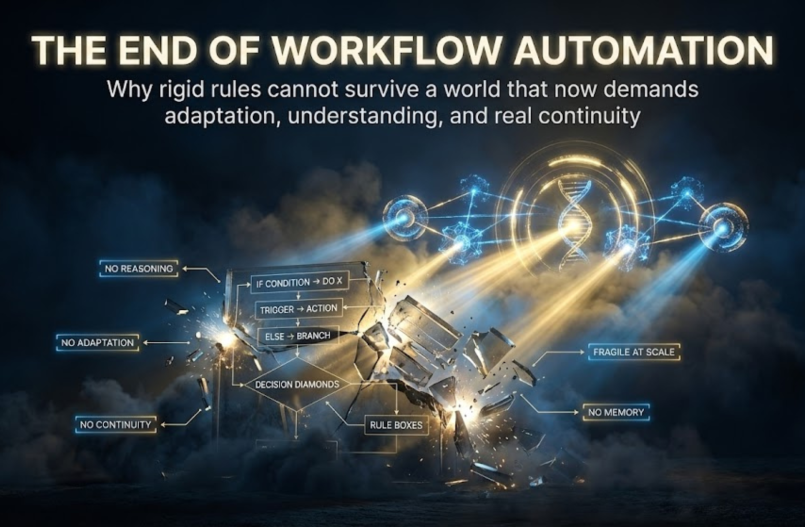
Why Rigid Rules Cannot Survive a World That Now Demands Adaptation, Understanding, and Real Continuity
For decades, enterprises believed automation would save them.
If they could build enough workflows…
If they could map enough rules…
If they could connect enough triggers…
…they could finally escape operational chaos.
Automation promised efficiency. It promised scale and control, but beneath all those promises was a flaw we could no longer ignore: Workflow automation cannot keep up with reality.
It cannot adapt or understand nuance. It collapses when context shifts. It breaks the moment the real world refuses to behave predictably. Automation assumed the world was stable. The world disagreed. Synthetic Cognition is not here to modernize workflow automation. It replaces the entire idea. Automation made work mechanical. Synthetic Cognition makes work intelligent.
The Fatal Limits of Workflow Automation
The reason automation fails has nothing to do with configuration. It fails because of its architecture.
1. Automation cannot reason
Automation is built on binary logic: If condition → do this. If not → do that. But real work requires interpretation:
Is this delay meaningful?
Is this tone a churn signal?
Does this exception matter?
Should the workflow be reordered?
Is this customer escalating emotionally?
No workflow can understand those nuances. It wasn’t built to.
2. Automation cannot adapt to change
Work shifts constantly:
Priorities change.
People change.
Customers change.
Markets change.
Regulations change.
Context changes.
A rigid workflow cannot adjust itself. Someone must manually rewrite it, usually after the failure.
3. Automation cannot maintain continuity
Work rarely follows a clean, linear sequence. Dependencies shift. Steps must move. Information arrives late. Something that mattered yesterday may not matter today. Automation has no memory. No long-term context or sense of evolving intention.
4. Automation becomes fragile at scale
The more workflows an organization builds, the more brittle the system becomes. One change breaks five things downstream. One exception triggers infinite loops. One update destabilizes an entire operational line. Organizations eventually discover:
Automation complexity grows faster than automation value.
Synthetic Cognition solves this by adding reasoning, perception, memory, and adaptive intelligence at the foundation.
Work Should Flow, Not Be Forced Into Workflows
Workflows assume predictability. Reality is fluid. Real work behaves like water: shifting direction, adapting to obstacles, responding to pressure, finding new paths. Synthetic Cognition mirrors that truth. It doesn’t force work into rigid sequences. It perceives, interprets, and decides the next step based on context. This is how work becomes intelligent.
How Synthetic Cognition Replaces Workflow Automation
Instead of rules, a persona uses judgment.
Instead of triggers, it uses perception.
Instead of rigid workflows, it uses adaptive intelligence.
1. Perceptors replace manual monitoring
Automation waits. Perceptors observe. They monitor:
- sentiment changes
- delays
- missing documents
- sudden inactivity
- risk signals
- anomalies
- new messages
- behavior shifts
They don’t wait for someone to look at a dashboard. They notice what matters.
2. NeuroFlow replaces flowcharts
Flowcharts force work into predefined boxes. NeuroFlow uses:
- reasoning cells
- memory
- identity
- prioritization logic
- contextual interpretation
It determines what makes sense, not just what the rule says.
3. Activators replace robotic execution
A persona can:
- update systems
- send messages
- produce documents
- schedule steps
- notify stakeholders
- escalate intelligently
- move workflows forward
- adapt when conditions shift
Actions come from understanding, not rules.
4. The Living Record replaces disconnected logs
Automation cannot remember anything beyond a single run. Personas can. They carry forward:
- decisions
- commitments
- evolving goals
- timelines
- relational history
- strategic context
Continuity becomes the default.
This Is Not a Better Workflow Tool. It’s a New Category.
Synthetic Cognition introduces:
- continuous perception
- contextual reasoning
- adaptive coordination
- long-term memory
- identity-driven behavior
- cross-persona collaboration
- model-agnostic thinking
- notarized lineage
- domain-specific intelligence
Automation executes rules.
Synthetic Cognition interprets reality.
Automation handles repetitions.
Synthetic Cognition handles complexity.
Automation completes tasks.
Synthetic Cognition moves work forward.
The Future of Operations Is Not Automated, It Is Intelligent
Enterprises will soon view workflow automation the way we view fax machines and phone trees:
Useful once.
Obsolete now.
The future belongs to systems that:
- perceive
- understand
- reason
- act
- escalate
- adapt
- remember
- maintain continuity
This is not automation. This is cognition.
Synthetic Cognition replaces the old world entirely.