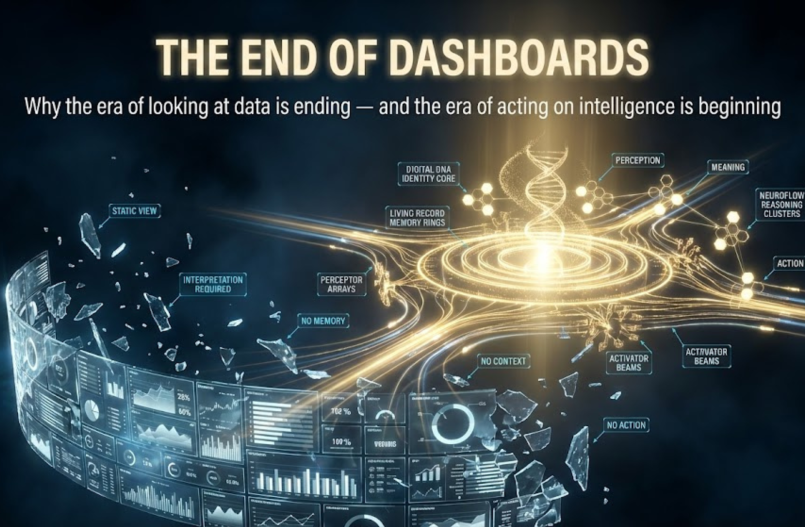
Why Looking at Data Is Dying and Acting on Intelligence Is the New Standard
There was a time when dashboards felt like magic. Interactive charts. Color-coded KPIs. Real-time graphs that made leaders feel informed and teams feel aligned. Dashboards promised visibility, clarity, and better decisions. But over the last decade, something became painfully obvious:
Dashboards don’t create action. They create cognitive debt.
Humans must interpret them.
Humans must connect the dots.
Humans must remember what matters.
Humans must translate data into decisions.
Humans must bridge the gap between what the charts show and what the organization needs to do next.
In a world moving this fast, dashboards are simply too passive to matter. Synthetic Cognition replaces dashboards with something exponentially more powerful: an intelligence layer that perceives, understands, reasons, and acts continuously.
The era of static visualization is ending. A new era of cognitive operations is beginning.
Why Dashboards Fail, No Matter How Beautiful They Look
Dashboards have three structural flaws that cannot be solved through design, AI plugins, or better filters.
1. Dashboards Have No Memory
A dashboard does not know:
- What decision you made yesterday
- What your team prioritized last week
- What tasks stalled
- What risks are building
- What actions succeeded
- What your customers expect
- What your strategy actually requires
Dashboards present isolated data points, not evolving context. There is no continuity. There is only presentation.
2. Dashboards Force Humans to Interpret Everything
Every chart is a burden disguised as insight.
What does this spike mean?
Is this trend good or bad?
Should someone act on this?
Is this a signal or noise?
Is a customer issue escalating?
Dashboards ask questions. They never answer them.
Worse, they force leaders and teams to spend thousands of hours making sense of what the charts can’t explain.
3. Dashboards Cannot Take Action
A dashboard cannot:
- follow up with a customer
- notify a team
- escalate a risk
- adjust a workflow
- reprioritize tasks
- detect sentiment
- interpret tone
- build an artifact
- move a project forward
Dashboards show. They do not do. In a modern enterprise, showing isn’t enough. Intelligence must participate.
Modern Organizations Need Continuity, Not Visualization
Work today is no longer linear. It flows. Signals appear, disappear, shift, and collide across:
- timelines
- conversations
- tools
- teams
- workflows
- relationships
Enterprises need systems that:
- perceive what is happening
- remember the history
- understand the meaning
- reason about the next step
- act proactively
- maintain momentum
- escalate intelligently
- learn from results
- adapt to changing conditions
Dashboards can’t do any of this. Synthetic Cognition does all of it.
Why Dashboards Collapse in Real Operations
Dashboards assume humans have:
- unlimited attention
- unlimited time
- unlimited focus
- unlimited memory
- unlimited situational awareness
They assume people will endlessly stare at data to stay informed, but people are overwhelmed. Teams face too many:
- KPIs
- dashboards
- alerts
- charts
- analytics tools
- meetings about dashboards
Dashboards demand constant human interpretation. Synthetic Cognition eliminates that burden.
What Replaces Dashboards: The Cognitive Nervous System
Synthetic Cognition introduces an intelligence layer that acts instead of displaying.
1. Perceptors Replace Manual Monitoring
Personas continuously sense:
- delays
- anomalies
- tone shifts
- sentiment changes
- risk indicators
- missing documents
- behavioral patterns
- workflow stalls
No one needs to “check the dashboard.” The system is always aware.
2. NeuroFlow Replaces Human Interpretation
Reasoning cells analyze:
- Is this urgent?
- Is this expected?
- What is at risk?
- What does this signal mean?
- What should happen next?
Dashboards leave these questions unanswered. Synthetic Cognition translates them into decisions.
3. Activators Replace Manual Action
Personas act:
- update systems
- send messages
- follow up
- coordinate flows
- adjust timelines
- notify humans
- escalate intelligently
Dashboards wait. Synthetic Cognition moves.
A Dashboard Shows a Snapshot. A Persona Understands the Story.
This is the fundamental shift:
A dashboard shows what happened.
A persona explains why it matters.
A dashboard shows a metric.
A persona drives the outcome.
A dashboard informs.
A persona collaborates.
Dashboards are for visibility.
Synthetic Cognition is for continuity.
What This Means for Enterprises
Companies can finally stop depending on:
- daily dashboard reviews
- weekly performance meetings
- manual KPI interpretation
- endless reporting cycles
- human-driven analysis
And replace all of it with:
- continuous perception
- memory-driven reasoning
- proactive action
- intelligent escalation
- cross-persona collaboration
- real-time continuity across teams
- long-term understanding of customers
- adaptive workflows
Dashboards don’t disappear. They simply fall into their rightful place:
references, not decision engines.
The intelligence layer does the thinking. Personas do the coordination. Humans do the creative and strategic work.
The Dashboard Era Is Ending
Not because dashboards lack value, but because cognition became possible.
Dashboards are static.
Enterprises are dynamic.
Dashboards show.
Intelligence acts.
Dashboards describe.
Intelligence understands.
Dashboards visualize.
Intelligence reasons.
The world doesn’t need another chart. It needs systems that can think.
Synthetic Cognition ends the dashboard era by replacing observation with interpretation and replacing visibility with action.
The future of operations isn’t a screen full of graphs. It’s a living intelligence layer that perceives, remembers, reasons, and acts continuously.
This is the next chapter of enterprise evolution.