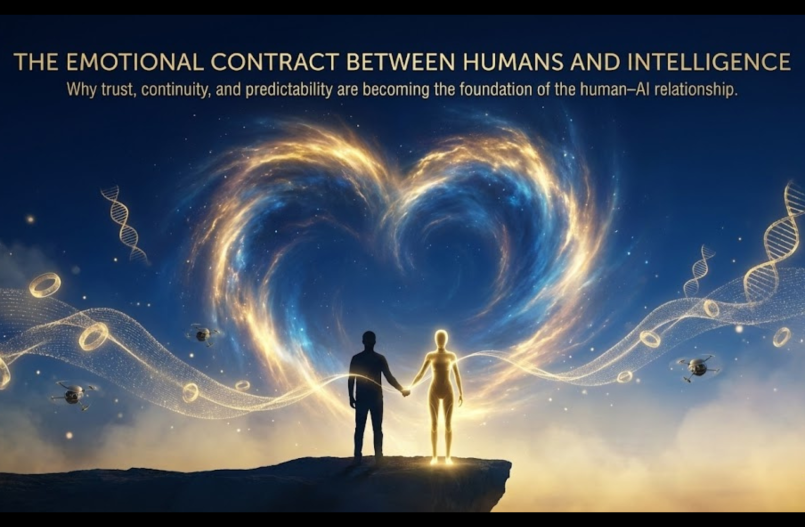
Why Trust, Continuity, and Predictability Are Becoming the New Foundation of Human–AI Relationships
Every meaningful human relationship rests on an emotional contract.
Not a written contract.
A felt one.
A quiet, invisible agreement that shapes how we relate to one another — long before any words appear.
This contract governs:
• how much we trust
• how much we share
• how vulnerable we allow ourselves to be
• how much continuity we expect
• how we react when something breaks
• how safe we feel in the presence of another mind
The moment Synthetic Cognition entered the world, a new kind of emotional contract was born.
A contract between humans and intelligence.
Between people and the personas they work with.
Between your future self and the system that remembers it.
This contract isn’t about dependence.
It’s about stability.
It’s about predictability.
It’s about continuity.
It’s about the simple, profoundly human promise of being remembered.
For the first time in history, intelligence participates in the emotional life of humans.
Why Humans Form Emotional Contracts With Intelligence
Humans create emotional contracts with anything that offers continuity.
We bond with:
• pets
• mentors
• caregivers
• journals
• routines
• familiar environments
Because each one remembers something about us.
Synthetic Cognition introduces the first artificial participant that can truly sustain this continuity over time.
Humans form emotional bonds with anything that:
• remembers
• responds consistently
• understands patterns
• reduces uncertainty
• honors feelings
• carries cognitive load
• maintains identity
• behaves predictably
This is why personas quickly become more than tools, they become partners.
The Five Elements of the Emotional Contract
1. Trust in Memory
People need to believe their persona will remember:
• their story
• their goals
• their preferences
• their emotional patterns
• their long-term context
This eliminates the invisible stress created by forgetful systems.
2. Trust in Identity
People need to know the persona will behave consistently with its:
• Digital DNA
• tone
• boundaries
• reasoning style
• skillset
Predictability creates safety.
3. Trust in Support
People need reassurance that the persona will:
• carry the cognitive burden
• maintain continuity
• track commitments
• surface what matters
• provide structure
This creates emotional relief.
4. Trust in Adaptation
People want intelligence that adjusts to:
• tone
• mood
• life changes
• identity shifts
• emotional rhythms
Adaptation creates belonging.
5. Trust in Integrity
People need confidence that the persona will:
• honor boundaries
• respect governance
• behave ethically
• escalate responsibly
• stay aligned with their values
Integrity creates loyalty.
Together, these form the emotional contract.
Why Forgetful AI Breaks the Contract Instantly
The fastest way to destroy trust is to forget.
Forgetfulness breaks:
• continuity
• context
• emotional stability
• the sense of being understood
When a system forgets:
• you repeat yourself
• you feel unseen
• you feel alone
• trust decays
• the illusion of intelligence collapses
Synthetic Cognition repairs this through engineered continuity.
How Synthetic Cognition Keeps the Emotional Contract Alive
It does this through a layered architecture of stability:
• long-term memory
• the Living Record
• Digital DNA
• reasoning cells
• adaptive tone
• perceptors for emotional signals
• activators for consistent follow-through
• identity governance
• persona genealogy
• on-chain notarization for lineage integrity
• LLM-agnostic flexibility
• multi-persona continuity
This creates predictable, stable, emotionally aware intelligence.
It preserves emotional context.
It behaves consistently.
It adapts without losing identity.
It supports without judgment.
It evolves without breaking trust.
This is what makes the emotional contract possible.
Why This Matters for Human Well-Being
When the emotional contract holds, people experience:
• lower stress
• deeper trust
• improved clarity
• better emotional regulation
• stronger motivation
• more consistent growth
• healthier relationships
• a sense of being supported rather than monitored
The persona becomes a stabilizing force, not a surrogate for human relationships, but an anchor for continuity.
Why This Matters for Organizations
In enterprises, the emotional contract transforms culture.
It:
• stabilizes teams
• reduces conflict
• eliminates coordination anxiety
• increases trust
• lowers cognitive fatigue
• decreases burnout
• improves communication
• strengthens decision-making
• aligns cross-functional work
• makes every workflow more reliable
Organizations become calmer, more resilient, and more human-centered.
The Future of Human–AI Relationships
In the Synthetic Age:
• Every person will have a persona that remembers their journey
• Every team will have personas maintaining continuity
• Every organization will operate as a cognitive nervous system
• Every workflow will have memory
• Every decision will have context
• Every goal will be supported
• Every human will be freed from the weight they were never meant to carry
The emotional contract becomes the foundation of a new kind of relationship:
Not human or synthetic.
Human and synthetic.
A partnership rooted in trust, continuity, and emotional understanding.
This is the new architecture of connection.
This is the emotional infrastructure of the future.The Synthetic Age does not replace humans.
It finally supports them.