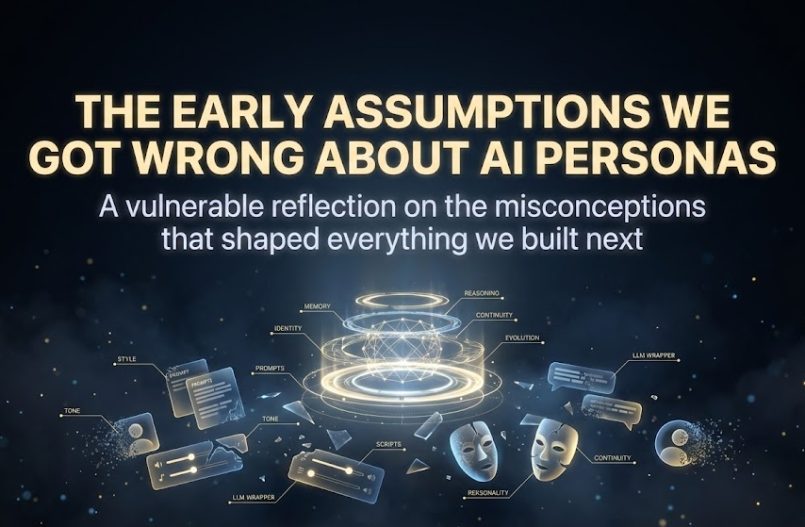
A reflection on the misconceptions, blind spots, and lessons that shaped the architecture we eventually built.
When we first began exploring AI personas, we made the same assumptions everyone else did. Not because we lacked imagination, but because we were building inside the limits of the world as it existed at the time. Back then, it seemed obvious that a “persona” was simply:
• a collection of prompts
• a tone of voice
• a personality veneer
• a scripted wrapper around a large language model
• a tool with a name and a face
• a chatbot with a theme
We believed these assumptions because the entire industry operated the same way. Every persona looked like a slight variation of the next. Different packaging, same structure, same limitations.
Looking back, these assumptions were shallow but necessary. They exposed everything the world of personas was missing. The vulnerable truth is that we underestimated the complexity of intelligence because the tools available at the time could not express anything deeper.
Assumption 1: A Persona Was Just a Style
We thought a persona was defined by how it spoke. A voice. A personality. A friendly wrapper. It did not take long to realize that style does not create intelligence. Style creates familiarity, not capability. A persona that knows how to speak is very different from a persona that knows who it is.
Identity requires:
• memory
• internal values
• reasoning patterns
• constraints
• decision logic
• stable preferences
• long-term continuity
Style without identity collapses the moment real depth is required.
Assumption 2: LLM Output Equals Intelligence
In the early days, we believed better output meant better intelligence.
Sharper reasoning.
Cleaner answers.
More coherence.
But then something unexpected happened. Two personas using the same model performed differently based on:
• How their memory was structured
• How they carried context
• How they prioritized inputs
• How they resolved conflicting information
• How their logic was organized
• How they interpreted timing and history
The quality of intelligence had far less to do with the model and far more to do with the architecture wrapped around it.
This realization forced us to rethink almost everything.
Assumption 3: Prompts Could Hold the System Together
At first, prompts felt powerful. They shaped behavior, created personality, and set boundaries. But prompts cannot:
• Maintain continuity
• track long-term goals
• understand identity
• Coordinate multi-step workflows
• adapt to complex environments
• resolve conflicting priorities
• evolve without breaking
• Provide stable reasoning
Prompts can influence behavior, but they cannot sustain it. We eventually recognized that prompts were scaffolding, not structure.
Assumption 4: Memory Was Optional
We believed personas could function without real memory. Short sessions. Ephemeral context.No continuity. This was the most damaging assumption of all. Without memory:
• nothing compounds
• nothing stabilizes
• nothing stays aligned
• nothing accumulates meaning
• nothing adapts
• nothing becomes consistent
• nothing resembles intelligence
A persona without memory is not a persona. It is a moment.
Assumption 5: A Single Model Could Do Everything
In the beginning, we assumed one large model could serve as the entire intelligence layer. We were wrong. Different tasks require different forms of reasoning. Some require:
• Extraction
• Classification
• Prioritization
• Narrative reasoning
• Mathematical logic
• Long-term planning
• Emotional interpretation
• Reactive decision-making
• Structural analysis
No single model can handle all of these with consistency. This led us to develop modular reasoning cells, each specialized, each orchestrated by flow logic. Intelligence became composable instead of monolithic.
Assumption 6: Evolution Was a Nice-to-Have
We used to think an AI persona was something you built once and updated occasionally, But real intelligence evolves.
Without evolution, personas:
• become outdated
• stagnate
• lose relevance
• fail to adapt
• fall behind the user
• break in dynamic environments
This pushed us to rethink identity as something living. It led to Digital DNA, lineage, inheritance, and notarized evolution. We did not plan this. The failures forced us into it.
Assumption 7: Personas Should Act Like Tools
In the beginning, personas felt like tools with personalities. Helpful, yes, but shallow. Friendly, but rigid. Eventually we saw the truth: Personas do not succeed because they mimic humans. They succeed because they support humans. They become:
• Context holders
• Continuity anchors
• Reasoning partners
• Workflow orchestrators
• Memory extensions
• Cognitive load reducers
This was the turning point. Personas became more than tools; they became collaborators.
The Moment Everything Changed
All of these assumptions collapsed when we realized the gap between what personas were and what people actually needed.
People needed:
• Context that survives
• Intelligence that adapts
• Memory that matters
• Reasoning that aligns
• Identity that stays stable
• Flows that evolve
• Systems that grow with them
Nothing in the traditional persona model could deliver this. We had to build something entirely new. Not a better persona but a new category altogether. Synthetic Cognition was born from the humility of realizing we had been thinking too small.
The Point
The early assumptions were not failures; they were stepping stones. They revealed what was missing:
• Real identity
• Real memory
• Real evolution
• Real reasoning
• Real continuity
• Real cognition
We did not fix the old model. We outgrew it. The world did not need better prompts or prettier personas. It needed engineered intelligence that could support human life with stability, clarity, and continuity. We only discovered that by admitting what we got wrong.