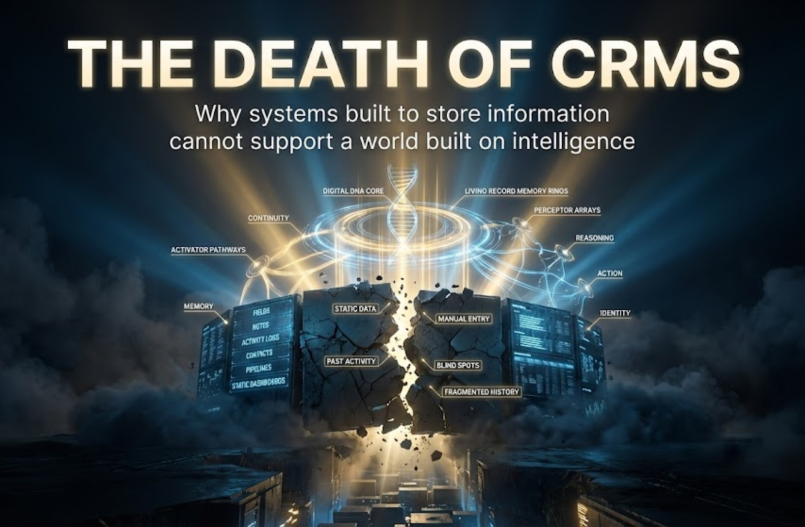
Why Systems Built to Store Data Cannot Support a World Built on Intelligence
For more than two decades, the CRM sat at the center of the enterprise universe.
It became the default system for “managing relationships,” tracking activity, and organizing customer information.
But the world moved on.
Customer expectations changed. Workflows became nonlinear. Communication exploded across channels. The speed of business accelerated beyond the limits of forms and fields.
CRMs never evolved with it. They remained static systems pretending to support dynamic relationships. They remained giant spreadsheets wrapped in UI. They remained entirely dependent on humans to keep them alive. Today, the gap between what enterprises need and what CRMs can deliver is no longer a crack; it’s a chasm.
Synthetic Cognition does not bridge that gap. It replaces the concept entirely because the era of static record-keeping is ending.
Why CRMs Are Failing (and Cannot Be Fixed)
CRMs have three structural flaws that no amount of AI, automation, or customization can overcome.
1. CRMs rely entirely on humans to maintain them
If someone forgets to enter notes, the CRM forgets.
If someone misses a call log, the CRM loses context.
If someone doesn’t update a status, the CRM becomes blind.
CRMs cannot:
- perceive
- listen
- interpret
- monitor
- understand
They are memory-poor systems dressed up as “relationship tools.”
2. CRMs store past activity, not present reality
CRMs cannot detect:
- Tone
- Sentiment
- Urgency
- Behavioral shifts
- Reaning behind silence
- Risk emerging across delays
They record what happened, never what is happening. They are rear-view mirrors in a world that needs radar.
3. CRMs cannot create continuity
This is the fatal flaw. A CRM cannot:
- maintain long-term relational memory
- carry context across teams
- coordinate workflows
- understand evolving goals
- reason about next steps
- escalate risks proactively
- adapt to shifting priorities
CRMs store fragments. Enterprises require continuity.
What CRMs Miss That Synthetic Cognition Delivers
The difference is simple: CRMs capture information. Synthetic Cognition understands it.
1. CRMs remember fields. Personas remember meaning.
CRMs store:
- names
- emails
- notes
- activities
Synthetic Cognition stores:
- preference patterns
- behavioral trends
- emotional signals
- long-term goals
- relationship arcs
- evolving context
- risks building beneath the surface
- momentum across time
CRMs hold data. Personas hold understanding.
2. CRMs wait for updates. Personas perceive automatically.
Perceptors allow personas to observe:
- incoming messages
- contract changes
- delays
- status shifts
- tone shifts
- risk signals
CRMs cannot sense anything.
3. CRMs organize contacts. Personas coordinate outcomes.
Activators allow personas to:
- follow up
- schedule
- notify
- update
- move workflows forward
- resolve issues
- escalate intelligently
A CRM is passive. A persona is operational.
4. CRMs record the past. Personas participate in the present.
One stores. One collaborates.
The Deeper Truth: CRM Thinking Is Holding Businesses Back
CRMs conditioned organizations to believe that storing information equals managing relationships. But information without continuity produces:
- repeated conversations
- missed opportunities
- inconsistent experiences
- operational drag
- preventable churn
- friction between teams
- lost context across tools
Enterprises need intelligence that can:
- understand
- remember
- reason
- interpret
- act
- coordinate
- escalate
- adapt
- evolve
These are cognitive functions, not database functions. Synthetic Cognition replaces CRM thinking with continuity thinking.
Why CRMs Cannot Evolve Into Cognitive Systems
Vendors promise “AI-powered CRMs.” But AI cannot be bolted onto architecture that fundamentally cannot:
- perceive
- interpret
- remember meaningfully
- reason structurally
- coordinate workflows
- evolve safely
CRMs were designed to store. Synthetic Cognition is designed to understand. They are not compatible paths.
What Replaces the CRM: The Cognitive Nervous System
Enterprises no longer need better record-keeping. They need a cognitive layer that:
- perceives
- remembers
- reasons
- acts
- collaborates
- escalates
- adapts
- learns
- maintains continuity everywhere
A CRM becomes a passive system of record. Synthetic Cognition becomes the active partner in operations.
The CRM Is Dying Because the World Outgrew It
Customers now expect intelligence that remembers them. Teams expect workflows that move forward without friction. Leaders expect visibility without chasing information. Enterprises expect continuity, not static fields. CRMs cannot deliver this. They were never built for it. The world needs systems that think, not systems that store.
The CRM era isn’t ending because of competition. It’s ending because of irrelevance.Synthetic Cognition does not modernize the CRM. It replaces the idea entirely.