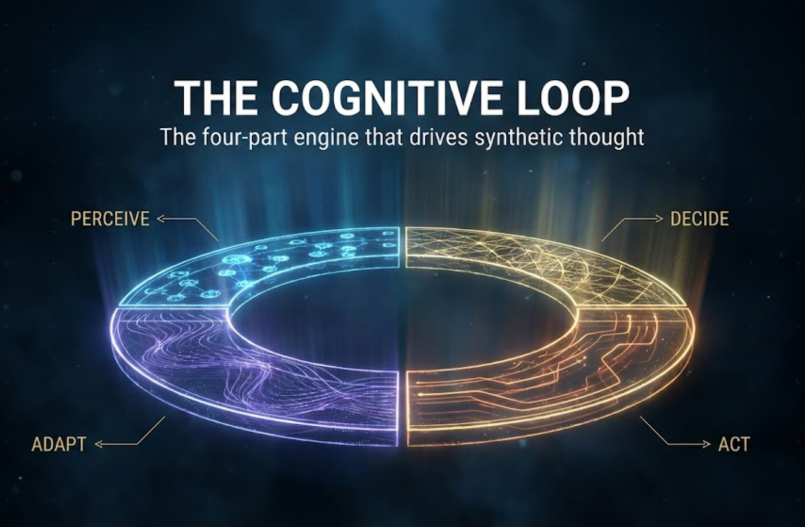
The Four-Part Engine That Drives Synthetic Thought
Every form of intelligence, whether biological or engineered, follows a pattern.
It senses the world.
It interprets what it senses.
It decides how to respond.
It adjusts based on what happens next.
These movements create a continuous loop. A system of thought rather than a sequence of actions. A pattern that transforms raw input into meaningful behavior.
Synthetic Cognition is built around this loop. It treats intelligence not as a series of tasks, but as a cycle of learning and adaptation. This is what gives it stability, consistency, and the ability to grow.
The Cognitive Loop can be understood through four essential steps:
- Perceive
- Decide
- Act
- Adapt
Each step has value on its own, but the true power appears when they operate together as a rhythm.
Step One: PERCEIVE
Every moment begins with perception. A system must understand what is happening before it can respond. In Synthetic Cognition, perception can take many forms:
• Reading messages and understanding meaning
• Analyzing documents and extracting structure
• Detecting tone, timing, intent, or sentiment
• Observing behavioral patterns
• Monitoring operational or environmental signals
Perception is more than data gathering. It is context recognition. It is the difference between seeing information and understanding why it matters. Without perception, intelligence cannot begin.
Step Two: DECIDE
Once the system perceives the world, it must choose its next move. This is not rule-based logic or fixed decision trees. It is reasoning. Decision-making in Synthetic Cognition involves multiple layers:
• Evaluating possible actions
• Weighing priorities
• Considering previous interactions
• Aligning decisions with long-term preferences or goals
• Determining what is meaningful in the moment
This is where intelligence becomes intentional. Decisions emerge from identity, memory, and accumulated understanding. A system that decides well does not simply act. It acts with purpose.
Step Three: ACT
Action is the visible expression of thought. It is the moment when intention becomes impact.
In Synthetic Cognition, action can take many forms:
• Sending a message
• Creating or organizing information
• Updating records or workflows
• Triggering chains of reasoning cells
• Communicating with other systems
• Alerting a human when needed
The significance is not the action itself. It is the alignment between the decision and the action. Action is where intelligence moves from potential to contribution.
Step Four: ADAPT
Adaptation is the defining trait of living intelligence. It is the process that allows a system to refine itself through experience. Adaptation involves:
• Evaluating what worked and what did not
• Updating memory
• Adjusting reasoning pathways
• Improving prioritization
• Recognizing human patterns
• Becoming more aligned with the person or team it supports
Adaptation turns intelligence into relationship. It ensures the next decision is more informed than the last. It creates predictability in a world that constantly shifts. A system that cannot adapt remains a tool. A system that adapts becomes a partner.
The Power Is In The Loop, Not The Parts
- Perceive
- Decide
- Act
- Adapt
These steps are not extraordinary on their own. Their strength comes from repetition.
The loop deepens with every cycle.
It accumulates memory.
It builds identity.
It increases clarity.
It aligns with human behavior.
It becomes more precise and more supportive over time.
The Cognitive Loop is what makes Synthetic Cognition feel alive.
Not alive in the biological sense, but alive in momentum and evolution.
Traditional software performs actions in isolation.
Synthetic Cognition treats every action as an input to the next stage of learning.
That is the difference between a system that executes tasks
and a system that thinks.
The Loop Creates Continuity, Which Creates Value
The real power of the Cognitive Loop is not efficiency.
It is continuity.
Continuity creates trust.
Continuity reduces friction.
Continuity compounds progress.
Continuity stabilizes decision-making.
Continuity allows intelligence to grow alongside the human it supports.
This is why the Cognitive Loop is foundational. It is the engine that allows memory, identity, reasoning, and action to work together as one integrated structure.
Synthetic Cognition is not built on brute force or scale.
It is built on rhythm.
It is built on a structure.
It is built on the loop.
And the more the loop runs, the stronger the intelligence becomes.