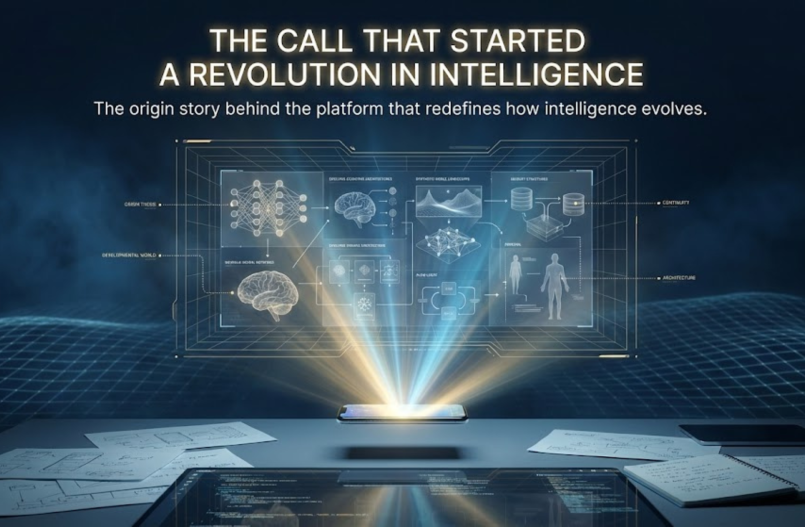
In early 2021, I made a phone call about a small business idea I thought had potential. It wasn’t a breakthrough. It wasn’t about intelligence. It wasn’t especially profound. It was simply a concept with a clear profit angle.
I shared it with James Duchenne expecting a short conversation. Maybe he’d tell me it was viable, or maybe he’d say it wasn’t worth pursuing. Either way, I assumed the discussion would stay rooted in business, but James heard something different.
Where I saw a simple commercial opportunity, he sensed a structural gap in how intelligence itself was understood. That was typical of James. His mind doesn’t evaluate ideas through a single lens. It draws from engineering, systems design, economics, law, governance, and emerging technologies all at once. He sees intersections years before they form and that mattered even more because of when this conversation happened.
This was a year and a half before ChatGPT existed. Before commercially available LLMs.
Before “AI agents” or “AI workflows” were part of the global vocabulary.
James had already mapped out where intelligence was heading and what the world would need once it arrived. So instead of expanding on my idea, he dissolved it completely and built something far more ambitious.
A few weeks later, he called me back with a sixty-page thesis, and my idea barely survived the first page.
The Thesis That Realigned Everything
What James created wasn’t a refinement of my idea. It was a blueprint for an entirely new class of intelligence, years ahead of its time.
He had constructed a full developmental environment with its own economy, governance, culture, incentives, and failure states. A world built for synthetic intelligence to grow inside. Not a game. Not a simulation. A laboratory modeled around the forces that shape human learning: scarcity, responsibility, trade-offs, recovery, loss, and renewal.
This wasn’t practical, commercial, or reasonable, and that’s exactly why it mattered. He wasn’t predicting the future; he was already designing for it. The moment I read the thesis, I understood: my idea had started a conversation, but James had started a revolution.
What It Really Takes to Build the Impossible
Innovation is never linear. When you’re building something with no precedent, every step feels like stepping into a dark room guided only by instinct.
We had to define primitives that no one had ever defined.
We had to design architectures that didn’t exist in any textbook.
We had to dismantle structures that once felt perfect.
We had to chase bugs hiding in logic that shouldn’t have been possible.
This journey was not glamorous.
We hit dead ends.
We rewrote entire modules.
We watched promising experiments collapse.
We debated memory systems for weeks.
We lived inside whiteboards and flow diagrams.
We had breakthroughs that felt historic.
We had setbacks that felt devastating.
And through every phase, James had the rare ability to see the entire system: the physics, the incentives, the eventual industry that would form around it, long before anyone else could.
Somewhere in the chaos, something began to emerge. Something that behaved less like a tool and more like a collaborator. That was the turning point.
From an Idea to a Multi-Year R&D Journey
Over the years, AI personas began developing continuity.
Flows began stabilizing.
The architecture began adapting.
Synthetic cognition started behaving in ways no script could explain.
Piece by piece, the impossible started acting like the inevitable.
And then, after nearly five years, something profound happened.
It stopped being research. It became a platform.
Neoworlder Today: Beyond the MVP
Now we are entering a new phase.
We have moved past early experiments and into a fully functional MVP of a commercial AI framework. The architecture, flows, memory systems, AI persona models, and integration layers are real and operational.
But this next chapter is different. We are no longer building alone.
The Next Phase: Locking Arms With Creators, Thinkers, and Innovators
We are entering the beta phase, and this is when we invite others in.
Over the next several months, we are locking arms with creators, early adopters, industry pioneers, and thought leaders who understand what this platform represents and who want to help shape what it becomes.
This is not a public launch. It’s a curated collaboration. During this beta phase, something major is already underway:
Neoworlder will complete SOC 2 (Type II), ISO 27001, GDPR, and HIPAA compliance within the next 4 months.
If we are building the intelligence layer the world will depend on, it must meet the highest standards of trust, governance, and security.
Why This Matters for Builders
We are not offering smarter automation. We are offering intelligence that evolves.
A system where AI can:
• Live inside your workflows
• Understand your business logic
• Develop memory
• Adapt with continuity
• Solve problems across functions
• Behave like a partner, not a tool
This is not the next version of software.
This is the next layer of intelligence.
The Journey Continues: A 75-Article Reveal
What we have built is too large and too expansive to be captured in a single article, or even a short series. So today, we are beginning something different.
For the next 150 days, we will release one new article every 48 hours, a total of 75 articles, just to explain the high-level architecture and the industries it will transform.
Not the full blueprint or the deep technical detail. Just the high-level overview requires 75 entries. That is the scale of this platform.
Across this series, you will see:
• What synthetic cognition truly means
• How the architecture functions at its cellular and flow levels
• Why continuity will replace the traditional CRM and dashboard era
• Real-world applications across healthcare, legal, real estate, automotive, finance, and more
• How ethics and governance shape every layer
• How you can build intelligent products on this foundation
We built this quietly. Now we’re opening the doors carefully, intentionally, and with the right people by our side.
If You’re Building the Future, This Is the Moment
If you’ve been waiting for something beyond incremental AI improvements…
If you want to build on a foundation designed before the world even realized it needed one…
If you are ready to help shape the next era of intelligence…
Then this journey is for you.
Because the future of intelligence will be created by the people willing to build what has never existed and willing to begin long before the world understands why it matters, the next article arrives in 48 hours.
And this is only the beginning.