Why the Future Will Be Built on Systems That Think, Not Systems That Store
For almost fifty years, software has been the foundation of the digital world. It gave us structure. It organized information. It standardized workflows. It created the backbone for modern industries.
But as the world has grown more dynamic, the expectations placed on software have expanded far beyond what it was ever designed to handle.
Organizations need systems that can adapt as fast as their environments. People need support that can understand context, not just hold it. Teams need tools that collaborate with them rather than freeze logic in place. This shift has revealed a quiet but undeniable truth: Software is no longer the core. It is now one layer inside something larger.
The new foundation is cognitive infrastructure.
Infrastructure that does not simply record information, but interprets it.
Infrastructure that does not merely automate tasks, but adapts to change.
Infrastructure that does not wait for instructions, but reasons, prioritizes, and evolves.
Cognitive infrastructure is the next step after software. It replaces rigidity with flexibility, static rules with adaptive insight, and isolated actions with continuous understanding.
The Limitations of Software Are Now Visible
Traditional software is built on fixed assumptions. It expects stable workflows. It assumes consistent inputs. It follows predefined logic. It depends on humans to maintain alignment. These assumptions worked in a slower era, but they break in today’s environment.
Modern life moves too quickly. Teams reorganize constantly. Customer expectations evolve in real time. Problems emerge with no predefined paths. Information moves faster than humans can structure it. A static system cannot support a dynamic world. This is the gap cognitive infrastructure is built to fill.
Cognitive Infrastructure Is Built to Think, Not to Store
The difference between traditional software and cognitive infrastructure is not incremental.
It is foundational.
Software stores.
Infrastructure thinks.
Software records.
Infrastructure reasons.
Software reacts.
Infrastructure anticipates.
Software waits for commands.
Infrastructure understands context.
This shift does not replace software.
It elevates it.
Cognitive infrastructure becomes the intelligence layer that sits above every workflow, channel, interaction, and tool. It brings coherence to environments that have become fragmented by too many disconnected systems.
Why Our World Now Demands Cognitive Infrastructure
The need for a new foundation is visible everywhere. People do not want dashboards that require interpretation. They want systems that interpret for them. Teams do not want workflows that break the moment conditions change. They want flows that adapt automatically. Leaders do not want fragmented data spread across dozens of tools. They want unified intelligence that grows smarter over time. Organizations do not want intelligence that resets at the end of each task. They want continuity that builds across days, months, and years.
Software alone cannot deliver this. A new layer is required; one where understanding and adaptation are not optional, but the foundation.
Cognitive Infrastructure Makes Continuity Possible
The core challenge cognitive infrastructure solves is simple and profound: Systems need memory.
Memory transforms transactions into relationships.
Memory allows intelligence to evolve through experience.
Memory creates patterns that become insight.
Memory forms consistency across every interaction.
Without memory, intelligence resets. With memory, intelligence grows. Cognitive infrastructure provides this by establishing a persistent identity layer that moves through every part of the system. It understands past context. It updates its reasoning. It maintains history. It evolves with the team it supports. Continuity becomes the standard rather than the exception.
A Foundation Designed for Adaptation
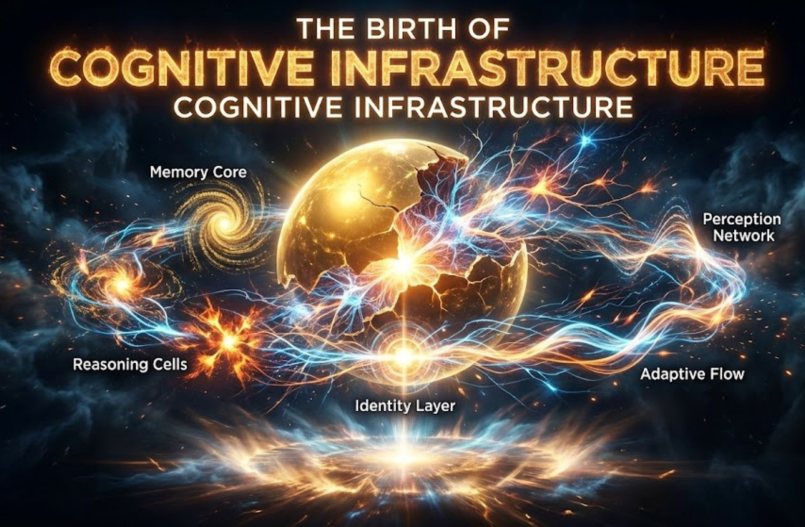
Cognitive infrastructure is built on a single idea: Intelligence should not be a separate tool. It should be the environment that everything else operates within. The infrastructure:
• Perceives information
• Evaluates context
• Decides what matters most
• Takes meaningful action
• Adapts based on outcomes
• Stores long-term memory
• Grows skills through modular reasoning cells
• Connects across channels and systems
• Maintains continuity at every stage
This architecture mirrors how real intelligence behaves. It does not treat actions as isolated events. It treats them as inputs to a continuous cognitive loop that strengthens over time.
Organizations Will Soon Compete Through Their Cognitive Nervous System
The next competitive advantage will not come from the number of tools a company uses.
It will come from the intelligence that connects those tools into a unified whole.
Cognitive infrastructure becomes the nervous system of the organization.
It coordinates.
It learns.
It adapts.
It supports.
It remembers.
It prioritizes.
It guides decisions.
It maintains continuity.
This is what allows teams to move faster with less effort.
It is what gives leaders clarity instead of complexity.
It is what allows organizations to scale without collapsing into chaos.
Cognitive infrastructure does not replace human intelligence. It amplifies it.
A New Era Begins When the Foundation Changes
Every major leap in technology began with a shift in the foundation. Electricity replaced manual power. Operating systems replaced raw computation. Cloud platforms replaced local storage. Software replaced paper processes. The next foundation will be cognitive.
A layer that sits under everything.
A layer that quietly guides, understands, and adapts.
A layer that supports humans rather than requires humans to support it.
The birth of cognitive infrastructure marks the beginning of that era. An era defined by systems that think, evolve, and stand beside the people they serve. This is the new foundation.
And the world is finally ready for it.