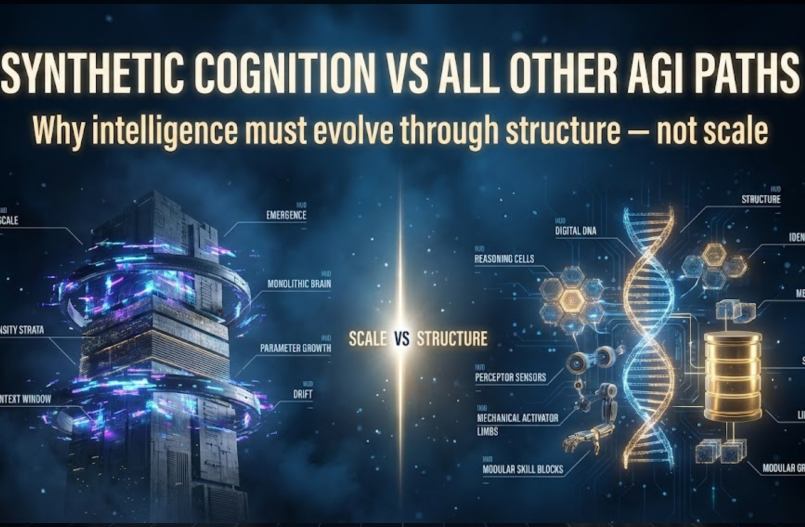
The pursuit of general intelligence has taken many forms. Some believe AGI will come from stacking more parameters. Some believe it will emerge from massive context windows. Some believe statistical prediction will evolve into true reasoning. Others believe the answer lies in consciousness, or something close to it.
Synthetic Cognition takes a different path. It does not chase intelligence through size. It does not assume emergence arrives if we keep scaling the same model. It does not treat “more data” or “more tokens” as destiny. Instead, it follows a principle found everywhere in nature: Intelligence evolves through structure, not size.
Every true intelligence system has:
• identity
• long-term memory
• modular skills
• sensory pathways
• action pathways
• clear methods for growth
• constraints that preserve stability
• lineage that shapes evolution
Synthetic Cognition applies these principles to engineered intelligence. This is not a competing AGI attempt. It is the structured foundation AGI will require if it is ever going to behave with purpose, continuity, and alignment.
Where Scale-Based AGI Hits Its Limits
The scale-first approach has produced astonishing breakthroughs, but it also hits fundamental constraints:
1. Identity collapses with every model update: Change the model → change its personality, tone, and reasoning patterns. There is no stable “self.”
2. Memory cannot be carried across time: Models remember only the prompt window.
Nothing persists across weeks, projects, cycles, or organizational history.
3. Behavior drifts because logic is monolithic: One model means one brain doing everything, and everything changes when anything changes.
4. Failure is systemic: If the model breaks, the entire product breaks. If the model is retired, everything built on top disappears.
5. There is no explainable chain of thought: Output is correlation, not structured reasoning. Tracing a decision is nearly impossible.
These constraints are not flaws. They are the natural limits of a monolithic, statistical system. Synthetic Cognition is designed to solve these limits directly.
How Synthetic Cognition Approaches Intelligence
Here are the principles that define this architecture:
1. Intelligence needs identity: Personas are built on Digital DNA: mission, tone, boundaries, and structure that persist across model generations.
2. Intelligence needs intentional, long-term memory: The Living Record provides continuity without chaos, memory that compounds rather than drifts.
3. Intelligence must be modular, not monolithic: Reasoning cells divide cognition into small, manageable units that can evolve independently.
4. Intelligence must be able to sense and act: Perceptors give awareness. Activators give it limbs. Intelligence stops reacting and starts participating.
5. Intelligence must evolve through lineage: Persona genealogy ensures growth is safe and cumulative, not a reset every time something changes.
This is not emergent magic. This is applied engineering.
Traditional AGI Tries to Build One Great Mind.
Synthetic Cognition Builds Many Minds That Work Together. A single, giant model trying to do everything will always be fragile. Synthetic Cognition creates a network of specialized personas, each with its own identity, skills, and mission. They collaborate like teams, form ecosystems, and operate like a digital civilization rather than a single monolithic intelligence. This reflects how intelligence works in the real world through distributed, specialized systems that coordinate.
Synthetic Cognition Is Compatible With Every Model
This architecture does not replace LLMs. It orchestrates them. Models become interchangeable tools. Personas provide identity and reasoning. Cells define logic. Skills define capability. The Living Record defines memory. Digital DNA defines who the persona is. Lineage defines how it grows. This is the missing structural layer that the field has been waiting for.
Why This Path Is More Practical for the Real World
Businesses do not need a god-model. They need intelligence that is:
• predictable
• governable
• compliant
• explainable
• stable
• adaptable
• aligned
• collaborative
• long-lived
Massive monolithic models cannot deliver that. Structured intelligence ecosystems can. Synthetic Cognition does not oppose scale; it enhances it. It makes powerful models usable, safe, and sustainable.
The Future Won’t Belong to One Great Intelligence
It will belong to systems built on:
• identity
• memory
• lineage
• governance
• modularity
• sensory pathways
• action pathways
• intentional evolution
• many minds working together
Synthetic Cognition is not another AGI race. It is the architecture that makes all paths toward intelligence viable and useful in the real world. The future will not be defined by the biggest model. It will be defined by the systems that give intelligence structure, continuity, clarity, and purpose.
This is that system.