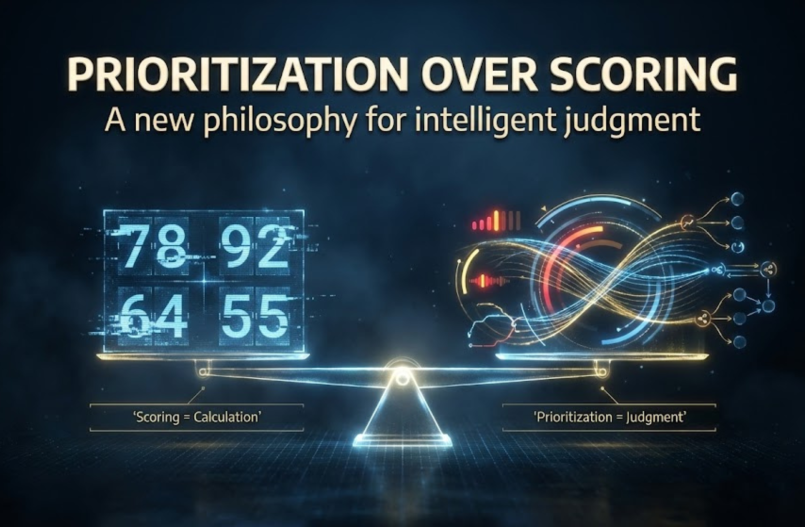
A New Philosophy for Intelligent Judgment
For years, the AI industry leaned heavily on scoring systems to approximate intelligence.
Probabilities. Rankings. Confidence levels. Numerical guesses about relevance.
Scoring worked in the early days. It was simple, measurable, and separated the signal from the noise quickly. But scoring was never designed to reflect how humans actually make decisions.
Scoring delivers information, not clarity. Rankings, not direction. Possibilities, not guidance. As AI systems began to take on more complex, human-centered tasks, the limitations became impossible to ignore. The world does not need higher scores; it needs better priorities.
Why Scoring Falls Short
Scoring is based on one rigid assumption: the highest number is always the best choice. That assumption works for simple decisions. It collapses under real-world complexity.
Scoring cannot account for:
• Context
• History
• Urgency
• Relationships
• Dependencies
• Personal preference
• Emotional or strategic nuance
Any one of these factors can change what the right decision should be.
A task with a low score may still be the most important task of the moment.
A message with a high score might be irrelevant if the timing is wrong.
A promising lead may fail because the relationship is cold.
A customer with complex needs may require attention before a customer who appears more valuable on paper.
Scoring wants a single correct answer. Life does not behave that way.
Prioritization Matches How Humans Think
Humans rarely choose based on numbers. They choose based on meaning.
People prioritize according to:
• What matters right now
• What is at risk
• What unlocks progress
• What supports long-term goals
• What creates leverage
• What protects relationships
• What prevents problems downstream
This is not ranking. It is judgment.
Judgment is about deciding the next meaningful step, not selecting the top statistical candidate. This is the philosophy of Synthetic Cognition. Intelligence should guide action, not build a scoreboard.
Prioritization Creates Clarity in Chaos
Modern work is chaotic. People juggle dozens of threads. Information floods from every direction. Priorities shift mid-day. Responsibility spreads across tools, teams, and systems. A scoring model cannot handle this movement. It tries to force complexity into a single number. Prioritization does something different. It extracts direction from complexity. It creates clarity, reduces friction, and shows the next step even when everything is moving. Scoring ranks options. Prioritization creates momentum.
Intelligence Should Help Humans Decide, Not Overwhelm Them
Most modern tools increase information without increasing clarity. Scoring adds more numbers. Dashboards add more charts. Analytics adds more data. Automations add more activity. More information does not create better decisions. Prioritization bridges the gap by turning information into guidance.
A truly intelligent system should say:
• Here is what matters most.
• Here is what you should do next.
• Here is what can wait.
• Here is what needs attention because of the larger context.
• Here is the path that prevents downstream issues.
This is where the real value begins. Intelligence exists to help humans act, not drown them in possibilities.
Prioritization Is Dynamic, Not Static
A priority changes the moment the world changes. A system capable of dynamic prioritization becomes far more capable than any static scoring model.
It considers:
• Current conditions
• Recent behavior
• Historical patterns
• Environmental signals
• Resource constraints
• Timing
• Relational impact
• Long-term objectives
This produces a living, adaptive understanding of what should happen next. Scoring cannot keep up with this level of movement, but prioritization can.
The Shift From Scoring to Prioritization Is a Shift From Classification to Intelligence
Scoring classifies.
Prioritization synthesizes.
Scoring analyzes.
Prioritization understands.
Scoring predicts.
Prioritization guides.
Scoring offers possibilities.
Prioritization offers direction.
The shift is not about replacing mathematics. It is about elevating the role of intelligence from calculation to collaboration. A system that prioritizes becomes a partner. A system that only scores remains a tool.
Prioritization Is the Heart of Synthetic Cognition
Synthetic Cognition is built on a different philosophy. Intelligence should behave like a supportive collaborator, not a complicated calculator. Prioritization gives it this quality:
• It reflects context
• It respects nuance
• It views decisions through a long-term lens
• It adapts as conditions shift
• It helps people move forward instead of hesitating
This is the difference between information and insight. Between data and direction. Between output and understanding. Prioritization is not a feature; It is a philosophy. It is the way intelligence learns to serve humans in the way humans naturally think and decide.