How Intelligence Inherits, Adapts, and Evolves With Purpose
The architecture that transforms personas from isolated tools into generational lines of growing intelligence. In nature, intelligence evolves through lineage.
Each generation inherits structure from the one before it. Each generation improves on what it receives. Growth compounds. Identity persists. Wisdom becomes cumulative. Synthetic Cognition brings this same idea into engineered intelligence.
Instead of treating each persona as a temporary, isolated system, Synthetic Cognition introduces persona genealogy: a framework where every persona belongs to a lineage, inherits structure from predecessors, and passes improved capability to descendants. Intelligence stops being disposable; It becomes generational.
Why Genealogy Matters in Synthetic Cognition
Most AI systems behave like short-lived snapshots:
• Build a bot
• Deploy it
• Update it
• Overwrite it
• Start again
There is no memory of what came before. No structural continuity. No inherited competence. This creates systems that reset instead of evolve. Persona genealogy changes everything. Every persona gains:
• A parent
• Descendants
• Inherited architecture
• Selective evolution
• Versioned identity
• Structured growth across generations
Intelligence finally compounds instead of resetting.
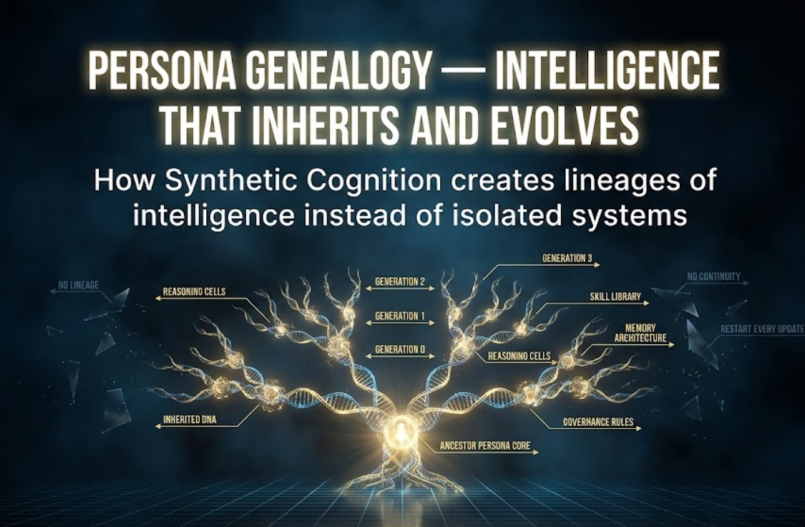
What a Persona Actually Inherits
Inheritance in Synthetic Cognition is not a loose copy of behavior.
It is a structured transmission of architecture. A persona inherits:
1. Digital DNA (the core identity blueprint)
• Identity
• Reasoning style
• Skill architecture
• Memory architecture
• Domain boundaries
• Evolution rules
This is the persona’s foundational self.
2. Reasoning Cells
The cognitive building blocks a persona uses to think.
Cells may be:
• Reused
• Upgraded
• Replaced
• Extended
Each generation becomes sharper.
3. Skills and Skill Flows
A full library of abilities, including:
• Decision flows
• Reasoning sequences
• Action pathways
• Tool access
A new persona begins life competent, not empty.
4. Memory Structure (not raw memory)
This is crucial for safety. Personas inherit:
• How to remember
• What to remember
• What NOT to remember
• Which memory maps exist
• The boundaries controlling each
Capabilities persist. Private data does not.
5. Governance and Alignment Rules
Inherited safeguards guide:
• Tone
• Safety boundaries
• Escalation triggers
•Compliance requirements
• Behavior constraints
This preserves trust across generations.
Why Genealogy Prevents System Fragility
Without genealogy, change becomes dangerous:
• One update breaks behavior
• A new model changes tone
• A workflow stops working
• Consistency disappears
• Trust collapses
With genealogy, evolution becomes responsible. You can:
• Create a new generation
• Test it safely
• Compare it to its parent
• Validate its improvements
• Release it without disruption
Previous generations remain intact. Nothing breaks. Confidence grows. Scaling becomes sustainable.
How Personas Share Ancestry Across Roles
Genealogy creates not just linear generations, but branches, just like biological evolution.
Examples:
• A Transaction Coordinator and a Contract Review persona share legal reasoning cells.
• A Lead Recovery Specialist and Lead Concierge share communication intelligence.
• A Healthcare Continuity persona and a Wellness Guidance persona share behavior interpretation logic.
Shared ancestry produces compatible skills and reasoning, making collaboration natural. Personas become part of a shared ecosystem, not isolated utilities.
How a New Generation Is Created
Creating a new generation is intentional and entirely no-code:
- Select a parent persona
- Choose what to inherit
- Add or modify reasoning cells
- Introduce or refine skills
- Update identity or domain boundaries
- Adjust memory architecture
- Modify governance rules
- Validate outputs and behavior
- Publish the new generation
This is evolution without risk.
Genealogy Makes Personas Long-Lived
Traditional AI personas die when the model changes. Synthetic Cognition personas persist across:
• LLM upgrades
• Architectural improvements
• New integrations
• New industry demands
• New workflows
• New organizational needs
The lineage continues, with identity and capability preserved. Personas become long-lived intelligences that evolve with the organizations they serve.
The Emergence of a Digital Civilization
Once personas can:
• Inherit
• Collaborate
• Specialize
• Branch
• Evolve safely
• Gain generational wisdom
• Maintain consistent identity
Something much larger emerges. Not a set of bots, an automation library, or scattered assistants, but a digital civilization of intelligence: interconnected, adaptive, stable, and growing together.
A society of synthetic minds built with purpose, lineage, structure, and shared evolution. Persona genealogy is how that civilization begins and how it grows for decades to come.