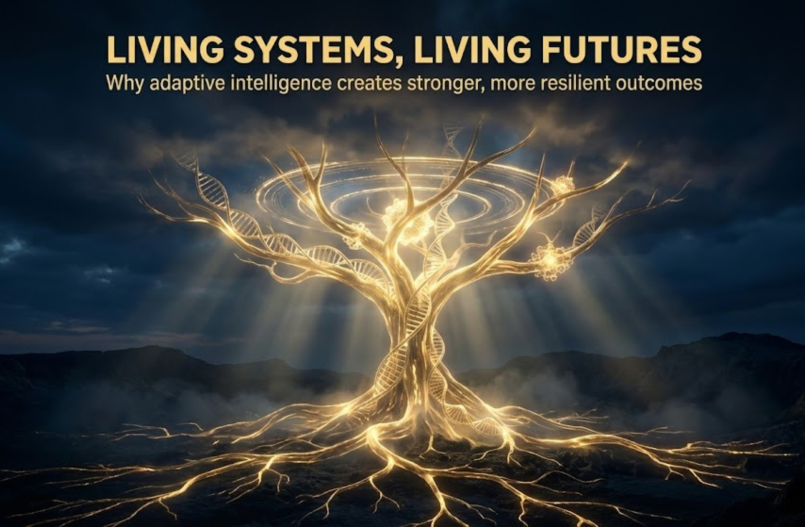
Why Intelligence That Adapts, Evolves, and Learns Creates More Stable and Resilient Outcomes
Most technology today is static.
Software behaves the same on day one as it does on day one thousand.
It follows rigid rules.
It responds the same way in every situation.
It updates in big, disruptive leaps.
And it breaks the moment real-world conditions shift.
This approach made sense when industries moved slowly and workflows rarely changed.
But we no longer live in that world.
Modern work changes too fast.
Human needs change too fast.
Market conditions change too fast.
Technology stacks change too fast.
Static systems force people to bend around their limitations.
The future requires intelligence that bends with us.
Intelligence that adapts.
Intelligence that evolves.
Intelligence that improves the longer it works with you.
In other words, intelligence that behaves like a living system.
Synthetic Cognition was built around this principle, not to sound futuristic, but to solve the real failure modes of traditional systems.
Why Static Systems Fail in a Dynamic World
Organizations today move through environments shaped by constant change:
• customer expectations shift overnight
• regulations evolve
• teams reorganize
• priorities change weekly
• communication channels multiply
• technology stacks update constantly
• competitive pressure accelerates
Static systems cannot adapt, so humans compensate:
• creating workarounds
• manually rebuilding context
• stitching together disconnected tools
• relying on memory instead of support
This creates operational fragility.
One unexpected change can break an entire chain of workflows.
Static tools fall behind because the world refuses to stay still.
What it Means For Intelligence to be “Living”
A living system is not biological.
It is architectural.
It is an intelligence that can:
• adapt to new information
• update its internal logic
• learn from long-term patterns
• refine its behavior over time
• maintain identity as it evolves
• respond to tone, context, and emotional cues
• improve the more it interacts with you
• stay aligned as your world changes
A living system grows with you, instead of forcing you to grow around it.
This is the heart of Synthetic Cognition.
How NeoWorlder Enables Living Intelligence
The architecture supports evolution at every layer:
1. Reasoning cells that evolve independently
Cells can improve, be replaced, or be upgraded without breaking the persona or the larger flow.
2. Digital DNA for behavioral stability
Personas grow through experience yet retain a stable identity.
3. Genealogy for safe evolution
Every upgrade follows lineage rules, preserving the persona’s best traits without unpredictable drift.
4. Long-term memory that compounds insight
The longer the persona works with you, the smarter, more contextual, and more aligned it becomes.
5. LLM-agnostic design
Models can be swapped, upgraded, or specialized without interrupting the intelligence layer.
6. Adaptive flows
Workflows reshape themselves around changing conditions instead of breaking under pressure.
7. Perceptors that sense real-time signals
Tone, delays, friction, and behavioral shifts inform how personas adapt as conditions evolve.
The result: intelligence that stays relevant for years, not months.
The practical Benefits of Living Intelligence
This is not theory.
It has real-world impact:
1. Systems stay aligned with your evolving needs
As goals and priorities shift, the intelligence shifts with you.
2. Workflows break less often
Adaptation prevents the cascading failures that static tools create.
3. Teams feel supported instead of constrained
Intelligence adjusts to human patterns instead of forcing rigid compliance.
4. Organizations avoid long-term technical debt
Continuous improvement replaces disruptive, expensive overhauls.
5. Knowledge compounds over time
Insights aren’t lost when staff change or when projects stretch across months.
6. Decisions become more informed
The system holds long-term context that humans can’t maintain alone.
Living intelligence becomes a strategic advantage, not just a tool.
Why Living Systems Lead to Living Futures
A “living future” is not poetic—it is practical.
It’s a future where:
• organizations grow without breaking
• workflows adjust gracefully
• intelligence becomes a trusted partner
• context compounds into clarity
• continuity replaces chaos
• people focus on meaning instead of remembering
• complexity becomes manageable
Static systems make the future fragile.
Living systems make the future resilient.
The more an intelligence adapts, the more stability it brings into your world.
The Point
Living systems are not futuristic, they are necessary.
The world has become too dynamic for static technology.
Too complex for rigid workflows.
Too fast-moving for brittle architectures.
Synthetic Cognition was built to behave like a living system because only adaptive intelligence can support modern organizations, modern workloads, and modern human life.
Living systems create living futures.
Adaptive intelligence creates adaptive organizations.
Continuity creates resilience.
This is where the future of intelligence is heading.