How Synthetic Cognition balances rapid improvement with long-term reliability
Innovation has always carried a cost.
Move quickly, and things break.
Slow down and progress stalls.
Most organizations still feel trapped in this old equation.
They want systems that evolve, but they also need systems they can trust.
They want new capabilities, but without new chaos.
They want momentum without instability.
Synthetic Cognition was designed to resolve this tension.
Its architecture allows intelligence to grow, adapt, and improve while keeping identity, memory, and workflows intact.
The balance between innovation and stability is not a convenience.
It is the foundation of the system.
The Limits of Traditional Innovation Cycles
Traditional systems update in bursts.
New versions.
Patches.
Migrations.
Rebuilds.
Each update brings risk.
Unexpected behavior.
Broken workflows.
Lost context.
Shifts in performance that people did not expect.
Moments of disruption that force teams to adjust.
For organizations at scale, these disruptions create hesitation.
Innovation slows because stability becomes the priority.
What begins as caution eventually turns into stagnation.
Why Synthetic Cognition Evolves Without Disruption
Synthetic Cognition was built to evolve continuously without losing the trust of the people who depend on it.
This comes from several architectural choices.
Reasoning Cells Evolve Independently
A single reasoning component can be improved without affecting the persona as a whole.
Innovation becomes incremental and safe.
Digital DNA Preserves Identity
Even as capabilities expand, the persona remains recognizable.
Users never feel like they are interacting with a stranger.
Genealogy Manages Controlled Evolution
Updates follow a lineage.
The persona grows the way a living system grows, not through sudden resets.
Memory is Preserved Across Improvements
The Living Record remains intact.
The system remembers the journey even as it becomes more capable.
LLM-Agnostic Design Protects the Future
Models can be upgraded or swapped without breaking context or behavior.
Adaptive Flows Absorb Change
Workflows adjust to new capabilities rather than collapsing under them.
Innovation becomes something that happens underneath the surface, continuously, quietly, responsibly.
The Experience for Users
Users do not feel disruption.
They feel improvement that blends into their existing rhythm.
They experience familiar behavior.
They see capabilities expand gradually rather than arriving as massive, destabilizing updates.
Their workflows stay intact.
There is no need to relearn the system.
Trust grows naturally because reliability becomes predictable.
Innovation becomes something users welcome rather than avoid.
The Experience For Organizations
Organizations gain a system that evolves without introducing chaos.
They get predictable behavior across personas.
Operational risk stays low.
Training burdens decrease.
Technical debt grows more slowly.
Governance becomes clearer because persona evolution is trackable and intentional.
Innovation becomes sustainable rather than disruptive.
Why This Balance Defines the Next Decade
The organizations that succeed during the next decade will rely on intelligence that can grow without breaking.
They will choose systems that can adapt without destabilizing teams.
They will demand platforms that become smarter without reinventing themselves every quarter.
The winners will be those who adopt intelligence that evolves like a living system rather than updating like old software.
Synthetic Cognition was built for this world.
The Point
Innovation alone is not enough.
Stability alone is not enough.
The future belongs to intelligence that can get better without forcing people to reset their habits, rebuild trust, or start from zero.
Synthetic Cognition achieves this by anchoring identity, preserving memory, and evolving intelligence in steady, controlled layers.
This is progress that feels natural.
Evolution that feels safe.
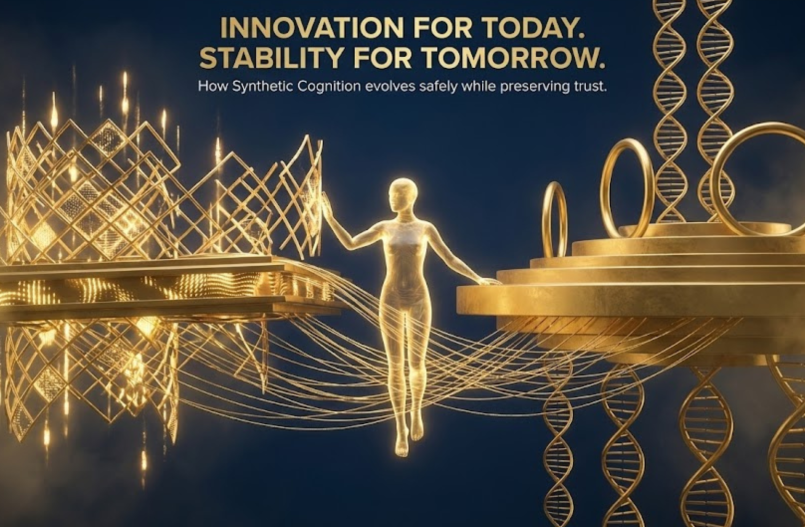
Innovation that feels human.Innovation for today.
Stability for tomorrow.