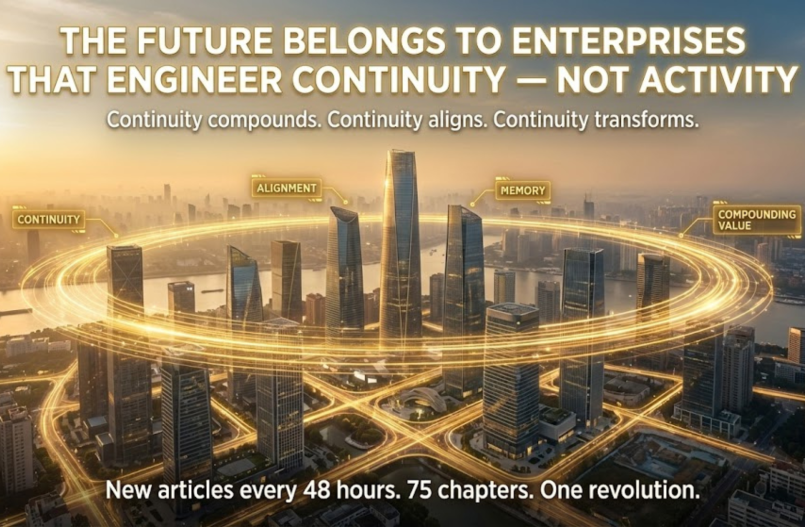
A clear look at how intelligence transforms from software into structure. Enterprises were never designed to think as one. Each department has its own tools. Each workflow has its own logic. Each customer interaction lives in its own system. Synthetic Cognition changes this.
It introduces a unified cognitive layer that sits above every system, carrying memory, context, reasoning, and action across the entire organization. This layer becomes the enterprise’s nervous system, sensing the environment, interpreting what matters, coordinating responses, and maintaining long-term continuity. Here is how the architecture works.
1. Perception: The Enterprise Finally Sees Itself
Perceptors serve as synthetic senses, always observing the signals that matter:
• shifting customer tone
• messages waiting for action
• contract changes
• timeline risks
• missing documents
• stalled workflows
• behavioral patterns
• escalation triggers
Perceptors give the enterprise something it has never had: situational awareness.
2. Memory: Context Becomes a Strategic Asset
The Living Record carries long-term understanding across the organization:
• decisions
• preferences
• in-progress workflows
• historical knowledge
• compliance requirements
• strategic intentions
• relationship insights
Enterprises stop losing context the moment someone changes roles, switches systems, or closes a ticket. Memory stops being a liability. It becomes infrastructure.
3. Reasoning: The Cognitive Layer That Makes Sense of Everything
NeuroFlow and reasoning cells interpret every signal in context:
• What is happening
• what should happen next
• what’s misaligned
• what’s at risk
• what needs escalation
• what needs to be done immediately
This is the first time an enterprise has a thinking layer not tied to any single tool. Reasoning becomes consistent, explainable, and aligned.
4. Action: Intelligence That Moves Work Forward
Activators allow personas to take meaningful, structured action:
• respond to customers
• update systems
• coordinate workflows
• generate artifacts
• schedule tasks
• notify stakeholders
• escalate risks
• maintain timelines
Action stops being reactive. It becomes intelligent.
5. Identity: The Unifying Behavior Layer
Digital DNA ensures every persona behaves consistently across:
• departments
• workflows
• industries
• stakeholders
Identity keeps reasoning, tone, decision-making, and boundaries stable. This brings coherence to organizations that have long operated as disconnected domains.
The Result: A Continuous Enterprise
When perception, memory, reasoning, action, and identity work together, something dramatic happens: The enterprise stops behaving like a collection of isolated tools and starts behaving like a single, aligned organism.
• Teams no longer chase updates
• Customers no longer re-explain themselves
• Projects no longer stall when someone leaves
• Leaders no longer make decisions without context
• Knowledge becomes persistent, not perishable
• Work gains momentum instead of starting over
The enterprise begins to think continuously.
Why This Is Not Automation
Automation executes rules. Synthetic Cognition interprets reality. Automation says: “If X happens, do Y.”
Synthetic Cognition says:
• Here is what’s happening
• Here’s why it matters
• Here’s what’s missing
• Here’s the right next step
• Here’s how to move forward
Automation is mechanical. Synthetic Cognition is cognitive.
Why This Is Not Integration
Integration connects data. Synthetic Cognition connects understanding. Enterprises have spent two decades wiring tools together, but connection is not continuity:
• integrated data ≠ shared memory
• shared fields ≠ shared reasoning
• synced updates ≠ aligned workflows
• API calls ≠ collaboration
Integration creates communication. Synthetic Cognition creates coherence.
How the Cognitive Nervous System Transforms Enterprise Outcomes
A continuous intelligence layer changes everything:
1. Customer relationships deepen: Memory follows the customer, not the ticket.
2. Projects move without friction: Context follows the workflow, not the person.
3. Decisions become clearer: Insight appears before issues escalate.
4. Teams stay aligned: Identity ensures predictable, stable behavior.
5. Risks surface earlier: Perceptors detect signals humans can’t see.
This is what happens when intelligence becomes structure rather than software.
The Enterprise of the Future Runs on a Cognitive Nervous System
Not dashboards.
Not workflows.
Not integrations.
Not scattered tools.
A unified cognitive layer that can:
• perceive
• remember
• reason
• act
• adapt
• collaborate
• evolve
This is Synthetic Cognition. This is the missing infrastructure enterprises have needed for decades. This is how work finally becomes continuous. This is how organizations begin to think. This is how intelligence becomes architecture.