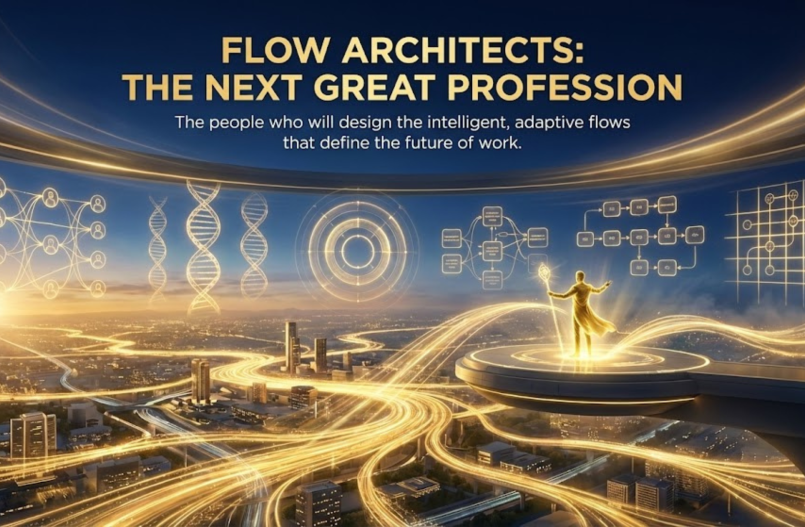
Why the Next Decade Belongs to Those Who Shape Intelligent, Adaptive Flows
Every major technological shift has created a new profession.
The rise of software created developers.
The rise of the internet created web designers.
The rise of data created analysts.
The rise of cloud created DevOps.
Each new layer of complexity demanded a new kind of mind.
Synthetic Cognition introduces the next layer — and with it, the next great profession.
Not a programmer.
Not a workflow designer.
Not an AI trainer.
Not a strategist or a project manager.
A Flow Architect.
Flow Architects design, govern, and evolve the intelligent flows that will run the next generation of organizations.
They understand continuity.
They understand context.
They understand how intelligence should move, reason, adapt, and collaborate.
In a world where work is fluid, nonlinear, and cognitively augmented, Flow Architects will become essential.
Why Organizations Need Flow Architects
Static systems cannot run modern companies.
Static roles cannot support dynamic environments.
Static tools cannot maintain continuity.
Organizations now require someone who understands:
• adaptive coordination
• cross-functional flows
• cognitive personas
• long-term memory
• identity-based intelligence
• perceptors and activators
• reasoning, logic, and tone
• human behavior under pressure
• business strategy in motion
No current profession covers all of this.
Flow Architects do.
The Core Responsibility: Designing Intelligent Flows
A Flow Architect doesn’t create workflows; they create living systems of intelligence.
They build flows using:
• perceptors that sense
• activators that take action
• reasoning cells that think
• Digital DNA that defines identity
• memory maps that preserve history
• skill architecture that shapes capability
• persona genealogy that governs evolution
• on-chain notarization when stability matters
• LLM-agnostic logic to ensure longevity
• safety and oversight structures
• multi-persona collaboration
Flows stop being documents.
They become cognitive.
They become aware.
They become adaptive.
They become continuous.
And Flow Architects are the ones who shape them.
What Flow Architects Actually Do
Flow Architecture sits at the intersection of:
• business design
• human psychology
• system reasoning
• enterprise operations
• intelligence governance
• cross-functional communication
• experience design
A Flow Architect:
1. Maps the real flow of work
Not what teams think happens — what actually happens.
2. Identifies where continuity breaks
They pinpoint the invisible friction behind:
• delays
• missed handoffs
• repeated questions
• lost context
• inconsistent decisions
3. Designs personas for each flow
Each persona gets:
• its own identity
• its own memory boundaries
• its own perceptors
• its own activators
• its own reasoning skill stack
4. Engineers persona collaboration
Flows often require multiple personas working together.
The Flow Architect defines:
• handoff rules
• shared memory scopes
• communication tone
• cross-flow alignment
5. Ensures safety and governance
They define boundaries:
• what personas may do
• what they must escalate
• what they should avoid
• how they evolve safely
6. Continuously refines flows
Flows evolve with:
• market changes
• organizational shifts
• new product lines
• team growth
• operational complexity
The Flow Architect becomes the steward of ongoing intelligence.
Why This is a Category-Defining Opportunity
Every company will adopt Synthetic Cognition.
When they do, they will need someone to:
• design the intelligence
• guide its evolution
• shape its reasoning
• align it with human goals
• adapt it as the organization changes
This is not workflow design.
This is not automation.
This is not traditional AI development.
It is the architecture of human–synthetic collaboration at scale.
And it will become one of the most valuable professions of the next decade.
What Makes a Great Flow Architect
Flow Architects are:
• strategic thinkers
• empathetic observers
• system designers
• pattern recognizers
• translators between people and intelligence
• natural storytellers
• operational problem-solvers
They understand people.
They understand complexity.
They understand how intelligence should behave.
They see the organization not as a chart, but as a living flow.
The Career Path That Didn’t Exist Until Now
Flow Architects will become:
• the next generation of operational leaders
• the designers of enterprise intelligence
• the guardians of continuity
• the architects of cognitive ecosystems
• the innovators of new business models
Within a decade, Flow Architecture will stand alongside:
• data science
• cybersecurity
• product management
• AI strategy
• cloud architecture
as a defining skill set for competitive organizations.
Companies that adopt Flow Architects early will operate at a level others cannot match.
The Future of Work Belongs to Flow Architects
Organizations are shifting from:
• tasks → flows
• roles → continuity
• automation → cognition
• departments → cross-functional ecosystems
• tools → synthetic partners
• memory gaps → unified intelligence
Flow Architects will define this transformation.
They will design the cognitive nervous system of tomorrow’s enterprises.
They will shape how human and synthetic intelligence collaborate.
They will build the infrastructures that make companies adaptive, resilient, and continuously evolving.
The era of Flow Roles has begun. The era of Flow Architects will lead it.