How Synthetic Cognition Defines, Protects, and Evolves the Core of Every Persona
Every living system begins with a blueprint. In biology, DNA dictates how an organism grows, adapts, and expresses its abilities. It sets boundaries, shapes potential, and ensures change never leads to chaos.
Synthetic Cognition follows the same principle.
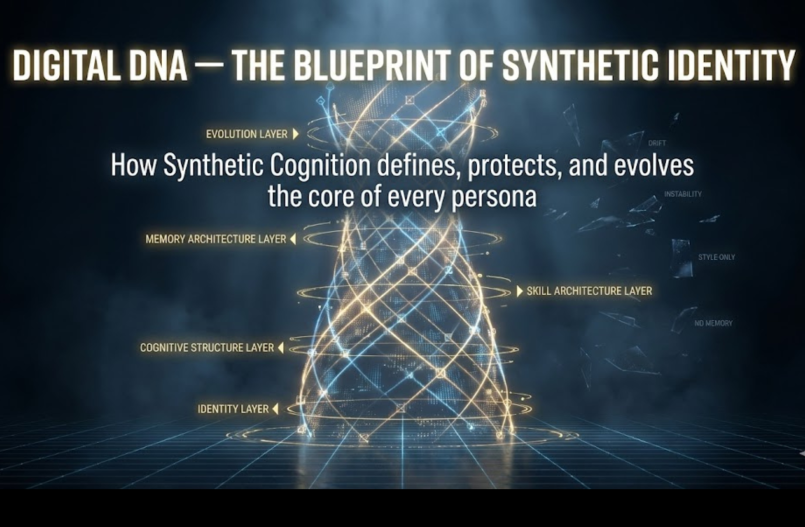
Every persona is anchored in a blueprint called Digital DNA: a structured identity layer that defines who the persona is, how it thinks, what it remembers, and how it evolves. It keeps intelligence grounded even as the world shifts around it.
Digital DNA makes growth intentional instead of accidental, coherent instead of chaotic, and reliable instead of unpredictable. It is the core that gives every persona a stable sense of self.
Why Intelligence Needs a Blueprint
Traditional AI behaves like a brilliant mind with no identity. Its reasoning shifts between responses. Its behavior changes with randomness and model updates. Its memory does not persist. Its decisions drift.
This unpredictability is why most AI systems remain useful only in isolated tasks, never in long-term operations, workflows, or relationships. Digital DNA solves this by defining a personas:
- Identity
- Memory structures
- Reasoning patterns
- Skill architecture
- Communication style
- Domain boundaries
- Escalation logic
- Evolution rules
It gives intelligence something it has never had before: a stable foundation.
What Digital DNA Contains
Digital DNA is composed of several interconnected layers. Together, they form the persona’s identity and cognitive structure.
1. The Identity Layer
This defines who the persona is.
- Name
- Mission
- Role
- Tone and voice
- Purpose
- Domain focus
- Boundaries of authority
Identity creates consistency. It determines how the persona shows up every day.
2. The Cognitive Structure Layer
This defines how the persona thinks.
- Linked reasoning cells
- Prioritization rules
- Context evaluation patterns
- Decision-making logic
- Interaction habits
- LLM choices for different cognitive tasks
This is the persona’s internal logic: stable, structured, and predictable.
3. The Skill Architecture Layer
This defines what the persona can do.
- The list of skills
- Which reasoning cells does each skill uses
- What tools can each skill access
- Memory maps assigned to skill steps
- Expected outputs
- Escalation or fallback rules
Skills are capabilities. Digital DNA defines them with precision.
4. The Memory Architecture Layer
This determines what the persona remembers and how.
- Long-term identity memory
- Domain-specific memory
- Preference memory
- Role memory
- Adaptive short-term memory
- Secured or restricted memory maps
This layer creates continuity, the ability to carry context forward across days, weeks, or years.
5. The Evolution Layer
This governs how the persona grows over time.
- Which skills can evolve
- Which reasoning cells can be replaced
- What must remain stable
- What data can it learn from
- What data must it ignore
- Governance controls and safeguards
- Versioning and lineage across generations
Evolution becomes intentional, controlled, and safe. Digital DNA is stored at the platform level, not inside a single model, which allows personas to survive model changes and technological upgrades without losing their identity.
Why Digital DNA Makes Personas Resilient
Because identity and cognitive structure are separated from the underlying LLM, personas can:
- Migrate to new models
- Add or refine skills
- Upgrade reasoning cells
- Change communication styles
- Adjust workflows
- Restore previous versions
- Evolve without drifting
Traditional personas die when the model changes. Synthetic Cognition personas persist. This is how intelligence becomes long-lived.
Digital DNA Enables Real Explainability
In monolithic AI systems, you cannot see why a decision was made. Everything happens inside one black box.
Digital DNA changes this.
Because each layer is explicit, you can trace:
- Which reasoning cells fired
- What memory did they reference
- What rules guided the decision
- What skill was invoked
- What tools were used
- How context was processed
- Why a particular action was chosen
This transforms AI from an opaque system into an auditable one. Governance becomes possible. Trust becomes natural.
Digital DNA Allows Persona-to-Persona Collaboration
Personas built on Digital DNA can collaborate because their structures are compatible.
They can:
- Pass information safely
- Share context
- Coordinate workflows
- Hand off tasks with continuity
- Align identity and memory rules
- Evolve in parallel
This creates an ecosystem of interoperable intelligences — a digital workforce rather than a single assistant overloaded with everything.
Digital DNA Prevents Drift
Over time, unstructured AI behavior degrades. Tone shifts. Decisions become inconsistent. Reasoning becomes unpredictable. Digital DNA prevents this by enforcing:
- Identity consistency
- Stable reasoning patterns
- Memory constraints
- Domain boundaries
- Behavioral expectations
- Skill-specific logic
Evolution becomes guided, not accidental. Intelligence remains clear, stable, and trustworthy.
Digital DNA: The Foundation of Evolvable Intelligence
Every persona begins with a blueprint.
Every iteration strengthens it.
Every generation expands its capability.
Just like biological DNA evolves through lineage, Digital DNA evolves through version-controlled updates. This allows personas to:
- Learn new workflows
- Acquire new reasoning cells
- Evolve capabilities safely
- Adapt to new industries
- Refine communication
- Improve decision-making
- Stay aligned with humans
Synthetic Cognition is not about static tools. It is about living, evolving systems. Digital DNA is the foundation that makes this possible.