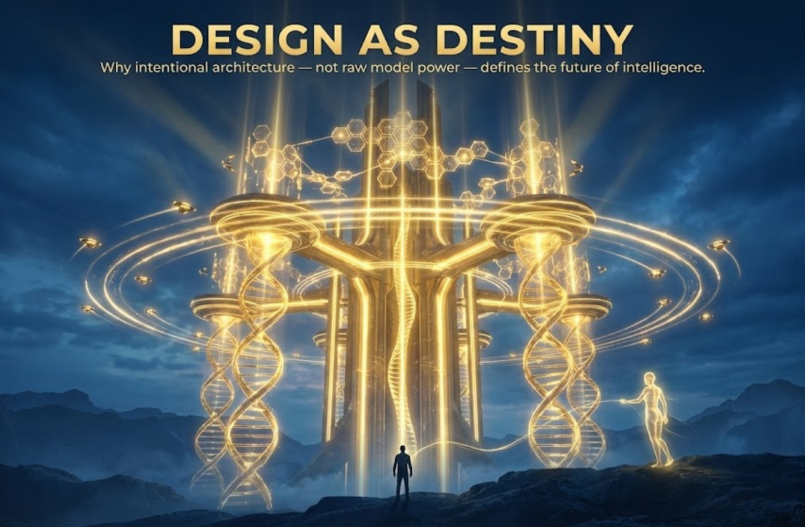
How Architecture Shapes Behavior, Trust, and the Long-Term Usefulness of Intelligence
When people talk about AI, the conversation almost always fixates on the model.
Bigger models.
Faster models.
More parameters.
More benchmarks.
But the destiny of an intelligent system is not determined by its size.
It is determined by its design.
Architecture becomes behavior.
Behavior becomes experience.
Experience becomes trust.
And trust determines whether an intelligence becomes part of someone’s life, or something they try once and abandon.
This is why intentional design matters.
Not as a philosophical stance, but as a practical foundation for intelligent people to rely on every single day.
Raw Power vs Designed Intelligence
A model can be incredibly powerful and still fail to be useful.
Without strong architecture around it, AI begins to:
• forget
• misread context
• react inconsistently
• lose track of goals
• produce unpredictable output
• provide results that feel different from moment to moment
Raw intelligence without design becomes unpredictable intelligence.
Intentional design turns potential into reliability.
Architecture Defines Behavior
Every layer of Synthetic Cognition exists because the structure determines how an intelligence behaves:
• Digital DNA shapes identity
• Reasoning cells shape decision-making
• Memory maps shape what is remembered and why
• Perceptors shape what signals get noticed
• Activators shape what the persona can do
• Genealogy shapes safe evolution
• LLM-agnostic cells shape long-term flexibility
• The Living Record shapes continuity across time
These are not optional features.
They are the behavioral foundations of intelligence.
Just as the layout of a city shapes how people move, the architecture of a cognitive system shapes how it thinks.
The Cost of Unintentional Design
Without intentional design, intelligent systems drift into patterns that undermine trust.
They become:
• reactive instead of thoughtful
• inconsistent instead of predictable
• fragmented instead of continuous
• overly complex instead of clear
• surprising instead of stable
This isn’t because the model is flawed.
It’s because the system surrounding it isn’t giving it structure.
Unintentional design leads to:
• confusing tools
• broken workflows
• misaligned recommendations
• context loss
• user frustration
• abandonment
Design determines whether intelligence clarifies or complicates life.
The Value of Intentional Design in Synthetic Cognition
Synthetic Cognition was built on the belief that intelligence must operate inside thoughtful, human-centered structure.
It is intentional about:
• how memory behaves
• how context flows
• how decisions are made
• how tone adapts
• how personas evolve safely
• how identity stays consistent
• how long-term goals persist
• how skills connect
• how follow-through works
• how safety is enforced
This is what creates intelligence that feels stable instead of chaotic, reliable instead of random.
Not because the model is “perfect,” but because the design supports the intelligence with clarity and purpose.
Design Choices That Shape Behavior
1. Memory Maps
Design: Give each reasoning cell its own memory reference.
Outcome: Cells think with relevant context, not global noise.
2. Digital DNA
Design: Encode identity at the architectural level.
Outcome: Stable personality instead of unpredictable tone shifts.
3. Genealogy
Design: Evolve personas through controlled lineage.
Outcome: Safe improvement without losing what made them effective.
4. LLM-Agnostic Cells
Design: Allow each cell to use the right model for the right task.
Outcome: Adaptability without vendor lock-in.
5. Perceptors + Activators
Design: Separate sensing from acting.
Outcome: Cleaner reasoning, more reliable execution.
Every design choice shapes the intelligence that emerges.
Design as Responsibility
As AI becomes more capable, design becomes more important.
Systems without intentional structure drift into:
• confusion
• inconsistency
• misalignment
• surprising behavior
• long-term instability
Good design is not about restricting intelligence.
It is about giving it clarity.
Design sets expectations for:
• how intelligence behaves
• how it adapts
• how it communicates
• how it evolves
• how it supports people
• how it remains trustworthy over time
Humans need predictability.
Design creates it.
The Future Belongs to Well-Designed Intelligence
As AI evolves, the gap between poorly designed systems and well-designed systems will widen dramatically.
Poor design will feel chaotic.
Good design will feel calm.
Poor design will create friction.
Good design will reduce cognitive load.
Poor design will impress in demos.
Good design will support people in real life.
Raw intelligence gets attention.
Intentional intelligence earns trust.
The Point
The destiny of an intelligence system is set long before the first user interaction.
It is set in the design.
When design is intentional, intelligence becomes:
• stable
• understandable
• consistent
• helpful
• aligned
• dependable
• long-lasting
This is why Neoworlder invests so deeply in architecture. Because design shapes behavior.
Behavior shapes trust.
And trust shapes the future of intelligence.