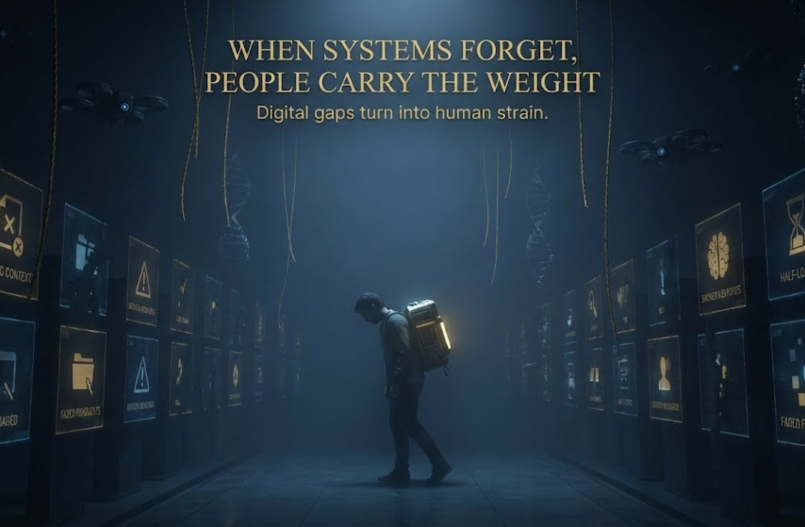
A clear look at how digital forgetfulness increases emotional load, cognitive burden, and daily friction
Forgetfulness in technology is often treated as a small inconvenience.
A minor flaw.
A tiny moment of friction in the flow of daily life.
But for real people, forgetfulness in digital systems carries a cost.
Sometimes it is subtle.
Sometimes it is invisible.
Sometimes it only becomes obvious during stressful seasons.
Yet the cost is always there.
Every time a system forgets something meaningful, the user is forced to carry the memory instead.
The burden shifts from the software to the human.
And over time, that burden becomes heavier than anyone expects.
This article is not a critique of old tools.
It is a clear explanation of what forgetfulness forces people to hold, and why intelligence that remembers makes life feel lighter in ways traditional software could never reach
The Quiet Burden of Digital Forgetfulness
Most people never complain when a system forgets something important.
They have been trained to work around it.
They take the responsibility on themselves.
They remember
What they told the system yesterday
Which file held the correct version
The details they entered last week
The conversation that shaped the decision
Why a task mattered in the first place
the steps that were supposed to follow
The nuance that software never captured
The handoff that happened during a meeting
Every gap in memory becomes a gap the user must fill with their own mind.
Forgetful systems create cognitive debt.
The Real Cost: Life Becomes Harder Than It Needs To Be
Digital forgetfulness increases emotional and mental load quietly.
People begin to experience
repeated explanations
avoidable confusion
lost threads
re-created work
missed details
unnecessary errors
frustration
decision fatigue
a sense of instability
fear that something important is slipping
People assume they are disorganized.
But often, the systems around them fail to remember enough to truly support them.
The forgetfulness becomes their burden to carry.
How Forgetful Systems Change Human Behavior
When people cannot trust a system to remember, their behavior shifts.
They over-document everything.
They keep duplicate notes just in case.
They hesitate to delegate because context might get lost.
They double-check simple details.
They rehearse tasks mentally.
They keep too much in their head.
They stay reactive instead of strategic.
Forgetfulness creates fear.
Fear creates overcompensation.
Overcompensation creates exhaustion.
This is the emotional cost people pay without even realizing it.
The Workplace Impact Is Just as Significant
Inside teams, forgetfulness creates ripple effects.
misaligned priorities
repeated meetings
fractured project threads
lost customer context
inconsistent follow-through
breakdowns under pressure
higher supervision
lower trust
Processes try to fix it.
Employees try to fix it.
Leaders try to fix it.
But the real cause is simple.
Systems forget what humans assumed they would remember.
Why Intelligence Changes the Experience Completely
When intelligence carries memory instead of the user, people receive something they have rarely felt from software.
Stability.
A sense that the past is still present.
A feeling that their words mattered.
A quiet trust that nothing important will disappear.
Memory in intelligence gives people
continuity
clarity
predictability
emotional safety
reduced cognitive load
smoother transitions
better decisions
more consistency
less anxiety
People feel supported instead of strained.
The Principle That Emerged From Our Work
Across thousands of interactions, one truth became impossible to ignore:
People do not need software to be brilliant.
They need software to remember what matters to them.
Forgetfulness is not neutral.
It pushes emotional and cognitive responsibility onto the user.
Remembering is not a convenience.
It is a form of care.
When a system remembers, the user can finally let go.
That is the difference between working with tools and working with intelligence.
The Broader Implication: Support Should Not Require Extra Effort
The future of technology should not require people to
rebuild context
repeat themselves
micromanage workflows
fear that something will be lost
remember every detail forever
Support should come naturally.
Memory should be expected.
Continuity should be the default.
Intelligence should lighten the load, not increase it.
The Point
When systems forget, people pick up the burden.
They stretch themselves to fill the gaps.
They absorb friction and cognitive overload quietly.
They carry stress that does not belong to them.
When intelligence remembers, that burden finally disappears.
People feel
lighter
calmer
more effective
more secure
more capable
more understood
Forgetfulness always has a cost.
People have been paying it for a long time.
It is time for systems to carry their share of the load.