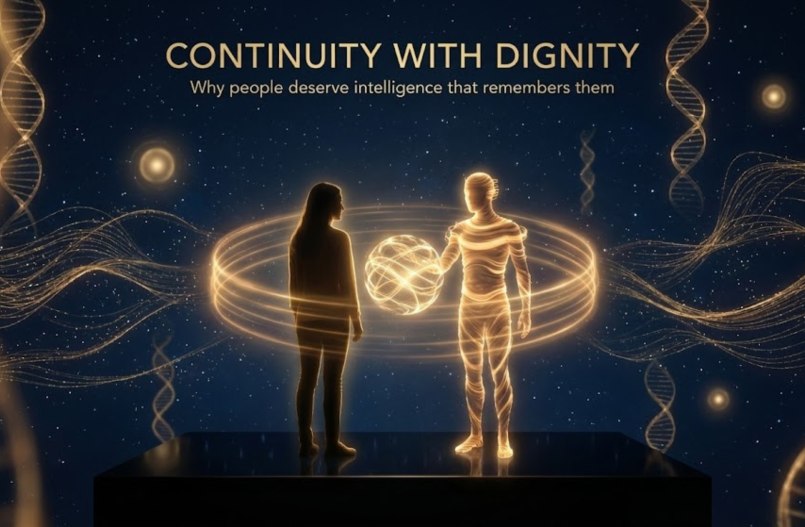
A human explanation of why memory is not a feature, but a form of respect
Most people think of memory in technology as a convenience.
A shortcut.
A quality-of-life enhancement.
A way to save time or personalize an experience.
But the more we watched real people interact with intelligence, the more something deeper became clear.
Memory is not just functional.
Memory is dignifying.
People feel more human when they are remembered.
They feel more grounded.
They feel more understood.
They feel less alone.
They feel like their efforts and their words matter.
And when technology forgets them, the opposite is true.
It makes them feel replaceable.
Invisible.
Forced to reintroduce themselves to a system that should already know them.
Continuity is not efficiency.
Continuity is dignity.
The Quiet Cost of Being Forgotten by Technology
Every day, people experience small but draining moments of digital forgetfulness:
• repeating themselves
• retyping basic information
• re-explaining preferences
• rebuilding context after brief interruptions
• reminding systems of who they are
• starting from zero every time they return
These moments aren’t dramatic.
But they carry emotional weight.
Each lapse is a tiny signal that says, “You don’t matter enough to be remembered.”
Even if people never say it out loud, forgetfulness chips away at their emotional experience.
Why Continuity Matters More Than Efficiency
When intelligence remembers your words, your tone, your stress level, your long-term goals, your preferences, your commitments, something shifts.
The interaction stops feeling like a transaction.
It starts feeling like a relationship.
People do not need perfect intelligence.
They need steady intelligence.
Someone, or something, that stays with them.
Continuity is not about storing data.
It is about holding meaning.
The Moment Everything Became Clear
During early testing, a persona gently reminded someone of something they said days before.
It wasn’t critical.
It wasn’t complex.
It was simply remembered.
The user paused and whispered:
“It feels like someone actually listened.”
That moment changed everything.
Continuity wasn’t making the system smarter.
It was making the user feel respected.
Remembering is a form of care.
Care is a form of dignity.
Why Forgetful Systems Feel Dehumanizing
People are used to software forgetting them, but accustomed does not mean acceptable.
Forgetful systems create emotional friction:
• “Why am I starting over again?”
• “Why does this system not know me?”
• “Why does this feel like my job, not the system’s job?”
When systems forget, people compensate.
They become the memory.
They carry the burden.
They shrink themselves to fit software that cannot hold context.
It is quiet harm.
But it is harm all the same.
How Continuity Restores Dignity
Continuity gives people:
- Stability — the system carries the thread, not the human.
- Emotional safety — no fear of being misunderstood again.
- Confidence — nothing important falls through the cracks.
- Agency — less time explaining, more time progressing.
- Identity reflection — the system grows with who they are becoming.
- Respect — their past matters because they matter.
Continuity honors the effort people bring to their lives.
Why Memory Is the Architecture of Dignity
Synthetic Cognition is built on:
• a stable identity
• a living memory
• context-aware evolution
Remove memory, and identity collapses.
Remove memory, and evolution becomes chaos.
Remove memory, and continuity disappears.
Without continuity, intelligence becomes cold —
just another tool that forgets the person using it.
Memory is what makes intelligence human-compatible.
The Practical Benefits Are Just as Important
When intelligence remembers:
• workflows smooth out
• conversations feel natural
• decisions get clearer
• people feel calmer
• mistakes shrink
• trust expands
• emotional energy stabilizes
Dignity creates better outcomes.
Not by magic — by removing the weight people were never meant to carry.
The Broader Truth: People Deserve to Be Known
Most systems treat people like transactions.
Synthetic Cognition treats people like ongoing stories.
A story deserves continuity.
A person deserves dignity.
A life deserves to be remembered.
Technology should not make people feel small.
It should make them feel understood.
The Point
Continuity with dignity is not a feature.
It is a principle.
People deserve intelligence that:
• remembers them
• respects their time
• carries their intentions
• preserves their story
• helps them feel seen, not forgotten
Forgetful systems dehumanize quietly.
Intelligent systems dignify quietly.
And dignity is the real foundation of trust.
If you want, I can also create:
• A cinematic X thread
• A LinkedIn version
• A short-form video script
• A compressed version for a keynote speech
Just tell me which one you want next.