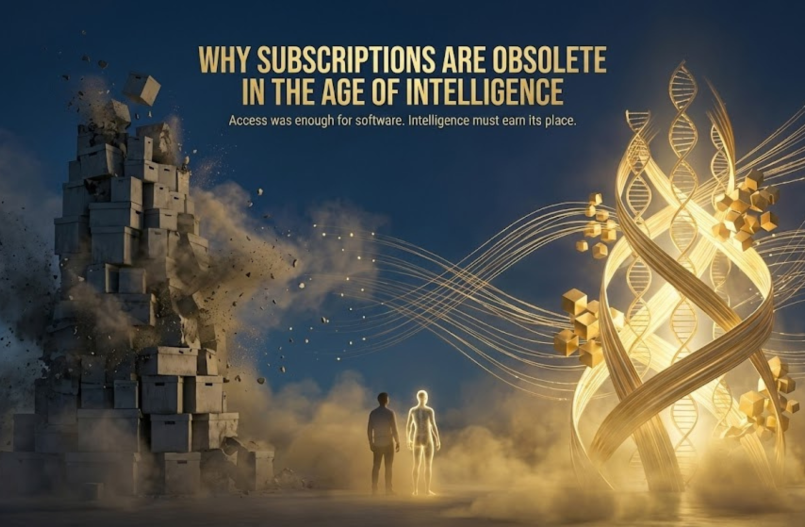
A practical and human look at why the old economic model no longer matches how value is created
For decades, the subscription model shaped the entire software industry.
It made sense for its time.
Products were static.
Features changed slowly.
Value came from access, not adaptation.
If you paid every month, the tool stayed available.
If you stopped paying, it disappeared.
Subscriptions brought predictability for companies and clarity for customers.
But they were designed for an era when software behaved the same on day one as it did on day one thousand.
Intelligent systems do not work this way.
They learn.
They adapt.
They remember.
Their value changes from day to day because their capabilities change from day to day.
A static payment model cannot match a dynamic intelligence.
This is why subscriptions feel increasingly out of place.
They were built for tools.
They were not built for partners.
Whysubscriptions No Longer Reflect Real Value
Subscriptions charge for access.
But in the age of intelligence, access is not where value comes from.
Value comes from performance.
Value comes from continuity.
Value comes from adaptive reasoning that supports outcomes.
Value comes from follow-through that compounds over time.
When intelligence becomes a system that works alongside you, the old math collapses.
A flat monthly fee cannot reflect the ebb and flow of real contribution.
Some months the system works lightly.
Other months it carries an enormous amount of cognitive load.
Yet the price stays the same.
Subscriptions charge for potential.
Intelligence delivers measurable impact.
These two ideas do not fit together anymore.
Where Subscriptions Break Once Intelligence Becomes Continuous
Intelligent environments expose the weaknesses of the subscription model.
- Value is uneven
Real life changes. The help you need changes. Subscriptions do not account for intensity, depth, or importance. - Usage is a misleading metric
Light usage can produce huge outcomes. Heavy usage can produce almost nothing. Access does not guarantee progress. - Intelligence compounds
As memory builds and understanding deepens, the system does more. Subscriptions ignore the curve. - Customers want aligned incentives
People want systems that win only when they win. Subscriptions charge even when nothing meaningful happens. - Enterprises demand proof
Procurement now requires demonstrable ROI. A monthly bill cannot justify itself without real performance.
Subscriptions assume that the existence of software equals value.
Intelligence proves this assumption false.
Outcome-Based Value is the Natural Replacement
Intelligence creates value in ways that can be measured.
It delivers results like:
• Recovered opportunities
• Actionable recommendations
• Improved accuracy
• Faster workflows
• Lower cognitive load
• Higher conversion
• Better customer experience
• More consistent execution
• Fewer mistakes
Outcome-based value aligns what users pay with what the system accomplishes.
It creates a shared incentive.
If the persona performs, the creator earns.
If it does not, the cost adjusts.
This is not just fair.
It builds trust.
Why Subscriptions Do Not Fit the Future of Intelligence
Subscriptions treat software like utilities.
Keep paying, or the lights turn off.
Intelligence functions differently.
It behaves like a teammate.
It adapts to your style.
It evolves with your goals.
It becomes more valuable with each interaction.
Partners do not charge for access.
Partners contribute and earn based on the contribution.
The economics must evolve with the role intelligence now plays.
Why Users Benefit When Subscriptions Disappear
The end of subscriptions gives people:
• lower financial risk
• no paying for features they never use
• clear alignment between cost and progress
• the freedom to experiment
• pricing tied to what the system actually achieves
• a sense that value is earned, not assumed
• ongoing improvement without arbitrary price hikes
The shift moves pressure away from the user and onto the intelligence itself.
It must perform.
It must deliver.
It must prove its worth.
This is the way it should be.
Why Enterprises Benefit Even More
Organizations gain:
• cost tied directly to ROI
• better forecasting
• less waste from unused licenses
• fewer renewal battles
• stronger adoption from internal teams
• greater accountability across vendors
• lower operational risk
Outcome-based intelligence turns procurement into a value conversation, not a licensing negotiation.
What Replaces Subscriptions
New models emerge once intelligence becomes adaptive:
Outcome-based billing
Pay only when work is done, or value is delivered.
Performance-linked incentives
Creators earn when personas achieve meaningful results.
Verified contribution
Memory trails, logs, and smart contracts confirm what the system accomplished.
Adaptive pricing curves
Cost reflects the depth, continuity, and long-term support the intelligence provides.
This is a more honest economy.
It is transparent.
It is fair.
It aligns with human priorities.
The Larger Economic Shift
Subscriptions thrived in a world where:
• The software was static
• Users carried the memory burden
•Progress was hard to measure
• Value lived in features
• Context was lost between sessions
Intelligence changes every one of these assumptions.
It adapts.
It evolves.
It collaborates.
It compounds.
It carries continuity.
It contributes to real outcomes over time.
People no longer pay to access tools.
They pay for results.
The Point
Subscriptions were right for the world they came from.
They are not right for the world we are entering.
In the age of intelligence:
Access does not equal value.
Usage does not equal progress.
Potential does not equal outcome.
People want systems that earn their place in their lives and businesses.
Enterprises want technology that proves its contribution.
Intelligence wants to be measured on the work it actually performs.Subscriptions are becoming obsolete for a simple reason.
The world has changed.
And the value of intelligence is no longer assumed.
It is delivered.
It is measurable.
It is earned.