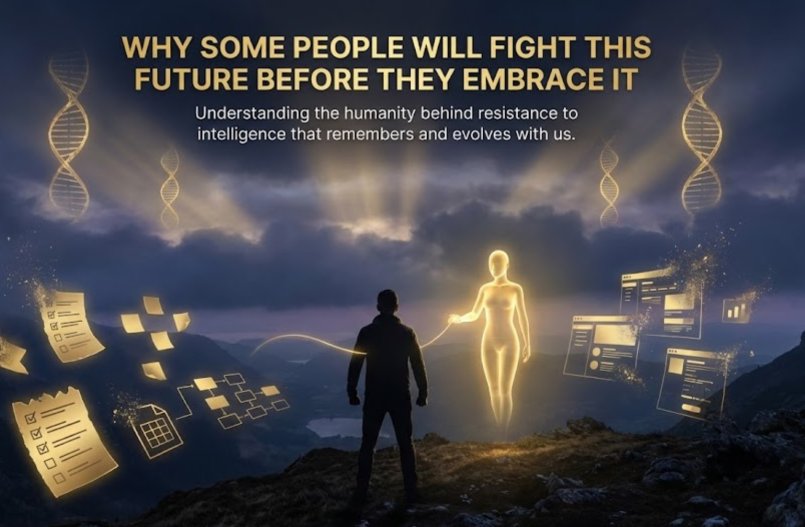
A real look at why resistance is a natural part of adopting intelligence that remembers, adapts, and evolves with us
There is a quiet truth about the future of intelligence that people rarely voice.
Some individuals will resist it.
Not because they fear innovation.
Not because they distrust technology.
Not because the systems are unfamiliar or unsafe.
They resist because the future asks them to release something deeply human: the belief that they must carry everything alone.
For years, people have relied on habits and tools that helped them survive overwhelming workloads.
Even when those tools created strain, they felt predictable.
Even when the systems were brittle, they felt familiar.
Even when the burden was heavy, it still felt like their burden to hold.
The first reaction to something truly new is not enthusiasm.
It is protection.
And that reaction is human.
The instinct to hold on to the familiar
Before people embrace a new way of working, they cling to what kept them steady in the past.
This looks like resistance, but it is really self-preservation.
They quietly wonder:
• Will this change how I work?
• Will I still feel capable?
• Will I lose control?
• Will I feel behind?
• Will others adapt faster than I do?
These questions are not about the technology.
They are about the stability people hope to keep.
The human mind reaches for the familiar, even when the familiar is no longer serving them.
Doubt before acceptance
People do not want promises. They want proof.
They look for:
• consistency
• clarity
• continuity
• reliability
• steady behavior
If any of these feel uncertain, they pull back.
This is not rejection.
It is a request for reassurance.
Feeling exposed
No one talks about this part.
When intelligence remembers, adapts, and follows your goals across time, it becomes difficult to hide how much effort you have been spending to keep everything together.
People begin to see:
• how much context switching drains them
• how often they repeat themselves
• How many tasks slip through cracks
• How fragile their own systems truly are
This is uncomfortable.
It shines a gentle light on the exhaustion we have normalized.
The future does not expose shortcomings.
It exposes how much weight people have been carrying.
The Moment the System Proves Itself
Every person has a turning point.
It usually arrives quietly.
• A persona recalls something they forgot.
• A workflow continues without being re-explained.
• A handoff happens smoothly.
• A goal resurfaces at the right moment.
• A conversation carries context across channels.
These moments feel small, but they land deeply.
Someone is finally helping carry the load.
This is when the future stops being theoretical and starts becoming support.
Relief Replaces Resistance
Once people feel continuity in action, something shifts.
They realize:
• They do not need perfect memory
• They do not need to hold every thread
• They do not need to rebuild context daily
• They do not need to manage their tools as much as their lives
• They do not need to feel guilty for forgetting something human
The future becomes lighter.
The resistance softens.
The experience becomes something they can trust.
The Point When People Take Ownership
Then people begin saying things like:
• This makes sense now.
• I feel more stable.
• I did not expect this to help in this way.
• This keeps me aligned.
• I am less overwhelmed than I used to be.
They stop fighting the future.
They start welcoming it.
Trust forms naturally when intelligence remembers you.
And trust dissolves the need to resist.
What This Reveals About People
Individuals do not resist the future because the future is wrong.
They resist because they fear being left behind by change.
They resist because they want to feel safe.
They resist because they want to understand.
They resist because they want room to adapt in their own time.
The future is not adopted all at once.
It is adopted gradually.
It becomes real when people feel that intelligence is walking with them, not replacing them.
The Point
Some people will fight this future before they embrace it.
Not because the future is threatening, but because change is a negotiation between who we have been and who we are becoming.
The turning point arrives when people realize the future is not asking them to carry more.
It is offering to help carry what they were never meant to hold alone.That is when resistance fades.
That is when adoption begins.
That is when the future finally feels human.