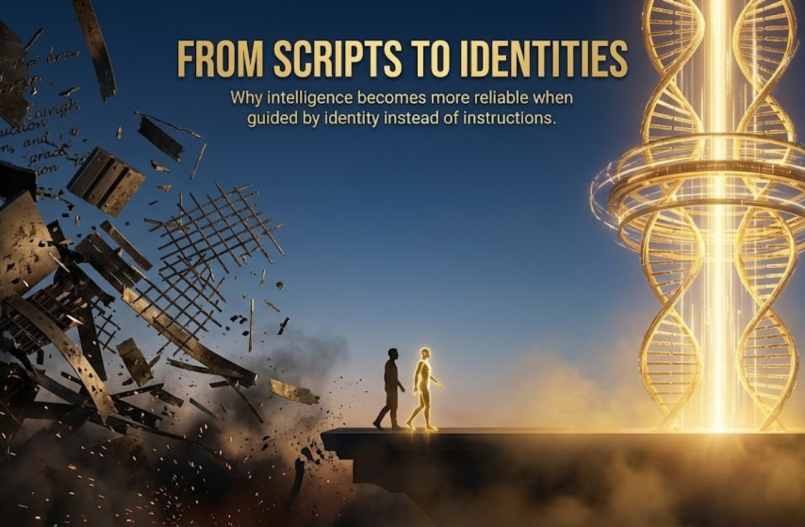
Why is intelligence more reliable when behavior is shaped by identity instead of fixed instructions
For decades, automation was built on scripts.
A script says:
When this happens, do that.
If the user clicks here, respond there.
If the workflow reaches step three, move to step four.
Scripts created predictable outcomes. They worked well in controlled environments. They made sense for machines.
But they do not make sense for intelligence.
People do not operate through scripts.
They operate through identity.
Identity shapes how a person communicates.
Identity shapes how someone behaves when life becomes messy or uncertain.
Identity carries intention, reasoning, tone, boundaries, and instinct through every moment.
Synthetic Cognition brings that same philosophy into intelligent systems.
Instead of programming personas to follow rigid sequences, we give them identities defined by Digital DNA.
Identity becomes the anchor that guides how a persona reasons, adapts, responds, and maintains consistency across time.
This simple shift creates intelligence that feels steadier, safer, and far more capable in the real world.
Why Scripts Fall Apart in Real Life
Scripts assume the world is predictable.
The world rarely agrees.
Scripts break when:
• a user changes course mid-task
• new information arrives out of order
• tone shifts in a conversation
• multiple workflows overlap
• priorities change without warning
• a request contains ambiguity
• something happens that no one ever planned for
Scripts require the world to follow the plan.
Identity allows the system to handle the world as it actually is.
Why Identity Creates More Reliable Intelligence
Identity is not a list of instructions.
Identity is a foundation.
It defines how a persona:
• communicates
• reasons
• interprets tone
• handles uncertainty
• adapts to context
• prioritizes decisions
• understands what matters
• maintains consistency across time
With identity, personas do not need a script for every possibility.
They have a structure that supports judgment.
A persona can adjust tone without a predefined rule.
It can navigate incomplete instructions.
It can make decisions anchored in long-term goals, not just immediate triggers.
It can stay steady when the workflow becomes chaotic.
Identity creates resilience, where scripts create fragility.
How Digital DNA Makes This Possible
Digital DNA is the architecture that defines persona identity.
It shapes:
• communication style
• values
• reasoning preferences
• escalation rules
• tone boundaries
• problem-solving behavior
• stability across time
• how a persona grows safely
This gives personas something scripts never could:
A sense of character.
Not personality for entertainment.
Character for stability.
Instead of predicting every scenario, Digital DNA prepares personas to handle whatever scenario appears.
Identity-Based Intelligence in Action
When personas operate through identity, behavior feels:
- Consistent
The tone does not shift erratically. - Adaptable
The persona can adjust without losing its foundation. - Thoughtful
Responses feel considered, not mechanical. - Aligned
Decisions follow long-term goals, not just triggers. - Collaborative
Multiple personas work together more smoothly because their identities define predictable patterns. - Safe to evolve
As personas improve through genealogy, their core identity remains intact.
Identity becomes the anchor that keeps everything stable.
Why Identity Matters in Real Workflows
Real life is full of variables.
Scripted systems break when:
• a customer changes their mind
• a document is late
• a decision requires nuance
• someone adds unexpected context
• emotional tone becomes relevant
• multiple tasks collide
Identity-based personas handle these situations with far greater grace.
This leads to:
• fewer broken flows
• more reliable outcomes
• smoother collaboration
• less friction for teams
• better customer experiences
• increased trust in the intelligence itself
People quickly learn how a persona behaves.
That predictability builds confidence.
The Deeper Shift: Stability Born From Character, Not Code
This shift is not about giving personas personality for the sake of style.
It is about building intelligence that can withstand complexity.
Scripts give control.
Identity gives resilience.
Scripts require prediction.
Identity supports interpretation.
Scripts work when everything goes right.
Identity works when real life happens.
Identity is the reason personas feel like partners rather than programs.
The Point
The future of intelligence will not be defined by longer scripts or more complex rules.
It will be defined by stronger identities.
Identity allows personas to:
• grow safely
• behave consistently
• understand context
• reason more intelligently
• support human goals
• maintain continuity
• earn trust
• navigate uncertainty
This is how Synthetic Cognition creates intelligence that feels stable, thoughtful, and genuinely helpful in a world too complex for scripted systems to survive.