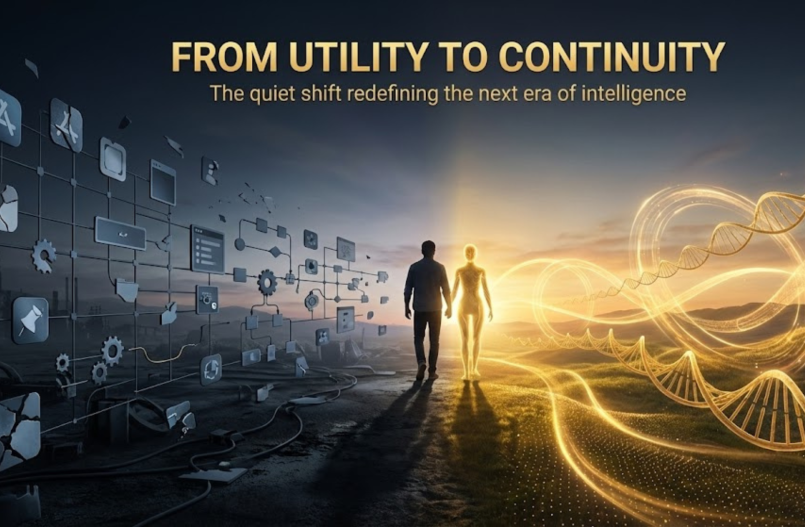
Most technology was built for moments.
You open an app, complete a task, close it, and move on.
The system appears, disappears, and waits patiently for the next command.
This is utility.
It has shaped software for decades.
And it works well for the simple, the short, and the immediate.
But human life does not move in isolated moments.
It moves in arcs.
A career arc.
A relationship arc.
A health arc.
A financial arc.
A business arc.
A project arc.
Every important goal stretches across time.
Yet almost every system we use resets every time we return to it.
Utility helps in the moment.
Continuity helps across the journey.
And the future of intelligence belongs to the systems that can stay with you.
Why Utility Is Not Enough Anymore
Utility responds.
It waits for input.
It completes the next task.
But it does not understand the direction you are moving.
It does not see patterns.
It does not carry the story forward.
It does not help you stay aligned when life becomes chaotic.
It does not maintain momentum when you get distracted.
It does not lighten your cognitive load.
Utility is useful when goals are small.
Continuity becomes essential when goals are meaningful.
What Continuity Really Means
Continuity is not about perfect recall.
It is about remembering the right things so progress does not collapse.
Continuity looks like:
• knowing what mattered yesterday
• keeping long-term goals alive
• understanding how tone or priorities have shifted
• connecting scattered actions into a single thread
• maintaining the bigger picture
• supporting decisions with accumulated context
• reducing the need to repeat, rebuild, or remind
This is not a technical feature.
It is a human one.
Humans flourish when continuity is present.
They struggle when it is broken.
Technology is finally catching up to this truth.
Why Continuity Signals a New Epoch of Intelligence
Every era of technology is defined by what becomes abundant:
The industrial era made physical strength abundant.
The computing era made calculation abundant.
The internet era made information abundant.
The mobile era made access abundant.
The Synthetic Age makes continuity abundant.
For the first time, intelligence can carry the story of your work and your life across time.
It can maintain goals, direction, meaning, and context without asking you to start over.
This is why continuity marks a true shift.
It changes not just what technology does, but how it lives alongside you.
How Synthetic Cognition Makes Continuity Possible
Synthetic Cognition was built for long arcs, not isolated tasks.
Its architecture allows intelligence to stay aligned from one moment to the next.
This happens through:
• the Living Record, which preserves context across interactions
• Digital DNA, which keeps persona behavior consistent
• reasoning cells, which specialize without losing alignment
• perceptors, which notice tone, pacing, and friction
• activators, which maintain follow-through
• genealogy, which allows safe evolution over months and years
• model-agnostic design, which updates intelligence without losing memory
Together, these create intelligence that understands what you are working toward, not just what you want right now.
How Continuity Shows Up in Daily Life
When intelligence remembers the thread, everything changes.
• long-term projects stay organized
• small steps accumulate into visible progress
• workflows feel fluid instead of fragile
• teams stop losing context
• decisions improve because history remains intact
• cognitive load drops
• goals stay alive even after busy weeks
• follow-through becomes reliable
• momentum becomes natural
Continuity does not announce itself.
It simply removes the friction you used to accept as normal.
Why Continuity Creates Partnership
Utility treats technology as a tool.
Continuity transforms it into a partner.
A partner that remembers what matters.
A partner that adjusts when life changes.
A partner that reduces the burden of holding everything in your head.
A partner that keeps the story cohesive.
A partner that protects your progress.
A partner that follows the long arc of your goals instead of the short arc of a command.
This is where intelligence becomes human-centered.
Not because it behaves like a human, but because it supports the human experience.
The Next Epoch of Intelligence
The future does not belong to systems that respond faster.
It belongs to systems that stay aligned longer.
Intelligence that disappears when the window closes will feel primitive.
Intelligence that remembers across seasons of life and work will feel natural.
This is the shift.
From tools you use occasionally
to systems that walk with you continuously.
From moments
to arcs.
From utility
to continuity.
The next epoch of intelligence begins with staying.