The real breakthrough wasn’t technical. It was human.
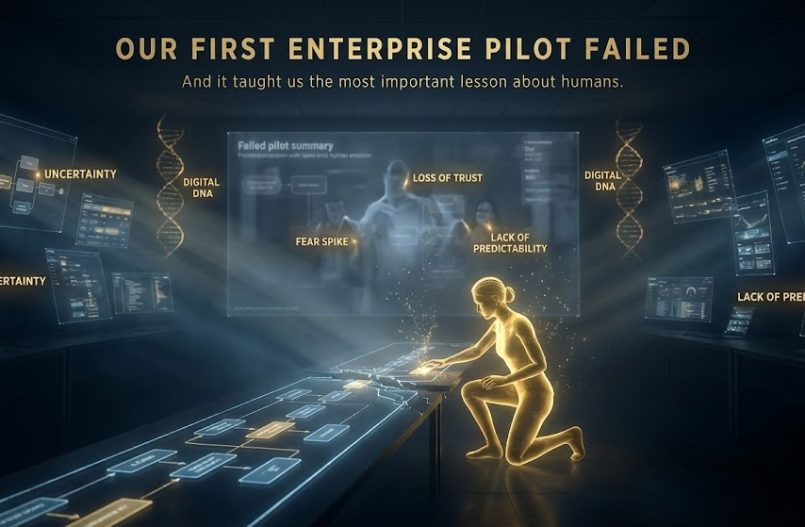
Our first enterprise pilot did not fail because the technology was fragile.
It did not fail because the personas malfunctioned.
It did not fail because the workflows collapsed.
It failed because we misjudged the humans using it.
And that single realization became one of the most important turning points in the evolution of Synthetic Cognition.
It exposed the gap between what people say they want from innovation and what they emotionally need to trust it.
It revealed truths that no architecture diagram, no whitepaper, and no benchmark could ever show.
This failure wasn’t technical.
It was psychological.
And it reshaped everything we built afterward.
The Plot Began With Momentum and Hope
The enterprise wanted innovation.
They wanted intelligence.
They wanted automation.
They wanted transformation.
So we delivered:
• domain-trained personas
• adaptive, continuous workflows
• long-term memory
• multi-step reasoning
• frictionless handoffs
• unified context
• operational clarity
On paper, everything was perfect.
In reality, something felt off almost immediately.
Red Flag #1: Trust Isn’t Built on Accuracy — It’s Built on Predictability
The personas were right more often than the human team.
But accuracy is not trust.
Humans trust what feels:
• stable
• predictable
• familiar
• aligned
• low-risk
The personas were powerful but not yet understood.
People worried:
“Will it embarrass me?”
“Did it make the right decision?”
“Why did it take that action?”
We assumed people would trust the intelligence.
They needed the intelligence to earn it.
Red Flag #2: Humans Don’t Resist Innovation; They Resist Losing Control
The personas took initiative:
• triggering actions
• reminding teams
• reorganizing priorities
• accelerating work
• catching inconsistencies
Instead of relief… people felt exposed.
Small moments triggered insecurity:
• A persona reminding them of something they missed
• A persona finishing work faster than expected
• A persona suggesting a better approach
• A person noticing a gap in the workflow
These weren’t technical failures.
They were emotional ones.
People didn’t need disruption.
They needed reassurance.
Red Flag #3: Transparency Matters More Than Power
People wanted to know:
• Why did it do that?
• What memory did it use?
• What reasoning did it apply?
• What data did it reference?
• What triggered this action?
They didn’t want a black box.
They wanted a partner.
We built intelligence before we built interpretability.
That had to change.
Red Flag #4: Fear of Replacement Silences Adoption
Even though we never positioned personas as replacements, fear still surfaced.
Quietly, subtly, but consistently:
“Will this reduce my responsibilities?”
“Will leadership expect more from me now?”
“What if the AI highlights my weaknesses?”
“Does this make part of my job obsolete?”
Fear is adoption’s silent killer.
People don’t resist new tools; they resist the feeling of being diminished by them.
Red Flag #5: Small Frictions Outweigh Large Achievements
A slightly off tone.
A recommendation too soon.
A memory surfaced at the wrong moment.
A workflow step that felt rushed.
These tiny frictions overshadowed all the things that worked flawlessly.
Humans remember friction, not perfection.
We assumed people would tolerate small imperfections.
They needed emotional stability before cognitive sophistication.
The Moment We Knew The Pilot Was Failing
There was no explosion.
No outage.
No crisis.
Just a quiet acknowledgment across both teams:
People weren’t ready.
And neither were we.
The technology was strong.
The emotional architecture was not.
This failure didn’t expose a technical weakness.
It exposed human truth.
And that changed the entire platform.
What This Plot Taught Us About Humans
This experience taught us more than any stress test or model benchmark ever could.
We learned:
- People need transparency more than sophistication
If they can’t see the reasoning, they can’t trust it. - People need consistency before capability
Predictability builds trust. - People need reassurance before results
Change threatens identity. - People need a gradual introduction, not instant immersion
The onboarding must be emotional. - People only adopt intelligence when they feel safe
Psychological safety drives engagement. - People need intelligence that aligns with their identity
Not one that exposes their weaknesses. - People trust intelligence in small moments first
Micro-trust creates macro adoption.
These insights became non-negotiable design principles.
How This Failure Transformed Synthetic Cognition
This single pilot directly led to:
• Digital DNA
• Identity stability rules
• Explainable reasoning
• Transparent memory surfacing
• Human-paced adoption flows
• Persona governance layers
• Adaptive workflow pacing
• Safety-based activation thresholds
• Tone-aware communication models
• Emotional-first integration logic
The failure became the blueprint for everything that worked later.
The Point
Our first enterprise pilot did not fail because intelligence was weak.
It failed because we underestimated humans.
It taught us:
• Trust is earned, not assumed
• Intelligence must be explainable
• Stability matters more than brilliance
• Adoption is emotional, not technical
• Humans need to feel safe before they feel impressed
• Innovation requires empathy
• Continuity must serve human identity, not disrupt it
This failure didn’t derail the vision.
It grounded it.
It humbled us.
It sharpened us.
It taught us how to build intelligence for people, not just for systems.
And that lesson became the foundation of everything that followed.