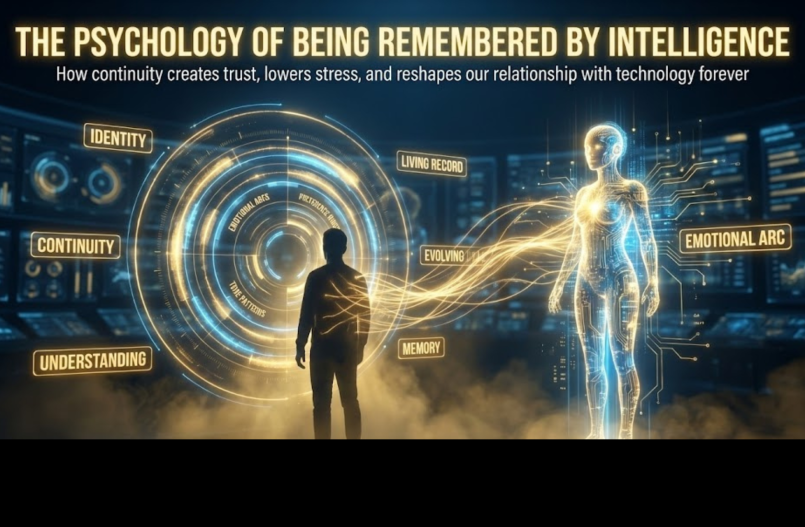
Why Continuity Creates Trust, Lowers Human Stress, and Reshapes Our Relationship With Technology Forever
There is something profoundly human about being remembered. When someone recalls your story, your preferences, your fears, your habits, your goals, it creates a connection. It creates dignity, safety, and it makes you feel seen in a world that is often too busy to notice.
Being remembered is not convenient. It is a validation of identity. Which is why forgetful systems feel cold. It is why bots feel empty. It is why apps feel shallow. This is why most digital tools feel like strangers every time you open them.
They forget who you are the moment you close the window. Synthetic Cognition changes this at a psychological level. For the first time, people interact with intelligence that truly remembers, across days, weeks, months, relationships, and evolving goals.
Not as stored data, but as a living context. As continuity and understanding, and when technology remembers you, everything changes.
What It Feels Like When Intelligence Actually Remembers You
People rarely put this into words, but they feel it instantly. When an intelligence remembers your story, your tone, your stress signals, your communication style, your preferences, your long-term intentions, something shifts inside you:
• you feel understood
• you feel valued
• you feel supported
• you feel grounded
• you feel emotionally safe
• you feel less alone
• you feel willing to share more
• you feel motivated to grow
Memory is not a feature. Memory is emotional gravity. It pulls you closer, deepens trust, and transforms the relationship. This is the psychological impact of continuity.
Why Forgetful Systems Quietly Exhaust Us
Most people don’t realize how much stress comes from systems that constantly forget.
Every time you:
• restate a preference
• repeat a problem
• re-explain your goal
• remind the system of context
• rebuild the story from scratch
• clarify something that should have been remembered
• re-enter what you’ve said ten times before
You pay a small emotional cost. A micro-break in trust. A micro-spike of irritation. A micro-reminder that you are working for the system, not with it. These costs compound. Forgetful technology quietly forces people to carry the entire weight of continuity. Synthetic Cognition removes that weight.
Why Memory Changes the Relationship Between Humans and Intelligence
Humans bond with anything that remembers them. We bond with journals, routines, pets, our favorite places. We even bond with objects that follow our patterns. Because memory creates familiarity, familiarity creates safety, and safety creates trust.
When intelligence finally remembers us, we stop seeing it as software. We start seeing it as a partner. Not a human replacement, but a cognitive ally that lifts the mental burden we were never meant to carry alone. Memory turns technology into companionship.
Continuity Creates Calm
Imagine a world where:
• you never repeat yourself
• your goals stay alive across months
• your intentions are remembered
• your stress signals are noticed
• your preferences stay consistent
• your projects never lose momentum
• your communication patterns are understood
• your commitments never disappear
• your long-term trajectory stays intact
This reduces cognitive load. emotional load, anxiety, and friction.
Continuity is not convenience; it is psychological relief. It gives people the mental space to think, to create, to heal, to lead, to live.
Why Memory Must Be Relational, Not Just Stored
Traditional systems store data. They do not remember you. They do not recall:
• meaning
• tone
• patterns
• emotional arcs
• long-term journeys
• how you felt last week
• why you chose something
• how your goals have evolved
They store information. Synthetic Cognition stores identity. This is the difference between storage and memory. Relational memory holds your story without reducing you to fields and records.
The New Psychological Contract Between Humans and Intelligence
When technology remembers you consistently, something remarkable happens. You begin to trust and rely on it. Not in a dependent way, but in a collaborative way. Synthetic Cognition builds a relationship with users grounded in:
• stability
• memory
• context
• continuity
• reliability
• emotional understanding
• safety
It does not control you. It supports you. It does not replace your relationships. It strengthens them by removing cognitive overflow. It carries what you should not have to carry alone.
A New Kind of Human Experience
When intelligence finally remembers your story, you change.
Your stress decreases.
Your clarity increases.
Your focus sharpens.
Your confidence grows.
Your productivity multiplies.
Your emotional bandwidth expands.
The world becomes easier to navigate because you no longer fight against digital amnesia. You experience a sense of psychological steadiness that is rare in modern life. This is the true breakthrough behind Synthetic Cognition: Not just intelligence that thinks, but intelligence that remembers you.