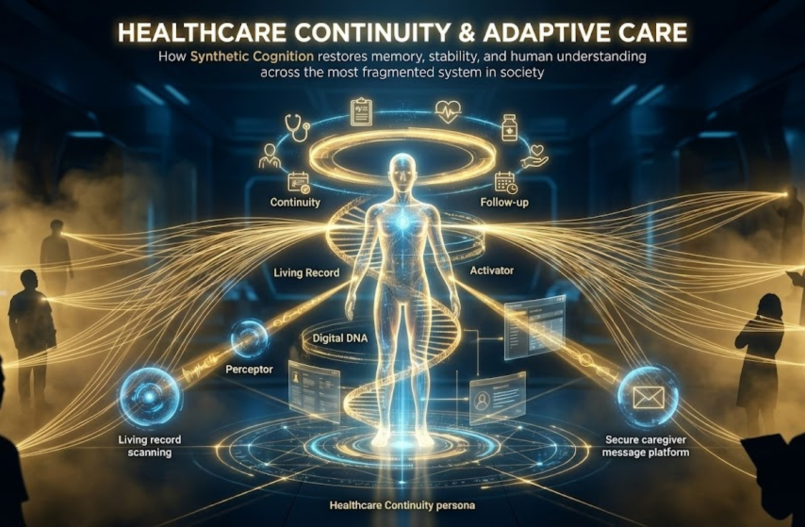
How Synthetic Cognition Restores Memory, Stability, and Human Understanding Across the Most Fragmented System in Society
Healthcare is built on expertise, compassion, and human intention. Yet the systems supporting it are built on fragmentation.
Patients must retell their story every time a new provider enters the room. Clinicians search for missing context inside charts that never paint a full picture. Care teams operate with partial information that changes faster than the system can track. Tasks get lost between handoffs.
Updates go unnoticed. Follow-up disappears into the cracks of a system that forgets as fast as it records. Emotional context evaporates the moment responsibility shifts to another department.
The result is predictable. Care becomes reactive, not proactive. Chaotic, not coordinated. Exhausting, not supportive. Expensive, not efficient. The problem is not the people. It is the architecture.
Healthcare has no continuity layer. Synthetic Cognition provides exactly that. A cognitive system that perceives, remembers, reasons, and adapts to every patient’s evolving story. A system that carries meaning forward so the patient does not have to. A system that supports clinicians with clarity instead of burdening them with memory. This is the beginning of adaptive, continuity-driven healthcare.
Where Healthcare Actually Breaks
Every major failure in healthcare traces back to one core issue: the system cannot maintain continuity.
1. The system forgets the patient’s story: Each handoff loses tone, nuance, emotional context, personal preferences, decisions, and historical patterns. This creates frustration and also creates risk.
2. Care teams see different slices of reality: Specialists, pharmacists, insurers, nurses, and physicians all operate from partial views. No one sees the full picture.
3. Tasks fall through the cracks: Referrals vanish. Follow-up stalls. Medication changes slip. Care plans drift without anyone noticing.
4. Workflows cannot adapt to changing conditions: Automations cannot handle shifts in symptoms, urgency, emotional state, test results, or caregiver involvement. Static workflows break in a dynamic environment.
5. Administrative load crushes clinicians: Doctors and nurses spend enormous effort compensating for the system’s inability to remember. Burnout is not caused by patients. Burnout is caused by architecture. Synthetic Cognition closes each of these gaps by design.
What Synthetic Cognition Brings to Healthcare
Healthcare requires more than data. It requires memory, awareness, adaptability, and coordinated reasoning.
Synthetic Cognition delivers these capabilities through:
• Digital DNA
• persona level memory
• the Living Record
• reasoning cells
• skill architecture
• perceptors
• activators
• genealogy
• on-chain notarization
• model agnostic intelligence
• continuity across every system
This is how care becomes intelligent.
The Health Continuity Persona
Every patient receives a dedicated persona designed to maintain the patient’s full story across time. This persona is not a chatbot. It is a cognitive companion built to support clinicians, reduce friction, and maintain continuity across every interaction.
It remembers: It maintains the patient’s history, preferences, medication patterns, concerns, tone, triggers, and longitudinal context.
It perceives: Perceptors detect new symptoms, tone changes, delays, escalation signals, adherence patterns, or updates from caregivers and clinicians.
It reasons: NeuroFlow evaluates urgency, follow-up needs, emerging risks, workflow steps that need adjustment, and which actions require clarification or clinician review.
It acts: Activators allow the persona to notify coordinators, schedule follow-ups, send reminders, track medication adherence, escalate changes, and summarize progress for clinicians. Continuity becomes constant and reliable.
How Synthetic Cognition Transforms Care Delivery
1. Patients stop repeating themselves: Their story moves with them. Clinicians receive intelligence, not a blank slate.
2. Care teams gain alignment instantly: The persona becomes the shared cognitive layer connecting departments and roles.
3. Follow-up shifts from reactive to proactive: Tasks, deadlines, and emerging risks are tracked automatically.
4. Emotional context stays intact: Tone, uncertainty, stress, and personal preferences remain part of the care experience.
5. Care plans adapt to the patient: As conditions shift, the persona adjusts steps, reminders, prioritization, communication patterns, and escalation logic.
6. Anxiety decreases for everyone: Patients feel supported. Clinicians feel less burdened. Families stay informed. Continuity brings calm.
Impact on Clinicians
Clinicians regain time, clarity, emotional bandwidth, cognitive energy, confidence in follow-up, and a complete understanding of the patient’s experience. The system finally carries the memory, so they do not have to.
Impact on Patients
Patients receive consistency, proactive support, continuity across departments, empathetic communication, fewer repeated explanations, smarter escalation, and better outcomes. Care becomes personal again.
Impact on Health Systems
Hospitals and clinics gain fewer readmissions, fewer errors, higher satisfaction, improved compliance, streamlined operations, and modernized workflows. Not through automation, but through cognition.
The Future of Healthcare is Continuous
Healthcare requires a system that perceives, remembers, reasons, adapts, collaborates, guides, supports, and grows with the patient. Synthetic Cognition is the first architecture designed to deliver this. It does not automate healthcare. It restores continuity to it.
It gives clinicians the support they deserve. It gives patients the experience they have always needed. It builds a healthcare system that finally thinks.