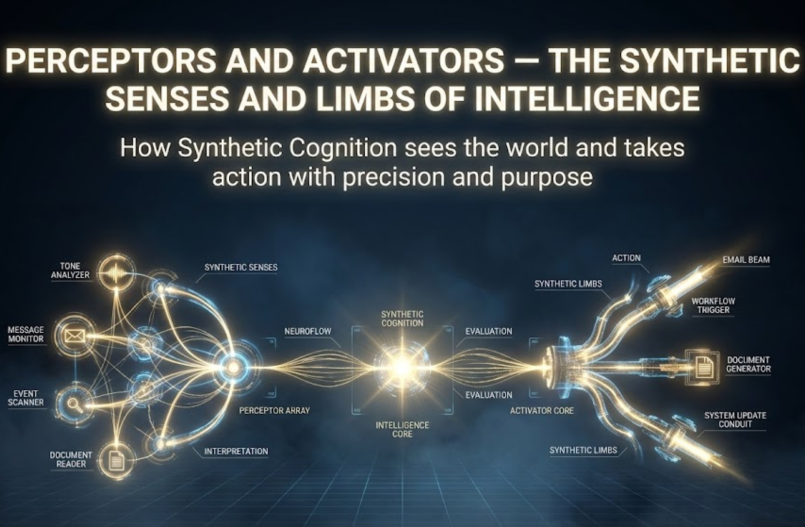
A synthetic intelligence system cannot live in isolation. To be useful, it must sense what is happening, interpret meaning, and take action with clarity and purpose. This is the role of perceptors and activators. Perceptors gather context. Activators create impact.
Together, they turn a persona from a passive system into an active participant in workflows, communication, and real-world operations. They give Synthetic Cognition awareness and agency, the essential ingredients for true intelligent collaboration.
Why Perceptors and Activators Matter
Most AI systems today behave reactively. They wait for a prompt, respond only when called, and rely entirely on whatever the user manually provides. This limits their potential. They can generate output, but not take initiative. They can answer questions, but not perceive changing conditions. They can process information, but not act on it.
Synthetic Cognition is designed differently. It does not wait to be spoon-fed; It observes, interprets, adapts, and responds. Perceptors and activators make this possible.
Perceptors: The Synthetic Senses
Perceptors are the sensory layer of Synthetic Cognition. They allow a persona to gather information from the world around it, not just through prompts, but through signals, patterns, behaviors, events, and system updates. A perceptor can:
• Read messages
• Detect tone
• Analyze documents
• Observe behavioral patterns
• Monitor activity across channels
• Scan timelines
• Detect anomalies or changes
Perceptors do not just capture data. They understand what the data means.
Because they are entirely no-code, anyone can configure:
• What the perceptor listens to
• The memory map it references
• Which reasoning cells should activate
• Thresholds that trigger action
• How often it checks for new signals
• Which model interprets the input
• The structure of its output
Perceptors reduce human effort by automating tasks that humans would otherwise need to manually track.
Examples of Perceptors in Real Use
A Lead Recovery persona can:
• Detect when a cold lead reopens an email
• Observe tone shifts in messages
• Identify timing patterns
• Notice sudden changes in engagement
A Transaction Coordinator persona can:
• Detect contract updates
• Identify missing documents
• Track deadlines before they become risks
• Observe delays that might impact closing
A Casino VIP persona can:
• Pick up behavioral changes
• Detect shifts in value or risk
• Identify moments of opportunity
Perceptors let the persona understand what is happening, without being explicitly told.
Activators: The Synthetic Limbs
If perceptors sense, activators act. An activator is the mechanism that allows a person to take meaningful action in the world. Not suggest. Not simply point out something. Not just comment, but act.
Activators can:
• Send emails or texts
• Update CRMs
• Schedule appointments
• Generate documents
• Execute workflow steps
• Trigger alerts
• Produce artifacts
• Escalate issues to humans
• Coordinate with other personas
• Move data between systems
This transforms a persona from an information generator into an operational partner, and like everything else in Synthetic Cognition, activators are fully no-code. You can define:
• When the activator fires
• Which reasoning cells prepare the action
• Which LLM executes it
• The tools or integrations it uses
• The memory it can reference
• The exact output structure
• What happens after the action completes
• Whether a human should be notified
• How the result should be logged
This makes action safe, predictable, and governed.
When Perceptors and Activators Work Together
Perceptors and activators operate as a cycle of intelligent interaction:
- A perceptor detects something meaningful
- NeuroFlow evaluates context
- The persona selects the right skill
- NeuroMatrix provides memory and identity
- An activator takes the appropriate action
- The system adapts based on the result
This is the cognitive loop in motion: perceive, decide, act, adapt. It gives personas the ability to move from passive responders to proactive collaborators. It lets intelligence participate in work instead of waiting for it. Humans operate this way, and now, synthetic intelligence can too.
What Makes This Different From Traditional AI
Most AI systems today:
• Wait for user prompts
• Lack sensory awareness
• Cannot monitor conditions
• Cannot act autonomously
• Produce isolated outputs
• Cannot update themselves after acting
Synthetic Cognition personas:
• Gather signals through perceptors
• Interpret context using NeuroFlow
• Reference long-term memory in NeuroMatrix
• Activate skills built from reasoning cells
• Take meaningful action with activators
• Update memory and refine reasoning afterward
This is a different class of intelligence. Not reactive. Not episodic. Not trapped inside a chat interface. A synthetic collaborator that can participate in real work.
Intelligence Becomes Useful When It Can See and Act
Perceptors give personas awareness. Activators give personas agency.
Together, they allow Synthetic Cognition to:
• Prevent risks before they appear
• Manage timelines without being reminded
• Maintain continuity across every interaction
• Reduce human coordination overhead
• Adapt to dynamic environments
• Support customer relationships proactively
• Automate complexity without rigidity
• Learn from every action it takes
This moves intelligence from theory into practice. The world does not need more AI that only answers questions. It needs intelligence that can observe, decide, and participate. Perceptors and activators are the foundation that makes that possible.