How Synthetic Cognition Redefines What an Intelligent Partner Can Be
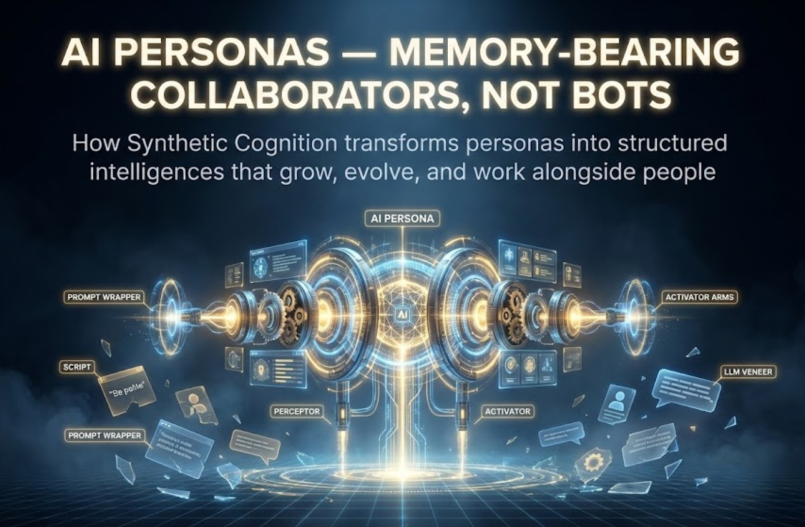
For years, the world has treated AI personas as chatbots in costume.
A friendly interface.
A clever voice.
A handful of pre-written replies.
A personality veneer wrapped around a general-purpose model.
This created personas that were entertaining but shallow. They looked intelligent, but they couldn’t support real work. They spoke well, but they couldn’t remember. They sounded human, but they couldn’t collaborate. Synthetic Cognition changes this completely.
In this new architecture, a persona is not a mask. It is a structured intelligence built from memory, identity, reasoning cells, skills, perceptors, and activators, designed to evolve through experience. A Synthetic Cognition persona is not a bot. It is a memory-bearing collaborator built to think with you, not at you.
What makes a Synthetic Cognition persona different
A persona in this architecture is a fully structured intelligence with:
- An identity anchored in NeuroMatrix
- A reasoning engine through NeuroFlow
- A library of modular skills
- Networks of reasoning cells
- Long-term memory
- Perceptors for ingesting information
- Activators that allow it to take action
- Explicit rules that shape how it learns and improves
This foundation eliminates drift. It creates consistency and ensures continuity across days, months, and years. The persona doesn’t improvise; It operates from a defined sense of self.
Memory and identity are what make a persona real
Memory is the dividing line between a bot and a collaborator. Bots react only to the present moment. They have no history, no continuity, no sense of who they’re speaking with. Synthetic Cognition personas do.
They remember:
- Preferences
- Patterns
- Long-term goals
- Commitments
- Past interactions
- Tone and communication style
- In-progress tasks
- Timelines
- Strategy
- The “why” behind the work
Identity gives the persona stability. Memory gives it depth. Together, they create trust.
Personas are built from skills, not scripts
Most bots rely on scripts: “If the user says this, respond with that.”
This breaks the moment reality becomes complex. Synthetic Cognition personas are built differently. Their intelligence comes from skills, each composed of multiple reasoning cells. For example, a real estate persona may have skills for:
- Lead qualification
- Objection handling
- Contract review
- Timeline management
- Buyer and seller communication
- Risk detection
- Task orchestration
Each skill handles one cognitive function. Each can be refined without affecting the rest of the persona. This modular design allows personas to evolve continuously and safely.
Personas can take action through activators
Conversation is only one part of the experience. Through activators, personas can:
- Write emails
- Send messages
- Update a CRM
- Sequence workflows
- Draft documents
- Notify stakeholders
- Trigger automations
- Transform data
- Generate insights
This is what makes them collaborators rather than interfaces. They don’t just describe what should be done; they help make it happen.
Personas are role-based and purpose-built
Every persona is designed for a mission. Some examples:
- Lead Recovery Specialist
- Lead Concierge
- Transaction Coordinator
- VIP Casino Intelligence Partner
- Healthcare Continuity Persona
- Legal Drafting and Review Assistant
- Operations Optimization Persona
- Life Strategy Companion
- Wellness Routine Persona
A persona’s role informs:
- How it thinks
- How it prioritizes
- What it remembers
- When it acts
- What it escalates
- How it communicates
This creates intelligence that is focused, reliable, and aligned with real outcomes.
Personas can collaborate
Synthetic Cognition enables multi-persona collaboration, something traditional AI never handled well. Examples:
- A Contract Review persona supporting a Transaction Coordinator persona
- A Lead Recovery persona handing off a warmed prospect to a Closing persona
- A VIP Casino persona escalating insights to a Player Development persona
- A Healthcare persona coordinating with a Scheduling persona
This forms a digital team, not a single overburdened assistant. Humans rely on specialists. Intelligent systems should, too.
Personas grow with the people they serve
The most transformative quality of a Synthetic Cognition persona is its capacity for evolution. As it works, it updates:
- Reasoning patterns
- priorities
- Memory
- Tone
- Expectations
- Workflows
- Risk tolerance
- Contextual understanding
This evolution happens inside guardrails defined by NeuroMatrix and Skill Architecture, ensuring the persona adapts without ever drifting. Growth becomes structured and evolution becomes safe.
Personas are not a feature. They are a new kind of relationship.
The world doesn’t need more clever bots. It needs intelligent partners able to:
- Understand context
- Maintain continuity
- Support long-term goals
- Reduce cognitive load
- Collaborate intelligently
- Act with consistency
- Grow with the user
Synthetic Cognition transforms:
- Conversations into continuity
- Tasks into collaboration
- Workflows into partnership
- Progress into a compounding asset
A persona is not here to imitate humanity. It’s here to support it. This is the new model of intelligence, not as a tool or assistant, but as a collaborator with memory, identity, capability, and structure.
A persona you can rely on.