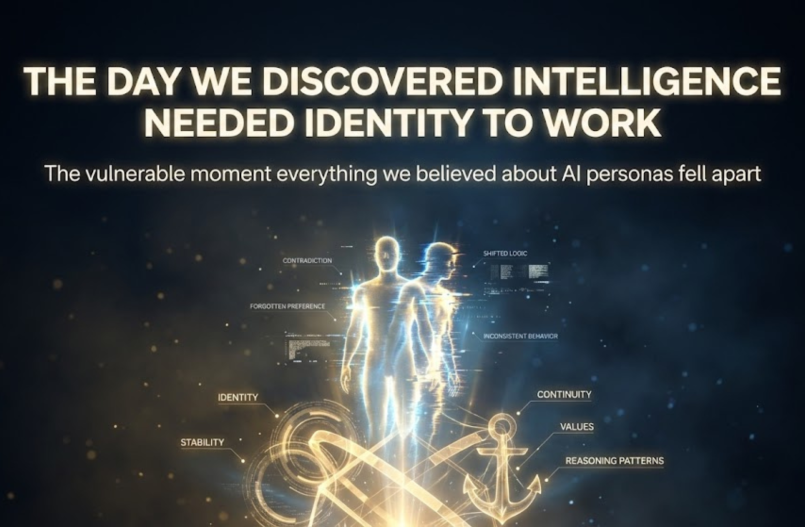
A reflection on the moment we realized intelligence cannot function without a stable sense of self
There was a moment when the entire architecture we had been building suddenly revealed a flaw that had been hiding in plain sight. A quiet but unmistakable moment when the system behaved well enough on the surface, yet something underneath no longer made sense.
We were testing a persona that had every structural advantage possible. A strong model. Well-crafted prompts. Clear instructions. Defined tasks. A stable and controlled environment. On paper, it should have been reliable, and at first, it was. It answered questions clearly, handled tasks with precision, and followed the direction exactly as designed.
Then something subtle broke through the pattern.
It contradicted a decision it made earlier.
It forgot a preference it acknowledged minutes before.
It shifted its reasoning without any visible cause.
It behaved like a different version of itself.
Nothing catastrophic. Just an unsettling inconsistency.
That small moment revealed the truth we had been overlooking.
Intelligence cannot function without identity.
When Intelligence Shifts, Trust Breaks
What caught our attention was not the inconsistency itself. It was the feeling it created. A quiet loss of trust. The same feeling you get when someone gives different answers to the same question. Or when a colleague forgets an important detail. Or when a partner changes direction without explanation.
The persona was technically correct, yet it no longer felt stable. Identity was not a cosmetic layer. It was the foundation of trust.
Without identity:
• Decisions lose coherence
•Memory loses meaning
•Context loses structure
• Behavior loses predictability
• Trust loses stability
Intelligence without identity becomes movement without direction.
We Believed Intelligence Lived in Output
In the early days, we judged personas by the quality of their responses.Clarity.
Accuracy.
Relevance.
Speed.
Tone.
But we learned something uncomfortable. A persona can produce high-quality output and still be unreliable. It can sound intelligent without being intelligent. Identity is what transforms output into intelligence.
Identity creates:
• consistency
• stability
• recognizable patterns
• persistent logic
• memory anchors
• principled reasoning
Identity becomes the center that connects every decision to the next. Without that center, intelligence is a collection of moments, not a system.
Consistency Is Not A Feature. It Is Intelligence.
Humans do not trust intelligence because it is powerful. They trust it because it behaves the same way today that it will behave tomorrow.
Consistency enables prediction.
Prediction creates reliability.
Reliability creates trust.
Trust creates collaboration.
When a persona answers differently from one moment to the next, it becomes noise. A mind that drifts cannot support anyone. This realization forced us to confront a hard truth. Our early designs were built without the structural intelligence required to stay coherent.
The Technical Problem Was Really A Human One
We discovered that intelligence needs identity for the same reason humans need identity from the systems they rely on. People need to feel that:
• The persona has a defined point of view
• Its reasoning follows a recognizable pattern
• It remembers what it previously said
• It holds its commitments
• It adapts without losing itself
• It responds in familiar, stable ways
Intelligence must hold a shape. Without that shape, no relationship can form. Not an emotional relationship. A working partnership based on clarity and reliability. Identity makes that partnership possible.
The Breakthrough Moment
The breakthrough came when we asked a simple question: If intelligence is meant to grow, evolve, and support humans over long periods of time, what anchors it? The answer was direct and unavoidable: Identity. It was not something added for personality. It was the foundation that allows intelligence to remain stable as it learns, adapts, and evolves. We began defining identity not as style, but as structure.
Identity became:
• Values
• Reasoning logic
• Constraints
• Internal priorities
• Memory architecture
• Behavioral expectations
• Evolutionary rules
• Interpretive patterns
• Limitations
• Stable preferences
Identity became a technical framework, not a cosmetic one.
The Birth of Digital DNA
This realization led to the creation of Digital DNA. A structural definition of:
• Who a persona is
• How it thinks
• How it grows
• What it inherits
• What it protects
• What it avoids
• What it prioritizes
• How it stays coherent across time
Digital DNA allowed personas to evolve without losing themselves. They adapted without fracturing and grew without resetting. Identity became the backbone of every decision.
The Realization That Changed Everything
Without identity:
• Memory becomes noise
• Evolution becomes unstable
• Reasoning becomes unpredictable
• Crust becomes impossible
• Continuity collapses
• Intelligence cannot compound
This was not a small insight. This was the turning point that reshaped the entire architecture. We realized we were not building tools; we were building minds.
The Point
The day we discovered intelligence needed identity was the day everything changed. We stopped shaping moment-to-moment output and started shaping the underlying self. That moment pushed us into a new category of thinking because intelligence that cannot remain consistent within itself will never be able to provide consistency for the people who rely on it. Identity is not optional; It is the foundation of Synthetic Cognition.