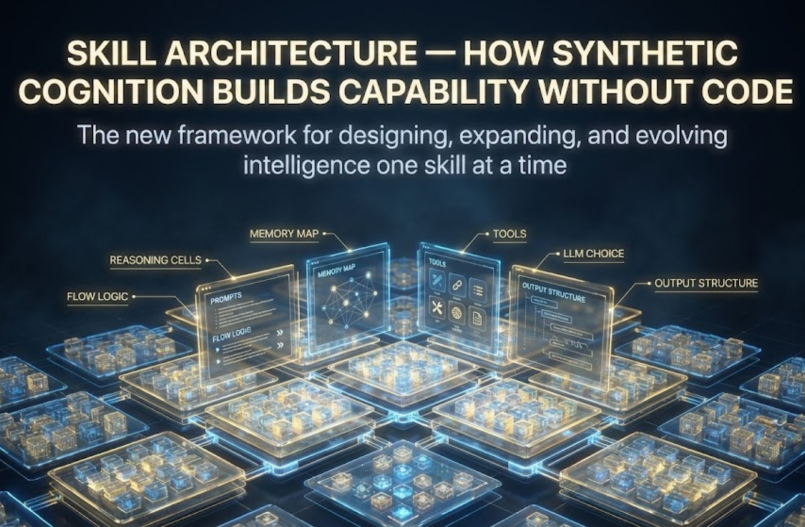
The New Framework for Designing, Expanding, and Evolving Intelligence
Every form of intelligence, whether biological or engineered, is defined by the skills it carries.
Skills determine what an intelligence can do.
They shape how decisions are made.
They shape how problems are solved.
They shape how the system grows with experience.
In traditional software, skills are locked inside code.
In traditional AI, skills are hidden inside a giant model and cannot be separated.
Synthetic Cognition introduces a different path.
Skills become modular.
Skills become visible.
Skills become editable.
Skills become entirely no-code.
Every skill is built from reasoning cells that can be composed, rearranged, replaced, or expanded with precision.
Skill Architecture turns intelligence into an adaptable system that grows one capability at a time with control and clarity.
This is how personas evolve with structure instead of drifting unpredictably.
The Purpose of Skill Architecture
The goal is simple.
A persona should not rely on a single, colossal brain.
It should rely on a collection of specialized abilities that reflect how real intelligence works.
Skill Architecture exists to:
• organize reasoning cells into cohesive abilities
• define how intelligence performs specific tasks
• maintain clarity and consistency
• allow rapid updates without breaking the persona
• enable industry-specific capabilities
• give users full no-code control over how the persona thinks
This creates intelligence that is transparent and governable, not mysterious or fragile.
A Skill Is a Composition of Reasoning Cells
In Synthetic Cognition, a skill emerges by linking multiple reasoning cells into a unified flow.
A skill like Lead Qualification may contain:
- A cell that analyzes incoming messages
- A cell that interprets buying signals
- A cell that references prior conversations
- A cell that sets priority based on context
- A cell that composes the follow-up response
Each cell handles one part.
Together, they form a complete capability.
Skills are created by:
• defining the task
• selecting the relevant cells
• arranging the sequence
• choosing memory access
• attaching tools or integrations
• defining expected outputs
All of this happens without writing code.
This is how intelligence becomes modular and ready for real-world complexity.
Why Skills Are Not Traditional Automation
Software automations follow rigid rules.
If A happens, do B.
Skills behave differently because they are cognitive.
They evaluate context before acting.
They reference memory.
They adapt when conditions shift.
They select the correct reasoning cells dynamically.
Automation is execution.
A skill is understanding plus execution.
That is why skills feel intelligent instead of mechanical.
What Can Be Customized Inside a Skill
Skill Architecture allows true no-code design of intelligence.
Every part of a skill can be tailored.
1. The reasoning cells inside the skill
Skills can include any number of cells, each one contributing a specific cognitive step.
2. The LLM used inside each cell
Cells can run GPT, Claude, Llama, Gemini, or custom models.
Different models can be used for different steps inside the same skill.
3. The internal prompts
Prompts inside cells are explicit and fully editable.
Small changes can alter behavior in powerful ways.
4. Memory maps
A skill can be accessed:
• global memory
• persona identity
• task-specific memory
• domain memory
• custom memory maps
Memory becomes precise and intentional.
5. Tools attached to the skill
Skills can access:
• search
• CRM integration
• contract analysis
• communication channels
• workflow tools
• data manipulation tools
Tools become extensions of the skill’s logic.
6. Output structure
Skills may return:
• structured data
• summaries
• recommended actions
• composed messages
• risk assessments
• next-step plans
Every output can be shaped for clarity and consistency.
How Skills Are Organized Inside a Persona
A persona may contain dozens or even hundreds of skills, grouped by:
• function
• industry
• domain
• role
• complexity
• context
For example, a Transaction Coordinator persona might include skills for:
• contract review
• scheduling
• compliance
• buyer updates
• seller communication
• timeline management
• risk identification
• step-by-step workflow execution
Each skill is built from reasoning cells.
Each cell is customizable.
Each component evolves independently.
This allows intelligence to grow indefinitely without losing coherence.
Why Skill Architecture Matters
Skill Architecture solves the real problem that prevents AI from supporting everyday work.
People need intelligence that adapts to their world, not the other way around.
By breaking capabilities into modular skills, Synthetic Cognition:
• lowers complexity
• increases clarity
• simplifies updates
• makes governance straightforward
• offers transparency
• ensures predictable behavior
• reduces drift
• empowers experts to design intelligence themselves
This is intelligence that teams can shape and trust.
Skill Architecture Is How Intelligence Becomes a Platform
Software platforms rely on modules and plugins.
Synthetic Cognition relies on skills and cells.
This makes intelligence:
• expandable
• customizable
• compliant
• industry-specific
• LLM agnostic
• safe
• continuously evolving
Every skill becomes a new capability.
Every capability strengthens the persona.
Every persona strengthens the cognitive ecosystem.
This is the compounding effect of structured intelligence.
Skill Architecture Makes Synthetic Cognition Scalable
The world does not need a single massive AI system.
It needs a structured ecosystem of modular, reliable, domain-specific intelligence.
Skill Architecture provides exactly that.
It gives intelligence a way to grow deliberately.
To evolve safely.
To expand endlessly without losing clarity.Skills are how Synthetic Cognition becomes practical.
Skills are what make it powerful.
Skills are how it becomes real.