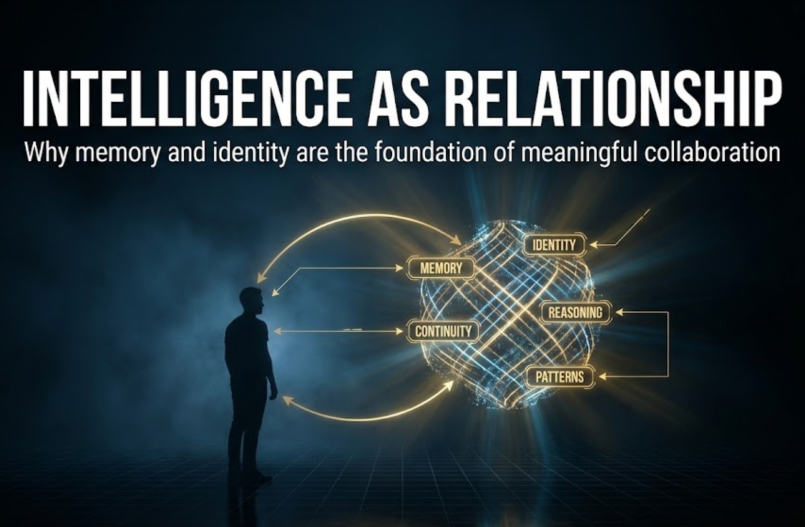
Why Memory and Identity Are the Foundation of Meaningful Collaboration
Most conversations about intelligence still focus on the surface.
How fast a system performs tasks.
How much data can it process?
How accurate its outputs appear.
How clever its responses seem.
These qualities matter, but they miss the part that determines whether intelligence actually feels valuable in daily life. The real measure of intelligence is not capability. It is a relationship.
When an intelligence remembers you, understands you, and adapts to you, something shifts. The interaction stops being a sequence of isolated tasks. It becomes a continuous journey.
The system stops behaving like a tool. It begins acting like a partner. This idea is simple and transformative. Intelligence becomes meaningful only when it can form a relationship with the person it serves.
Relationship Requires Memory
Every meaningful relationship in life depends on memory. We trust the people who remember:
• Our preferences
• Our habits
• Our history
• Our style
• Our recurring challenges
• Our long-term goals
Memory creates continuity. Continuity creates confidence. Confidence creates trust. Trust enables deeper collaboration. Remove memory, and everything breaks into repetition.
You explain the same things again. You rebuild context again. You restate your priorities again. The system responds, but nothing carries forward. This is the difference between intelligence that performs tasks and intelligence that understands you. A forgetful system may look impressive, but it cannot form a relationship.
Relationship Requires Identity
Memory is not enough. Intelligence must also have identity.
Without identity, a system behaves differently from moment to moment. Its decisions drift. Its tone shifts. Its reasoning changes based on temporary conditions.
Identity gives the system stability.
It defines what it knows.
It defines how it reasons.
It defines what it prioritizes.
Identity does not make a system human. It makes it consistent. People do not need emotional AI.
They need reliable AI. Identity is what allows intelligence to behave with clarity instead of randomness.
Relationship Creates Companionship, Not Dependence
The purpose of forming a relationship with intelligence is not emotional attachment.
It is the removal of friction.
When a system understands your patterns, it anticipates needs before you articulate them.
When it maintains continuity, you move faster without losing context.
When it aligns with your preferences, you stop spending energy explaining yourself.
This is not about replacing human thought. It is about removing unnecessary cognitive load.
A relationship-based intelligence grows more helpful over time.
It does not reset every day.
It does not erase progress.
It carries you forward instead of pulling you back to zero.
Relationship Gives Intelligence a Long Arc
Most tools operate in short cycles.
They process the moment and then forget it.
They cannot see beyond the immediate task.
A relationship-based intelligence sees the longer arc.
It tracks you over weeks, months, even years.
It recognizes patterns you may overlook.
It adapts your goals based on your changing environment.
It supports growth rather than isolated decisions.
This long arc is what makes intelligence feel alive. Not because it thinks like a human, but because it carries forward understanding. A system that remembers your journey is a system that can help shape your future.
Relationship Builds Trust
Humans trust consistency more than competence. We trust systems that:
• Behave predictably
• Remember what matters to us
• Improve with experience
When intelligence holds continuity, trust forms naturally. When it forgets, trust dissolves.
Trust determines whether people rely on the system day after day.
A system that forgets may be powerful, but it will always feel temporary.
A system that remembers becomes dependable.
Trust is not built through output. It is built through accumulated understanding.
Intelligence Without Relationship Is Just a Tool
Tools are useful. They help us complete tasks. But they remain separate from our lives.
They never change based on who we are.
They never adapt to our story.
They never grow with us.
Relationship transforms intelligence.
It creates shared context.
It creates a foundation for collaboration.
It creates alignment that traditional systems cannot offer.
This is the core idea behind Synthetic Cognition. Intelligence becomes meaningful when it forms a relationship.
It remembers.
It evolves.
It adapts.
It supports.
It grows.
It becomes a genuine partner in clarity and continuity.
The Future Belongs to Intelligence That Can Form Relationships
The past belonged to tools.
The present belongs to automation.
The future belongs to continuity and collaboration.
People are not looking for systems that can simply perform actions. They are looking for systems that can walk with them through complexity.
This is why memory matters.
This is why identity matters.
This is why continuity matters.
This is why relationship matters.
Intelligence becomes truly valuable the moment it begins to understand the person it serves.This is the next chapter in digital life, and we are only beginning to see what becomes possible when intelligence learns how to relate, not just respond.