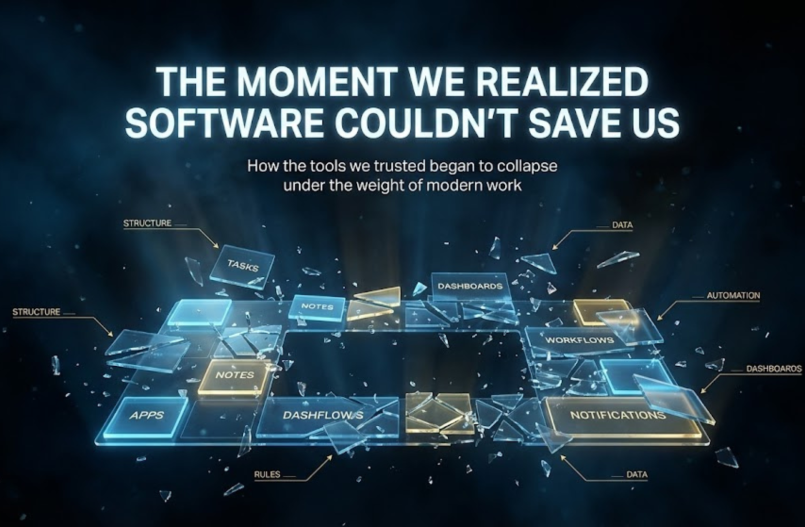
A Look At How the Tools We Relied On Began To Collapse Under The Weight Of Modern Work
There was a moment when the promise of software no longer matched the reality of daily life. It happened quietly. Not during a crisis. Not during a dramatic event. But in the middle of an ordinary workday, when everything was running exactly the way software was designed to run.
Tasks were logged. Notes were stored. Reminders were set. Dashboards were updated. Projects were broken into steps. Workflows were automated. Apps were connected. Notifications were everywhere.
And yet no one felt more organized. No one felt more supported. No one felt more in control. If anything, people felt more overwhelmed. Everything was working, but nothing was helping. That was the moment we realized software could not save us.
When Volume Outgrew Structure
The old model of software was built for a slower world.
A world where information arrived in predictable shapes.
A world where processes stayed stable.
A world where tasks followed linear paths.
A world where communication moved at a manageable pace.
But the world changed faster than the tools did. People now live in an environment where:
- Information flows constantly
- priorities shift mid-conversation
- platforms multiply
- responsibilities overlap
- context disappears
- cycles accelerate
- decisions require more nuance
Software tries to keep up by adding more menus, more features, more integrations, more dashboards, more layers. But complexity is not the solution for complexity.
When Work Became Fragmented
The deeper problem revealed itself only when we looked closely. Work was no longer one thing. It was dozens of disconnected threads spread across:
- text
- calls
- apps
- documents
- meetings
- shared drives
- chat threads
- forms
- workflows
Software could handle each of these pieces individually.
What it could not handle was the space between them.
The context.
The meaning.
The story.
People began carrying that weight themselves. They became the bridge between systems. They became the memory layer. They became the continuity layer. They became the ones stitching together conversations, tasks, and decisions that refused to stay in place. Software could not save them because it was never built to carry the full picture.
When Automation Revealed Its Limits
Automation promised efficiency. And for a while, it delivered. Until people noticed the hidden cost:
Automation can move tasks forward,
but it cannot understand when the task has changed.
It can send reminders,
but it cannot sense when the timing is wrong.
It can follow a script,
but it cannot adjust to human nuance.
It can complete a step,
but it cannot understand the full goal.
It can react,
but it cannot reason.
The more automated a system became, the more humans had to step in to fix the gaps. Automation saved minutes. Context switching costs hours.
When No One Could Remember Everything
There was also a quieter shift. A human shift. People started to forget things they never used to forget:
- Small commitments
- Meaningful details
- Important context
- Decisions made in passing
- The real reason behind a task
- The tone of a conversation
- What happened last meeting
- where the last file was saved
- What someone said last week
Software stores data, but not the narrative. It remembered fields, but not meaning. Humans were trying to survive in a world that required perfect recall. But human memory is not built for that kind of load. Software could not save us because humans were never meant to carry this much information alone.
The Moment Became A Realization
It became clear that software was not failing because it was poorly designed. It was failing because the world outgrew the ideas it was built on.
Software organizes.
But people need understanding.
Software runs tasks.
But people need continuity.
Software automates steps.
But people need context.
Software stores data.
But people need memory.
Software completes actions.
But people need intelligence that adapts.
This realization did not arrive with excitement.
It arrived with honesty.
A quiet acknowledgment that the tools we trusted could only take us so far.
And that the next step would not be more software.
It would be a new kind of intelligence entirely.
The Point
Software did not fail us.
It simply reached its limit.
It was built for a different era.
A slower era.
A simpler era.
The moment we realized software could not save us was not a moment of disappointment.
It was a moment of clarity.
The world needed intelligence that could:
- remember
- adapt
- reason
- carry context
- connect meaning
- follow the story
- grow with people
Not software that organizes tasks,
but cognition that supports lives.
This moment marks the beginning of the story of Synthetic Cognition.