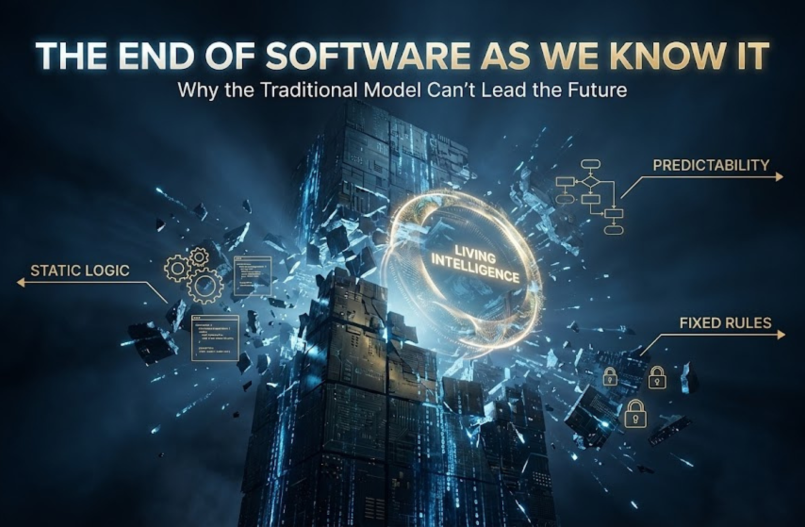
Why the Traditional Software Model Has Quietly Reached Its Limit
Every era has a moment when its dominant model reaches the edge of its usefulness.
Not because it failed, but because the world around it transformed so dramatically that the model’s core assumptions no longer make sense. We are living through that moment right now.
For nearly fifty years, software has defined how the world works. It automated industries. It standardized processes. It gave organizations something they had never had before: structure.
But today, the world has outgrown the model that once supported it.
This is not the collapse of software.
It is an evolution that software cannot lead.
The Original Promise of Software Was Brilliant
When software first emerged, it solved a fundamental problem:
The world needed order.
Software delivered:
• Structure
• Repeatability
• Standardization
• Clarity
• Consistency
It captured processes with precision.
It enforced rules.
It became the system of record and the source of truth.
For decades, this was exactly what the world needed.
Problems were stable.
Workflows were predictable.
Industries changed slowly enough that software could keep up.
In a world defined by predictability, static logic was a perfect solution.
But that world is gone.
The World Outgrew the Software Model
Traditional software is built on fixed logic, which is essentially rules defined once, then executed forever. It only evolves when a human updates it.
That limitation used to be manageable, but today, it is impossible to ignore.
The modern world is defined not by predictability, but by complexity.
Teams shift priorities weekly.
Customers change their needs daily.
Information moves faster than any human or any static system can process.
Markets swing without warning.
A static system cannot keep pace with a dynamic world. This is the breaking point we have quietly arrived at.
The Harsh Truth: Traditional Software Requires Humans to Stay Static
This is the part no one says out loud.
Traditional software assumes:
• Tomorrow behaves like yesterday
• People stay consistent
• Processes don’t change
• Data structures remain stable
But reality no longer behaves this way. People change roles. Teams reorganize. Strategies shift. Customers evolve. Priorities move. Markets realign.
Static systems cannot absorb this level of fluidity, so the burden shifts.
When software cannot adapt, humans adapt.
When software cannot hold context, humans carry it.
When software cannot build continuity, humans become the memory.
This is the silent tax the world has been paying, a tax extracted through meetings, manual updates, status checks, dashboards, and relentless operational drag. Static systems demand that humans never change, even as the world changes faster than ever.
The Gap Between Software and Reality Is Now Too Wide
Every industry is feeling the pressure.
Companies buy more tools, but complexity increases.
Teams automate more tasks, but chaos grows.
Workflows become more detailed, but execution becomes harder.
Dashboards multiply, but clarity never arrives.
Software was supposed to make work easier. Instead, many teams now spend more time managing their systems than doing their actual work.
This gap cannot be solved with:
• Another integration
• Another upgrade
• Another dashboard
• Another “AI-powered” feature
The model itself has reached its limit. It requires a new way of thinking altogether.
Why Software Has Reached Its Natural Limit
This has nothing to do with features.
It has everything to do with philosophy.
Traditional software was built on three core beliefs:
- The world is predictable.
- Processes can be mapped once and reused forever.
- Logic should be defined before action.
These beliefs were true when software was born. They are no longer true today. We now live in a world defined by:
• Constant change
• Endless variation
• Continuous adaptation
• Fluid identities
• Dynamic goals
• Interconnected systems
• Real-time expectations
A world like this cannot be navigated with fixed logic. It requires something software was never designed to become:
intelligent, adaptive, continuous, contextual.
Software cannot transform into this simply by adding new features.
The Era That Is Ending And the Era That Is Beginning
We are not witnessing the end of software. We are witnessing the end of software as the foundation of intelligence.
Software will continue to matter. But its role is shifting from being the center of the digital world to being just one layer within something larger. A static system cannot lead a dynamic future.
That role belongs to something fundamentally different:
• Systems that can sense
• Systems that can remember
• Systems that can reason
• Systems that can adapt
• Systems that build continuity
• Systems that evolve with people
• Systems that understand goals
• Systems that reorganize themselves around change
Not more apps, dashboards, or workflows.
A new cognitive infrastructure. One that replaces static logic with living intelligence. The end of software as we know it is not a loss.
It is the clearing of space for what comes next, and what comes next will redefine everything.