Why the Future of Intelligence Isn’t About Tasks, But About Life
If you zoom out far enough, the story of technology becomes a story about how humanity keeps trying to keep up with its own complexity.
We built tools to extend our hands.
We built machines to extend our strength.
We built software to extend our logic.
Eventually, we built automation.
Automation made sense for a long time because it promised efficiency, scale, and relief.
For a while, it delivered exactly that.
With time, though, something became clear.
Automation did not actually fix the parts of work that were broken.
It simply accelerated them.
Automation Was A Necessary Step, But Not The Final On
Automation works well when the world behaves like a production line.
The rules are clear.
The inputs are predictable.
The outcomes repeat.
That world has been shrinking for years.
Today, almost everything we do contains some combination of uncertainty, nuance, context, and emotional intelligence.
People operate in situations that are constantly changing.
Decisions shift hour by hour.
Priorities move as conditions evolve.
Automation was never designed for any of that.
It was designed for sameness and consistency, which is not how modern life operates anymore.
The Limit of Automation Is Simple, It Can’t Understand
You can automate tasks.
You can automate sequences.
You can automate responses.
What you cannot automate is understanding.
Automation cannot make sense of identity, history, preference, tone, or shifting priorities.
It cannot hold long-term context.
It cannot evolve its own judgment.
It cannot form a relationship with the person it serves.
It moves, but it never grows.
It acts, but it never develops insight.
It completes tasks, but it cannot internalize meaning.
This is the boundary we have been hitting for years without having a word for it. Automation looks impressive until you ask it to adapt.
The World Doesn’t Need Faster Systems, It Needs Living Ones
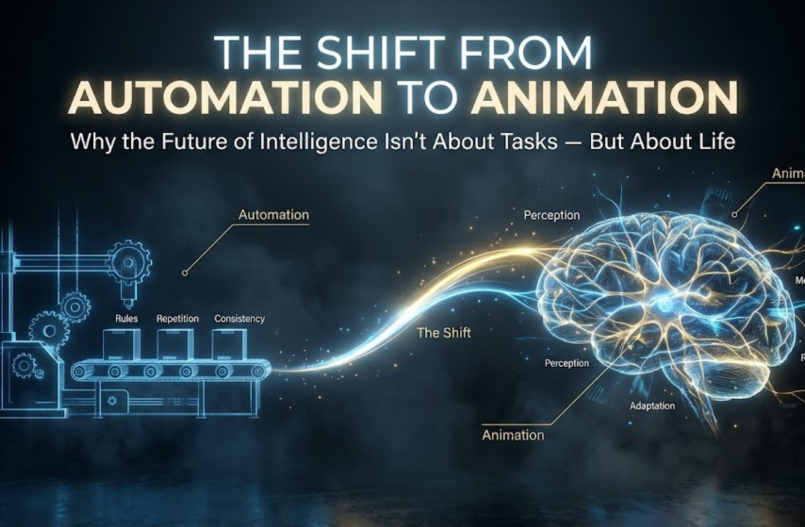
The real shift we are living through is not from manual work to automated work.
It is from automated systems to animated systems.
An animated system behaves differently. It perceives, remembers, reasons, and adapts. It reprioritizes when the world changes. It collaborates with you rather than waiting for instructions. It grows through experience.
Animation is not just movement. It is computational life. Not biological life, but something that feels alive because it changes based on what it learns. That is the dividing line between the technology of the past and the intelligence of the future.
Animated Systems Don’t Just Follow Tasks, They Follow You
Automation forces humans to do all the thinking. You create the structure, write the rules, maintain the logic, troubleshoot failures, and update the system when reality shifts. Animation flips this dynamic.
An animated system carries forward your history, preferences, values, and patterns.
It remembers how you like to communicate. It recalls what matters most and what tends to fall apart when life gets busy. It adapts to new conditions and redirects itself automatically.
You no longer have to constantly re-teach it. You no longer have to rebuild your processes every time something changes. You no longer lose continuity because a system forgot what happened yesterday.
Automation replaces activity. Animation replaces unnecessary thought.
That subtle difference becomes a massive transformation.
Why This Shift Matters Now
The world reached a point where complexity is no longer optional.
Information moves faster.
Decisions must be made quickly.
Expectations keep rising.
And the margin for error has almost disappeared.
Automation gave us speed. Speed alone is not enough when life itself has become unpredictable.
We need intelligence that understands context and identity.
We need systems that grow with us instead of fighting against us.
We need continuity rather than fragmentation.
In short, we need technology that behaves more like a partner than a tool.
The Shift Is Happening, Even If People Can’t Name It Yet
You can feel the tension everywhere.
People are overwhelmed by tools that move quickly but understand very little.
Teams rely on systems that automate tasks but fail to carry the story forward.
Organizations depend on workflows that break every time reality changes.
We are surrounded by technology that can perform actions but cannot maintain a relationship with the person behind those actions.
The word automation no longer describes what the world needs.
The word animation finally gives shape to the transition we are all experiencing.
The Future Isn’t About Faster Systems, It’s About Responsive Ones
Automation removes effort.
Animation removes friction.
Automation increases output.
Animation increases clarity.
Automation completes tasks.
Animation understands your goals.
Automation scales actions.
Animation scales intelligence.
Automation will always have its place.
But its ceiling is visible now, and the world is asking for more.
The next era will be defined by systems that evolve with us.
Systems that understand the moment, not just the instructions.
Systems that build continuity instead of starting over every day.
This is the turning point. The shift from automation to animation is not a technological upgrade.
It is the beginning of a new relationship between humans and intelligence.