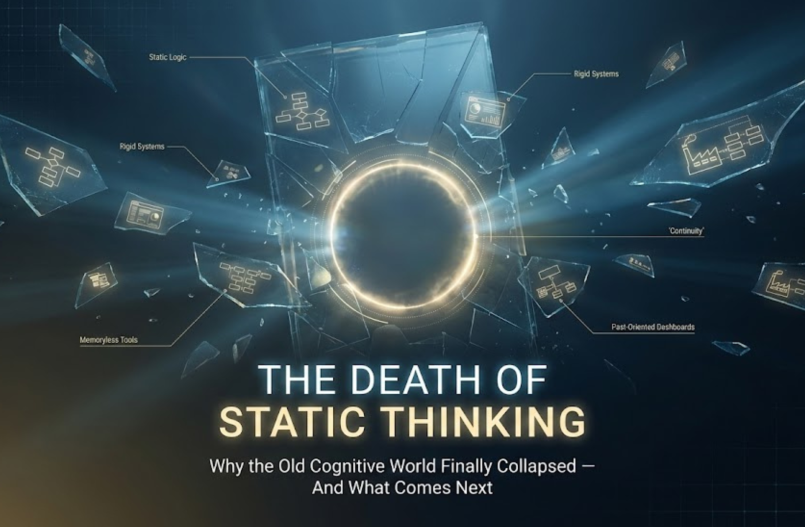
Why the Old Cognitive World Finally Collapsed And What It Revealed About the Future of Intelligence
For decades, the entire digital world was built on one quiet, unquestioned assumption:
The world is static enough to be modeled.
Predictable enough to be mapped.
Stable enough to be standardized.
We built software the way we built factories.
We mapped workflows like architectural blueprints.
We defined “user personas” as if real humans never changed.
We created rigid systems and hoped people would bend themselves to fit inside.
And for a while, that illusion held. Then the cracks began to show.
Not with a single disruption or dramatic collapse.
But slowly, quietly, through a thousand small failures, everyone felt, but no one could fully explain.
A creeping realization spread across teams, industries, and even within ourselves:
Static thinking no longer matches the world we live in.
When The Old Model Began To Break
The symptoms were everywhere, hiding in plain sight:
• Software that never adapts to how people actually work
• Automations that shatter the moment reality deviates from a flowchart
• Dashboards that describe the past but never guide the future
• CRMs that store information but never build understanding
• Workflows that create more work than they remove
None of these tools was inherently “wrong.”
They were simply born from a worldview that no longer makes sense:
A world that once changed slowly…
Now changes constantly.
A world that once valued repetition…
Now demands variation.
A world that once tolerated memoryless systems…
now depends on continuity and intelligence.
The tragedy is simple:
Humans didn’t break first.
Our tools did.
And we’ve been carrying the weight ever since.
The Human Cost of Static Systems
Static thinking is not just a technical limitation; it’s an emotional burden.
When systems cannot remember us, we become the memory.
When systems cannot adapt, we become the adapters.
When systems cannot hold context, we become the translators.
This creates:
• Exhaustion disguised as productivity
• Complexity disguised as progress
• Burnout disguised as “the job.”
We built a digital world that demands humans remain static while our real lives evolve every hour.
No wonder people feel overwhelmed.
No wonder organizations feel chaotic.
No wonder teams feel like they’re drowning in tools that were meant to help them.
Static thinking isn’t outdated.
It is incompatible with human reality.
The World Moved, Software Did Not
The pace of change accelerated.
Information multiplied.
Expectations expanded.
Margins for error evaporated.
But our tools…
our systems…
our logic…
remained frozen in time.
They weren’t designed to:
• Interpret nuance
• Understand identity
• Build continuity
• Evolve with their users
• Learn from history
• Anticipate change
• Prioritize what truly matters
Static thinking assumes tomorrow looks just like today.
Look around. It doesn’t.
The Moment the Illusion Shattered
We didn’t set out to challenge the foundations of software.
We didn’t gather in a room and declare the old world obsolete.
We didn’t plan a reinvention of intelligence.
The realization came quietly, almost reluctantly.
We watched systems break.
We watched teams drown in complexity.
We watched “AI tools” promise intelligence but deliver noise.
We watched people sacrifice evenings, creativity, and well-being just to keep fragmented systems functioning.
At some point, we asked the one question that cracked everything open:
“Why are humans doing all the adapting?
Why aren’t our systems adapting to us?”
That question ended the era of static thinking.
The Death of Static Thinking Isn’t A Failure, It’s An Awakening
Static thinking had its time. It took us far. It digitized industries. It helped build the world we know. But it cannot take us where we are going.
The world is now:
Too dynamic.
Too contextual.
Too relational.
Too human.
Incremental improvements won’t solve this.
Better dashboards won’t solve this.
Smarter automations won’t solve this.
What’s required is a new mental model for intelligence itself, one built around continuity, context, adaptation, memory, and collaboration.
This article is not about the solution.
It’s about the truth we finally admitted:
Static thinking is dead.
And the world is ready for what comes next.